Advantage+ Sales Campaigns Explained
Advantage+ Sales Campaigns Explained: What You Need to Know
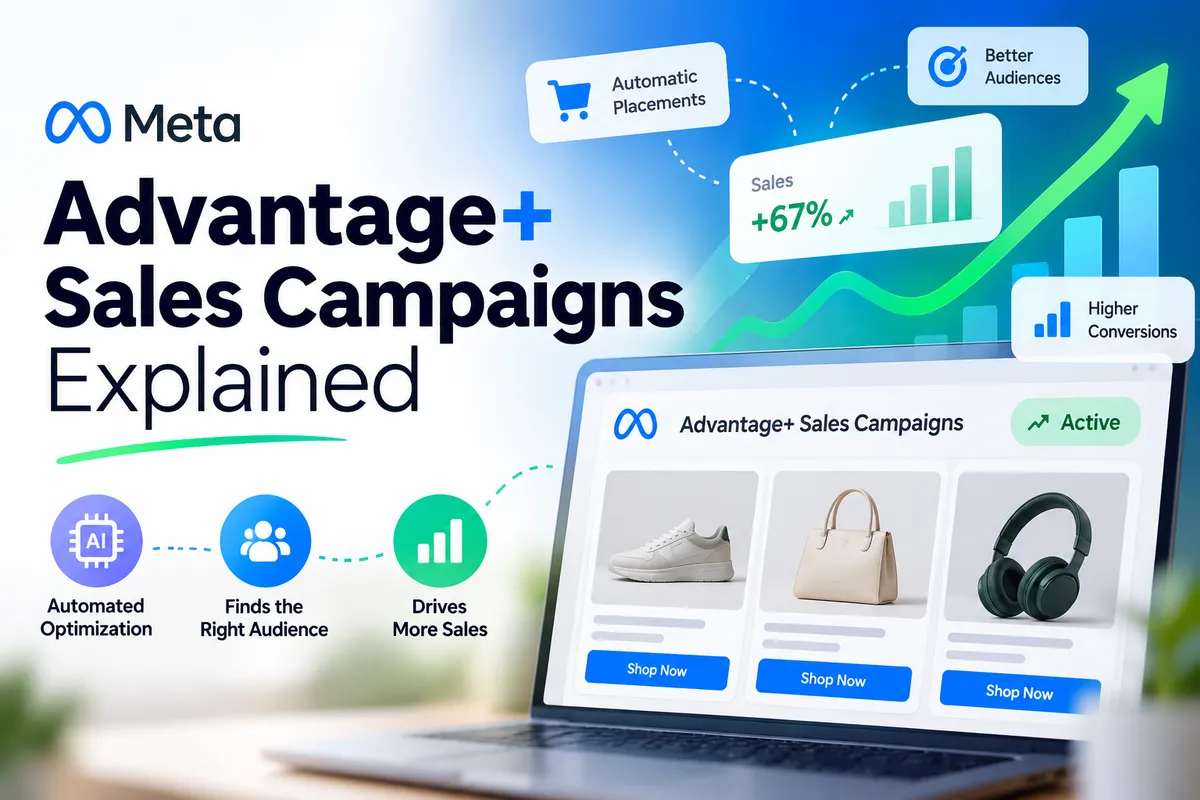
Meta Advantage+ Sales Campaigns use artificial intelligence and machine learning to automate important parts of Facebook and Instagram advertising. Instead of relying entirely on manually selected audiences, placements and campaign settings, advertisers can use Meta's AI-powered advertising technology to identify potential buyers and optimize ad delivery.
Here's what matters most:
What they are: AI-powered Meta Ads campaigns designed to generate sales and improve conversion performance through automation.
How they work: Meta's machine learning algorithms analyse audience signals, predicted conversion behaviour, creative assets and auction opportunities to determine where ads are most likely to produce results.
Who they're for: Ecommerce businesses, online retailers and brands looking to acquire customers, increase purchases and scale advertising more efficiently.
What gets automated: Depending on campaign settings, Meta can automate audience expansion, ad placements, budget distribution and creative enhancements.
What you still control: Your advertising objectives, budget, product positioning, creative strategy, measurement setup and available campaign controls.
Why they matter: Advantage+ campaigns can reduce manual campaign management while helping advertisers find conversion opportunities beyond their existing audience assumptions.
The biggest consideration: Automation doesn't guarantee profitability. Strong creative assets, accurate conversion tracking, sufficient data and a commercially sensible campaign strategy remain essential.
How success is measured: Return on ad spend (ROAS), cost per acquisition (CPA), purchase volume, conversion value and customer acquisition costs are among the key performance indicators.
The bottom line: Advantage+ Sales Campaigns can make Meta advertising more efficient, but the best results come from combining intelligent automation with a clear understanding of your customers, products and profit margins.
What Are Meta Advantage+ Sales Campaigns?
Meta Advantage+ Sales Campaigns are automated advertising campaigns built around Meta's sales objective. They use machine learning to help advertisers reach people who are more likely to complete valuable actions, particularly purchases.
Think of them as a shift from telling Meta exactly who should see your ads towards telling Meta what business result you want to achieve.
With traditional Facebook Ads, advertisers often spend considerable time building interest-based audiences, creating lookalike audiences, adjusting placements and testing different audience combinations.
Advantage+ Sales Campaigns change that relationship.
Rather than depending primarily on an advertiser's assumptions about potential customers, Meta's advertising system uses behavioural signals, predictive modelling and historical performance data to help determine which advertising opportunities are most promising.
For ecommerce businesses, that distinction matters.
Imagine you sell premium skincare products. You might assume your ideal customers are women aged 25–45 who follow beauty brands and skincare influencers.
That sounds reasonable.
But what about a 52-year-old customer buying skincare as a gift? Or someone who recently developed an interest in premium self-care products but doesn't follow any obvious beauty-related accounts?
A narrowly defined manual audience could miss those opportunities.
Advantage+ audience targeting gives Meta greater flexibility to discover potential customers based on signals that may indicate purchasing intent.
This doesn't mean every person reached will become a customer. It means the system can explore a broader range of opportunities than a rigidly defined audience might allow.
Why Meta introduced more automated sales campaigns
Digital advertising has become increasingly complicated.
Advertisers must account for changing consumer behaviour, privacy restrictions, rising competition, fragmented customer journeys and the sheer number of potential ad delivery combinations.
Manually evaluating every possible audience, placement, creative and bidding opportunity is impractical.
Meta advertising automation is designed to address that complexity.
Its machine learning systems can process large volumes of advertising signals and continuously evaluate opportunities within Meta's advertising auction.
Instead of requiring advertisers to make every tactical decision, Advantage+ automation handles more of the delivery process.
This allows businesses to focus on the decisions that still require commercial judgement:
Which products are worth advertising?
How much can the business afford to spend acquiring a customer?
What makes the product genuinely different?
Which advertising messages are most persuasive?
How should campaign performance be evaluated against profitability?
Those questions are particularly important for businesses with limited advertising budgets.
An automated campaign might generate more purchases, but if those purchases cost more than the business can sustainably afford, the campaign still needs attention.
Before committing significant advertising spend, understanding your potential returns is essential. Our marketing ROI calculator can help you evaluate the relationship between marketing investment and revenue.
Are Advantage+ Sales Campaigns the same as Facebook Ads?
Not exactly.
Facebook Ads is a broad term commonly used to describe advertising across Meta's platforms, including Facebook and Instagram.
Advantage+ Sales Campaigns are a specific approach to running sales-focused campaigns within that advertising ecosystem.
You still create and manage campaigns through Meta Ads Manager, and your advertisements can appear across eligible Meta placements.
The main difference is how much of the optimization process is handled automatically.
Traditional manual campaign approach | Advantage+ Sales Campaign approach |
|---|---|
Advertisers may define narrowly targeted audiences | AI can explore broader audiences within applicable controls |
Manual audience testing plays a significant role | Automated audience discovery plays a larger role |
Placements can be selected manually | Advantage+ placements can automate placement selection |
Budget distribution may require manual adjustments | Automated budget allocation can distribute spend where configured |
Advertisers manage more delivery decisions | Meta handles more tactical optimization |
Performance depends partly on manual targeting decisions | Performance relies more heavily on automated predictions and advertiser inputs |
Neither approach is automatically superior.
Manual campaigns can provide valuable control for specific advertising requirements, while Advantage+ campaigns offer greater automation and flexibility.
The right choice depends on your objectives, available data, account structure and the level of control your business requires.
How Do Advantage+ Sales Campaigns Work?
To understand how Advantage+ Sales Campaigns work, it's helpful to look beyond the idea that Meta simply finds people interested in your products.
The system is considerably more sophisticated.
Meta uses machine learning algorithms to evaluate advertising opportunities, estimate the likelihood of different outcomes and decide how ads should participate in auctions.
It combines advertiser inputs with available platform signals to optimize delivery towards the selected objective.
In practical terms, the process involves five interconnected elements.
1. Meta analyses signals to identify potential buyers
Every time someone interacts with content or advertising across Meta's platforms, the system may receive signals that help inform its predictions, subject to applicable privacy and data-use restrictions.
These can include:
Engagement with advertisements and content.
Previous interactions with a business.
Website conversion events shared through approved tracking systems.
Responses to different creative formats.
Contextual and behavioural patterns associated with advertising outcomes.
Historical campaign performance and conversion data.
Meta's AI-powered targeting technology uses available signals to estimate which advertising opportunities are more likely to produce the desired result.
For a sales campaign, that result might be an online purchase.
For example, two people might both be interested in fitness products.
One regularly watches workout videos but rarely purchases anything through online advertisements.
The other has recently engaged with several ecommerce brands and demonstrates behaviour that Meta's models associate with purchasing.
The system may predict different conversion probabilities for those advertising opportunities.
Crucially, these predictions are probabilistic.
Meta doesn't know with certainty who will buy. It estimates the likelihood of an outcome using the information available to its models.
2. Machine learning evaluates advertising opportunities
Meta Advantage+ campaigns use machine learning to make advertising decisions at a scale that would be impossible to manage manually.
One relevant part of Meta's advertising technology is Meta Andromeda, an AI-powered ad retrieval system.
Andromeda helps identify relevant advertising candidates from a large pool of eligible ads before subsequent ranking and auction processes determine which advertisements are shown.
This distinction is important.
Andromeda isn't a separate campaign type, nor is it a setting you simply switch on inside an Advantage+ Sales Campaign.
It's part of the broader advertising infrastructure supporting Meta's AI-driven ad delivery.
The overall process involves technologies for:
Ad retrieval: Identifying potentially relevant ads for an advertising opportunity.
Conversion prediction: Estimating the likelihood of outcomes such as purchases.
Ad ranking: Evaluating competing advertising opportunities using Meta's auction systems.
Algorithmic ad delivery: Selecting and delivering advertisements based on predictions and auction considerations.
Real-time optimization: Updating delivery decisions as additional information becomes available.
These processes work together to help match advertisements with potential customers.
For advertisers, the practical implication is straightforward: your targeting assumptions are no longer the only factor determining who might see your ads.
3. Advantage+ audience targeting expands customer discovery
Traditional audience targeting often begins with demographic characteristics, interests, behaviours or previously identified customer groups.
Advantage+ audience targeting places greater emphasis on automated audience discovery.
Rather than requiring advertisers to identify every potential customer segment manually, Meta can explore people beyond suggested audiences where campaign controls allow.
Consider an online furniture brand advertising a premium ergonomic office chair.
A traditional targeting strategy might focus on:
Remote workers.
Business owners.
People interested in home office furniture.
Professionals aged 25–55.
Lookalike audiences based on previous customers.
These audiences may contain valuable prospects.
But they aren't necessarily the only people likely to purchase.
Someone setting up a gaming room, studying for professional qualifications or buying a chair for a family member could also be interested.
Broad audience targeting gives the system more flexibility to identify such opportunities.
This is one reason audience expansion can be valuable for ecommerce customer acquisition.
However, broad targeting should never be confused with completely unrestricted targeting.
Advertisers may still have access to location restrictions, audience controls, exclusions and other settings depending on the campaign configuration and current Meta functionality.
A useful principle: Give Meta enough flexibility to discover customers, but retain the business controls necessary to protect your advertising objectives.
4. Automated budget allocation prioritises opportunities
Budget management is another important component of Advantage+ campaign optimization.
With automated budget distribution, Meta can allocate advertising spend between eligible delivery opportunities according to its predictions of campaign performance.
Where Advantage+ campaign budget is enabled across multiple ad sets, budget distribution can also adjust between those ad sets.
This is related to the functionality historically known as campaign budget optimization (CBO).
Imagine a campaign with a £100 daily budget and several eligible ad delivery opportunities.
Instead of dividing spending equally across every audience or placement, Meta may direct more budget towards opportunities its models predict will produce stronger results.
That flexibility can improve campaign cost efficiency.
But there's an important limitation.
Automated budget allocation optimizes towards the campaign's configured objective, not necessarily your business's true net profit.
A campaign might achieve an attractive cost per purchase while still promoting products with insufficient margins.
That's why advertisers should evaluate advertising spend alongside product costs, average order value and customer acquisition cost.
5. Creative assets influence which customers respond
One of the biggest misconceptions about Meta advertising automation is that targeting technology does all the work.
It doesn't.
Your advertisements still need to persuade people.
Meta can predict which individuals may be receptive to an advertisement, but it cannot compensate indefinitely for an unconvincing offer, weak product positioning or poor customer experience.
Creative diversification therefore plays a central role in Advantage+ campaign performance.
Different potential customers respond to different messages.
For example, a premium coffee brand might test:
A short video demonstrating how the coffee is prepared.
A customer testimonial explaining its flavour.
A lifestyle image showing a morning coffee ritual.
A carousel highlighting different coffee blends.
A product-focused advertisement emphasising quality and sourcing.
Each creative communicates a different reason to buy.
Meta's delivery systems can use performance signals to determine which ads are more likely to resonate with particular advertising opportunities.
Advantage+ creative optimization can also apply supported automated enhancements, depending on the settings and formats available.
However, Advantage+ creative isn't the same thing as a complete creative strategy.
Businesses still need to develop compelling concepts, communicate meaningful benefits and test different advertising angles.
The stronger the creative inputs, the more useful the automation can become.
Advantage+ Sales vs Advantage+ Shopping Campaigns: What's the Difference?
If you've been running Facebook Ads for a few years, you've probably encountered both Advantage+ Shopping Campaigns and Advantage+ Sales Campaigns.
And understandably, the terminology can get confusing.
Are they different advertising products? Has Meta simply renamed an existing feature? Do they use the same machine learning algorithms?
The answer lies in how Meta's advertising platform has evolved.
Advantage+ Shopping Campaigns (ASC) were introduced as a highly automated approach to ecommerce advertising. They were designed to simplify campaign creation by allowing Meta's artificial intelligence to handle much of the audience discovery, placement selection and delivery optimization.
Rather than building numerous manually targeted ad sets, advertisers could use a more streamlined campaign structure focused on generating purchases.
Meta has since evolved its Advantage+ advertising products, bringing more automated capabilities into its broader sales campaign experience.
Advantage+ Sales Campaigns represent the newer sales-focused approach to Meta advertising automation, while Advantage+ Shopping Campaigns remain an important term for understanding the platform's development.
Advantage+ Sales vs Advantage+ Shopping: Key differences
Feature | Advantage+ Shopping Campaigns | Advantage+ Sales Campaigns |
|---|---|---|
Primary purpose | Automated ecommerce sales | AI-assisted sales and conversion optimization |
Campaign positioning | Earlier automated shopping campaign product | Newer sales campaign experience |
Audience targeting | Automated audience discovery | Advantage+ audience capabilities and applicable controls |
Budget management | Automated campaign-level optimization | Automated budgeting options depending on configuration |
Ad placements | Automated placement optimization | Advantage+ placements where enabled |
Creative optimization | Supports multiple ad creatives | Supports creative diversification and eligible Advantage+ enhancements |
Campaign flexibility | Historically more prescriptive | Greater integration with Meta's evolving campaign controls |
Best suited for | Ecommerce purchase acquisition | Ecommerce brands and other eligible sales-focused advertisers |
The distinction isn't that one uses artificial intelligence and the other doesn't.
Both approaches rely heavily on machine learning.
The difference is primarily how Meta packages and configures those automated capabilities within its advertising platform.
It's also worth remembering that Meta regularly updates campaign terminology, account interfaces and available settings.
An advertiser working in an older account or following a historical tutorial may encounter different labels from those used in a newer Meta Ads Manager interface.
Should you switch from Advantage+ Shopping to Advantage+ Sales?
Not simply because the name has changed.
If you're reviewing an existing campaign, the more useful questions are:
Is the campaign achieving an acceptable cost per acquisition?
Is it generating profitable sales rather than simply attributed revenue?
Are your current audience and creative settings limiting performance?
Would a different campaign structure provide meaningful advantages?
Can you test a new configuration without unnecessarily disrupting existing performance?
Avoid rebuilding successful campaigns solely to follow the latest advertising terminology.
Campaign changes should be guided by business objectives, available functionality and measurable results.
For new advertisers, however, understanding the current Advantage+ Sales Campaign setup is the more practical starting point.
Key Features and Benefits of Advantage+ Sales Campaigns
The appeal of Meta Advantage+ campaigns is straightforward.
Less time spent micromanaging advertising settings. More opportunity for the system to identify valuable customers. And potentially, a more efficient route from advertising spend to sales.
But the real advantages extend beyond convenience.
Let's examine what these campaigns can actually offer ecommerce businesses.
1. Automated audience discovery can uncover new customers
One of the biggest challenges in ecommerce advertising is knowing who your next customer will be.
You might understand your existing customers extremely well.
You know their approximate ages, interests, buying habits and preferred products.
But your next thousand customers won't necessarily look identical to your first thousand.
This is where automated audience discovery becomes useful.
Advantage+ audience targeting can explore a wider pool of potential buyers, using predictive audience targeting and available behavioural signals to identify promising advertising opportunities.
Instead of relying exclusively on interest-based targeting or manually constructed lookalike audiences, advertisers can allow Meta's algorithms to discover additional customer segments.
For example, a brand selling sustainable kitchen products might initially target environmentally conscious shoppers.
Yet its products could also appeal to:
Homeowners renovating their kitchens.
Parents looking for durable household products.
Gift buyers searching for practical presents.
Cooking enthusiasts interested in premium utensils.
Consumers replacing cheaper, lower-quality alternatives.
These groups may have different motivations, even when purchasing the same product.
Broader targeting can give Meta more opportunities to find them.
The benefit: Potentially reaching valuable customers that manually selected audience segments might overlook.
2. Real-time optimization reduces manual intervention
Traditional campaign management often involves checking performance across multiple ad sets, adjusting budgets and making targeting decisions.
That process can consume hours.
Advantage+ campaign optimization automates more of those decisions.
Meta's algorithms continually evaluate available advertising signals and adjust delivery according to the selected objective.
This doesn't eliminate the need for campaign monitoring.
Instead, it changes what advertisers should focus on.
Rather than reacting to every short-term fluctuation in cost per click (CPC) or click-through rate (CTR), businesses can spend more time evaluating:
Overall purchase volume.
Cost per purchase.
Revenue generated.
Return on ad spend.
Customer acquisition costs.
Creative performance.
Profitability trends.
That shift is important because a campaign can generate inexpensive clicks without generating profitable customers.
Automated optimization should support your commercial objectives, not distract from them.
3. Automated placements can improve delivery flexibility
Meta's advertising ecosystem includes numerous placements across Facebook, Instagram, Messenger and other eligible inventory.
Different placements offer different opportunities.
A vertical video might perform well within Instagram Reels, while a product-focused image could be effective in Facebook Feed.
Manually predicting the best placement for every potential customer isn't easy.
Advantage+ placements allow Meta to distribute ads across eligible placements according to predicted performance.
The system can consider available inventory, auction conditions and estimated results when making delivery decisions.
This can reduce the need for advertisers to create separate campaigns for every placement.
However, placement automation doesn't mean every creative will look equally effective everywhere.
A square product image, for instance, may not communicate its message as effectively within a full-screen vertical environment.
Creative assets should still be designed with their intended formats in mind.
The benefit: More flexibility for Meta to identify cost-effective advertising opportunities across eligible placements.
4. Dynamic budget allocation can improve efficiency
Advertising budgets are finite.
Every pound spent reaching an unlikely buyer is a pound that cannot be invested in a more promising opportunity.
Advantage+ campaign budget functionality can help distribute spending between eligible ad sets based on predicted opportunities.
This approach reduces the need to allocate equal budgets to every audience or campaign component.
But there is an important distinction between efficient budget delivery and profitable advertising.
Suppose your campaign generates the following results:
Metric | Example result |
|---|---|
Advertising spend | £500 |
Purchases | 25 |
Revenue | £1,500 |
Cost per purchase | £20 |
ROAS | 3.0x |
At first glance, those numbers look encouraging.
But what if the products have low margins, expensive fulfilment costs or unusually high return rates?
A 3.0x ROAS doesn't automatically mean the campaign is profitable.
This is why budget scaling decisions should account for contribution margins and customer lifetime value, not just the numbers displayed in Meta Ads Manager.
5. Campaign consolidation can simplify account management
Some advertisers create dozens of ad sets, each targeting a slightly different audience.
One targets fitness enthusiasts.
Another targets healthy eating interests.
A third targets lookalike audiences.
A fourth targets a particular age group.
Over time, the account becomes increasingly complicated.
And that complexity isn't always productive.
Highly fragmented campaigns can divide conversion signals across multiple ad sets, making it harder for each delivery system to accumulate useful performance information.
A more consolidated Advantage+ campaign structure may allow the system to optimize across a larger pool of eligible opportunities.
This can be particularly useful for smaller ecommerce brands without the purchase volume to support extensive audience segmentation.
However, consolidation isn't a universal solution.
Separate campaigns may still be justified when businesses have different objectives, markets, product economics or operational requirements.
The goal isn't to create the fewest possible campaigns.
It's to create the simplest structure that supports meaningful optimization and business control.
6. Advantage+ creative optimization can improve ad delivery
Advantage+ creative features can apply eligible automated enhancements to advertising assets.
Depending on the creative format and available settings, these may include adjustments to presentation, formatting or other supported creative elements.
The aim is to improve how advertisements are displayed across different delivery environments.
But there's a distinction worth making.
Creative automation improves the delivery or presentation of your advertising assets. Creative strategy determines whether your message is worth paying attention to.
If your product photography is poor, your offer is uncompetitive or your copy fails to communicate value, automated enhancements have limited room to help.
The strongest Advantage+ sales campaign strategy therefore combines automated delivery with deliberate creative development.
Are Advantage+ Sales Campaigns Worth It for Ecommerce Businesses?
For many ecommerce advertisers, Advantage+ Sales Campaigns are worth testing.
But whether they deserve a significant share of your advertising budget depends on your business.
Automation works best when it's given a meaningful objective, useful conversion signals and advertising assets capable of generating demand.
It becomes less useful when those foundations are missing.
When Advantage+ Sales Campaigns make sense
These campaigns may be particularly suitable when your business:
Has a clear purchase objective: You want to generate online sales rather than simply increase website traffic.
Has reliable conversion tracking: Meta can receive useful purchase and conversion signals.
Has sufficient creative variety: You can test different product messages, formats and advertising angles.
Can accommodate broader targeting: Your products appeal to more than a narrowly restricted audience.
Understands its acquisition economics: You know how much you can afford to spend acquiring customers.
Wants to simplify campaign management: You would benefit from reducing unnecessary manual targeting complexity.
For an established ecommerce business with consistent sales data, these conditions can provide a useful foundation for AI-driven campaign optimization.
When Advantage+ Sales Campaigns may struggle
Automation isn't a shortcut around fundamental business problems.
Campaigns may struggle when:
Conversion tracking is inaccurate. Missing purchase events or duplicated conversions can undermine performance analysis and the quality of optimization signals.
The product offer is weak. Advertising automation cannot make an uncompetitive product automatically desirable.
Creative assets are repetitive. Too few advertising concepts can limit opportunities to discover effective messages.
Budgets are too restrictive for meaningful learning. Limited conversion volume can make performance evaluation difficult.
The website converts poorly. Slow loading times, unclear product information and complicated checkout processes can waste valuable traffic.
The business lacks clear profitability targets. Optimizing for purchases without understanding margins can lead to unsustainable acquisition costs.
These problems aren't unique to Advantage+ campaigns.
They affect most forms of performance advertising.
However, increased automation can make them particularly important because advertisers have fewer reasons to expect manual audience adjustments alone to resolve underlying issues.
The key takeaway: Meta's AI can help identify advertising opportunities, but your business must still provide a compelling reason for customers to buy.
If you're uncertain whether your current campaigns have the right foundations, a free ecommerce marketing audit can be a useful starting point for reviewing your advertising approach and identifying potential areas for improvement.
How to Set Up Advantage+ Sales Campaigns Step by Step
Understanding the technology is useful.
But eventually, you need to build a campaign.
The following Advantage+ Sales Campaigns tutorial explains the practical setup process for an ecommerce business using Meta Ads Manager.
Meta regularly updates its advertising interface, so individual settings and labels may vary depending on your account, region and the features currently available.
The underlying principles remain consistent: choose the correct objective, configure conversion tracking, establish a sensible budget, provide strong creative assets and measure results.
Step 1: Open Meta Ads Manager and create a sales campaign
Start by opening Meta Ads Manager and selecting the option to create a new campaign.
Choose Sales as your campaign objective.
This tells Meta that your primary goal is to generate sales-related outcomes rather than traffic, awareness or engagement.
Depending on the campaign creation experience available to your account, Meta may offer Advantage+ automation options or an automated sales campaign configuration.
Review the available options carefully.
Don't assume that every setting labelled Advantage+ performs the same function.
Advantage+ audience, Advantage+ campaign budget, Advantage+ placements and Advantage+ creative are related capabilities, but they affect different parts of campaign delivery.
Practical tip: Give your campaign a descriptive name that identifies its objective, market and purpose.
For example:
UK | Sales | Prospecting | Core Products | Oct 2026
A clear naming convention makes campaign reporting easier as your advertising account grows.
Step 2: Choose your conversion location and performance goal
Next, configure where you want conversions to happen.
For most ecommerce stores, this will be your website.
You will then need to select the appropriate performance goal and conversion event from the options available.
For an online retailer focused on completed orders, the Purchase event is usually the most commercially relevant choice.
Why?
Because optimizing for clicks and optimizing for purchases are not the same thing.
Someone who frequently clicks advertisements isn't necessarily someone who frequently buys products.
A purchase-focused campaign gives Meta a more relevant objective for identifying valuable advertising opportunities.
However, the quality of your tracking setup matters.
If purchase events aren't being recorded correctly, the system may have incomplete information about which advertising interactions produce sales.
Before launching, verify that your selected data source is receiving the intended events.
Step 3: Configure Meta Pixel and Conversions API
Reliable conversion tracking is one of the most important foundations of automated advertising campaigns.
Meta Pixel, previously commonly referred to as Facebook Pixel, is a browser-based tracking tool that can record relevant website events.
These might include:
ViewContent: Someone views a product or relevant webpage.
AddToCart: Someone adds a product to their shopping cart.
InitiateCheckout: Someone begins the checkout process.
Purchase: Someone completes an order.
These events provide useful information about how customers interact with your ecommerce store.
But browser-based tracking has limitations.
Privacy restrictions, browser settings and technical factors can affect the availability of tracking information.
That's where Meta Conversions API (CAPI) becomes relevant.
Conversions API allows businesses to send supported event data from server-side systems or approved integrations.
Using browser and server-side tracking together can improve measurement resilience when configured correctly.
However, sending the same purchase event through both methods requires appropriate event deduplication.
Without deduplication, a single purchase could potentially be recorded twice.
That would distort conversion reporting and undermine your understanding of campaign performance.
Before launching, check the following:
Your Meta Pixel is installed correctly.
Purchase events are being received.
Purchase values and currencies are accurate.
Conversions API is configured where appropriate.
Browser and server events are properly deduplicated.
Events Manager shows no unresolved critical tracking problems.
Accurate tracking won't guarantee profitable advertising.
But inaccurate tracking makes reliable campaign optimization and performance analysis much harder.
Step 4: Set your Advantage+ campaign budget
Now comes one of the most commercially important decisions: how much should you spend?
There is no universal Advantage+ minimum budget that guarantees results for every ecommerce business.
The amount you need depends on factors such as your product price, target acquisition cost, market competition and expected conversion volume.
A business selling £15 accessories has very different advertising economics from one selling £1,500 furniture.
Instead of choosing an arbitrary daily budget, work backwards from your customer acquisition targets.
For example, suppose:
Your target cost per acquisition is £25.
You want approximately 20 purchases during an initial evaluation period.
You estimate the required advertising spend at £500.
That gives you a starting budget estimate.
It isn't a guarantee that £500 will generate 20 purchases.
Actual results may vary considerably.
The important point is that your budget should be connected to your commercial objectives.
Daily budget vs lifetime budget
Meta may offer different budgeting options depending on the campaign configuration.
Budget type | How it works | Practical consideration |
|---|---|---|
Daily budget | Sets an average amount to spend per day | Useful for ongoing campaigns and flexible monitoring |
Lifetime budget | Sets a total budget for a defined campaign period | Useful for time-limited promotions or campaigns with fixed spending limits |
Availability and spending behaviour depend on Meta's current budget rules and campaign settings.
If Advantage+ campaign budget is enabled across multiple ad sets, Meta can distribute available spending according to predicted opportunities.
If you're using ad set budgets instead, spending is managed at the individual ad set level.
Neither option eliminates the need for financial oversight.
Practical tip: Start with a budget you can afford to evaluate properly, rather than immediately committing your entire advertising allowance.
Step 5: Configure Advantage+ audience targeting
Audience targeting is where Advantage+ campaigns differ significantly from many traditional Facebook Ads strategies.
Instead of beginning with numerous narrowly defined interests, consider whether broader targeting could give Meta more flexibility to identify potential buyers.
Depending on your campaign configuration, you may be able to provide audience suggestions or use available audience controls.
These can include:
Geographic targeting.
Applicable age controls.
Custom audience suggestions.
Customer lists.
Lookalike audience signals.
Available audience exclusions.
Not every audience input functions as a strict restriction.
Some settings act as suggestions that Meta can move beyond when the system predicts better performance elsewhere.
This distinction is essential.
For example, supplying a lookalike audience as a suggestion doesn't necessarily mean your advertisements will only reach people within that lookalike audience.
Similarly, broad audience targeting doesn't automatically mean you should ignore geographic restrictions or other legitimate business requirements.
An ecommerce store delivering exclusively within the United Kingdom shouldn't assume that global targeting is appropriate.
Use the controls necessary to reflect your actual serviceable market.
Then allow the system flexibility within those boundaries.
Should you exclude existing customers?
That depends on your objective.
If your primary goal is new customer acquisition, you may want to evaluate the existing customer controls or exclusions available within your campaign configuration.
If you're promoting repeat purchases, customer retention or complementary products, reaching existing customers may be desirable.
The important consideration is that new customer acquisition and repeat customer revenue are different business outcomes.
An Advantage+ campaign can generate attractive ROAS while attributing purchases from customers who already know your brand.
That doesn't automatically make the campaign ineffective.
But it does mean reported ROAS should be interpreted alongside customer acquisition metrics and, where possible, incremental performance.
Step 6: Select placements and prepare your advertising assets
Next, review your placement options.
Advantage+ placements can allow Meta to deliver ads across eligible inventory according to predicted results.
For many ecommerce campaigns, this can provide useful flexibility.
However, your creative assets should be suitable for the environments where they might appear.
A strong creative mix could include:
Product photography: Clear images showing the product and its key features.
Lifestyle images: Visuals demonstrating how the product fits into everyday life.
Short-form videos: Engaging demonstrations suitable for vertical placements.
Customer testimonials: Authentic explanations of the product's benefits.
Carousel ads: Multiple images highlighting features, variations or related products.
User-generated content (UGC): Customer-style creative that communicates genuine product experiences.
Don't create different formats simply to increase the number of advertisements.
Each creative should serve a purpose.
One might introduce a problem.
Another might demonstrate the solution.
A third could overcome a common purchasing objection.
This variety gives Meta more meaningful creative options while helping you learn which messages resonate with customers.
Step 7: Review, publish and monitor the campaign
Before publishing, complete a final quality check.
Campaign launch checklist:
Sales objective selected correctly.
Appropriate conversion location configured.
Purchase event selected where relevant.
Meta Pixel and conversion tracking verified.
Budget aligned with acquisition targets.
Geographic and audience controls reviewed.
Creative assets checked across eligible placements.
Advertising copy and destination URLs verified.
Product landing pages tested.
Campaign reporting metrics identified.
Once your campaign is live, resist the temptation to change settings every few hours.
Meta's delivery system needs opportunities to collect signals and evaluate performance.
Frequent significant edits can interfere with stable optimization and may trigger renewed learning behaviour.
Monitor performance regularly, but distinguish between ordinary short-term fluctuations and meaningful problems.
For example, a single expensive purchase doesn't necessarily indicate a failing campaign.
Likewise, one unusually profitable day doesn't prove that your strategy is ready for aggressive budget scaling.
Look for patterns.
Evaluate results against your targets.
And make decisions based on sufficient evidence rather than individual daily fluctuations.
Remember: Launching an Advantage+ Sales Campaign is only the beginning. The real value comes from understanding what the system is delivering, why performance changes and how to improve results without undermining the automation you're relying on.
Understanding Advantage+ Audience Targeting and AI Automation
You've built your campaign. Your tracking is configured. Your creative assets are ready.
Now comes the part that separates average advertisers from those who consistently improve their results: understanding how to work with Meta's automation rather than constantly trying to override it.
One of the most significant changes introduced by Meta Advantage+ campaigns is the shift away from rigid audience segmentation.
For years, Facebook Ads strategies revolved around finding the perfect combination of interests, demographics and lookalike audiences.
Advertisers would build dozens of ad sets, hoping to discover an audience that consistently delivered affordable purchases.
Advantage+ audience targeting approaches customer discovery differently.
Instead of requiring advertisers to define every potential buyer, Meta's machine learning algorithms can evaluate a broader range of advertising opportunities.
But that doesn't mean audience strategy has become irrelevant.
It means your strategy needs to evolve.
Broad audience targeting vs interest-based targeting
Broad audience targeting allows Meta greater flexibility to identify potential customers within applicable audience controls.
Interest-based targeting, by comparison, uses selected interests and behaviours to help define or suggest an audience.
Both approaches have potential advantages.
Targeting approach | Potential advantages | Potential limitations |
|---|---|---|
Broad audience targeting | Greater flexibility, automated audience discovery, fewer restrictive assumptions | Less direct control over audience composition |
Interest-based targeting | Useful for specific customer hypotheses and targeted messaging | Can unnecessarily restrict potential reach |
Custom audiences | Useful for reaching people with existing brand interactions | Audience size and data quality can be limiting |
Lookalike audiences | Can provide signals based on existing customers | Similarity doesn't guarantee purchasing intent |
Advantage+ audience | Combines automation with supported controls and suggestions | Some audience suggestions may not function as strict restrictions |
For many ecommerce businesses, broad targeting is worth testing.
Why?
Because your creative assets can help communicate who your products are for.
Imagine you're advertising a premium dog bed.
An advertisement showing an older dog comfortably resting on an orthopedic mattress naturally communicates a specific product benefit.
The creative may appeal particularly to people concerned about their dog's comfort and mobility.
You don't necessarily need to construct an extremely narrow audience to communicate that message.
The advertisement itself helps establish relevance.
This is an important principle of modern Meta advertising: creative strategy and audience discovery increasingly work together.
Prospecting campaigns vs retargeting campaigns
Another important consideration is how Advantage+ Sales Campaigns fit into your broader customer acquisition strategy.
Traditionally, ecommerce advertisers often separate campaigns into two categories.
Prospecting campaigns focus on reaching potential customers who may not have purchased from the business before.
Retargeting campaigns focus on people who have already interacted with the brand, such as website visitors, product viewers or previous customers.
Both can contribute to sales.
However, their results shouldn't always be evaluated in exactly the same way.
Retargeting campaigns may generate strong reported ROAS because they reach people who already know the business.
Prospecting campaigns may require more investment to introduce the brand, communicate its value and persuade new customers to purchase.
Advantage+ campaigns can reach different customer groups depending on their configuration and the opportunities identified by Meta.
That makes it important to understand whether reported purchases represent genuinely new customers, returning customers or a mixture of both.
Where supported, customer lists and existing customer controls can help inform campaign configuration and reporting.
But don't assume that every attributed purchase represents a customer who discovered your business because of that particular advertisement.
Attribution and incrementality are different concepts.
We'll explore that distinction shortly.
How much control should you give Meta's AI?
There's no universal answer.
The appropriate balance depends on your business requirements.
For example, a retailer selling products exclusively within the UK needs to maintain appropriate geographic targeting.
A business promoting products with different profit margins may need separate campaign strategies to protect acquisition economics.
And a company with strict advertising compliance requirements may need to exercise additional control over creative presentation and delivery.
The goal isn't to surrender every decision to artificial intelligence.
It's to automate decisions where Meta's technology can add value while retaining control over the factors that determine business success.
Creative Testing and Optimization Strategies for Advantage+ Sales Campaigns
If there's one area where advertisers should continue investing serious attention, it's creative development.
Meta's automated advertising systems can evaluate enormous numbers of delivery opportunities.
But they still need advertisements worth showing.
A weak advertisement delivered to the right person is still a weak advertisement.
That's why Advantage+ creative optimization should begin with your message, not simply with automated image adjustments.
Creative diversification: Give Meta different reasons to sell
Creative diversification means developing advertisements that communicate different product benefits, customer motivations and purchasing objections.
It doesn't mean producing twenty nearly identical advertisements with slightly different headlines.
Consider an ecommerce brand selling reusable water bottles.
A useful creative testing strategy might include the following approaches.
Creative angle | Example message | Customer motivation |
|---|---|---|
Product benefits | Keeps drinks cold throughout the day | Practical functionality |
Lifestyle | Your everyday companion for work and travel | Convenience |
Sustainability | A reusable alternative to disposable bottles | Environmental consideration |
Social proof | See why customers recommend our bottle | Trust |
Product demonstration | Watch the leak-resistant lid in action | Confidence |
Design | Minimalist style without compromising functionality | Aesthetics |
These advertisements may appeal to different potential buyers.
Some customers care primarily about convenience.
Others care about durability, design or sustainability.
By testing different messages, advertisers can discover which product benefits generate meaningful purchasing behaviour.
How many creatives should an Advantage+ campaign have?
There isn't a universally correct number.
The ideal creative mix depends on your advertising budget, product range, testing objectives and the amount of conversion data available.
A small ecommerce business shouldn't automatically upload dozens of advertisements simply because a larger advertiser does.
Too many creatives competing for a limited budget can make individual performance difficult to evaluate.
Instead, begin with a manageable selection of genuinely different concepts.
For example, an initial test might include:
A product demonstration video.
A customer testimonial.
A lifestyle image.
A benefit-focused product advertisement.
A creative addressing a common buying objection.
These are illustrative starting points, not a mandatory Meta campaign requirement.
As performance data develops, introduce new creative concepts based on what you've learned.
How to prevent Advantage+ creative fatigue
Creative fatigue occurs when an advertisement becomes less effective after repeated exposure or changing audience response.
It may appear through a combination of:
Declining click-through rates.
Increasing cost per acquisition.
Falling conversion rates.
Rising frequency.
Reduced purchase volume.
Deteriorating return on ad spend.
However, these symptoms don't automatically prove that creative fatigue is the cause.
Competition, seasonality, website problems and changes in consumer demand can produce similar patterns.
Before replacing an advertisement, investigate the broader performance context.
If creative fatigue appears likely, test a genuinely new advertising angle.
Don't just change the background colour and hope for a dramatic improvement.
Try a different opening hook, demonstrate another product benefit, address a new objection or show the product in a different situation.
The objective is creative learning, not endless creative replacement.
Should you use AI-generated advertising creatives?
AI-generated creative assets can help accelerate production and experimentation.
They may be useful for developing concepts, creating variations or adapting advertising materials to different formats.
But speed doesn't automatically produce persuasive advertising.
Review AI-generated assets for:
Product accuracy.
Brand consistency.
Misleading visual representations.
Unsupported claims.
Readability and accessibility.
Compliance with Meta's advertising policies.
For a single-brand ecommerce store, product authenticity is particularly important.
Customers should receive what your advertisements lead them to expect.
Automation can support your creative workflow, but it shouldn't compromise trust.
Measuring ROAS, CPA and Advantage+ Campaign Performance
Here's where things get interesting.
An Advantage+ campaign might generate impressive results inside Meta Ads Manager while producing disappointing results for your business.
How?
Because advertising-platform performance and business profitability aren't always the same thing.
Understanding the difference is essential for effective Advantage+ campaign optimization.
Return on ad spend (ROAS)
Return on ad spend measures how much attributed revenue an advertising campaign generates relative to its advertising cost.
ROAS formula:
ROAS = Revenue attributed to advertising ÷ Advertising spend
For example:
Advertising spend: £1,000
Attributed revenue: £4,000
ROAS: 4.0x
This means Meta attributed £4 in revenue for every £1 spent on advertising.
Sounds excellent.
But is it profitable?
That depends on your margins.
If the products have a 20% contribution margin before advertising costs, £4,000 in revenue generates only £800 in contribution before the £1,000 advertising expense.
In that simplified example, the campaign loses £200.
This is why ROAS should never be evaluated in isolation.
Cost per acquisition (CPA)
Cost per acquisition measures how much you spend to generate a desired acquisition or conversion.
For ecommerce campaigns, advertisers often focus on cost per purchase.
CPA formula:
CPA = Advertising spend ÷ Number of attributed acquisitions
Suppose you spend £600 and generate 30 attributed purchases.
Your cost per purchase is £20.
Whether that is acceptable depends on your average order value, contribution margin and customer lifetime value.
A £20 acquisition cost might be excellent for a business selling high-margin products.
It could be unsustainable for a retailer selling low-margin accessories.
The key metrics every ecommerce advertiser should monitor
Metric | What it measures | Why it matters |
|---|---|---|
ROAS | Attributed revenue relative to advertising spend | Evaluates revenue efficiency |
CPA | Cost of acquiring a customer or conversion | Measures acquisition efficiency |
Cost per purchase | Advertising spend per attributed purchase | Useful for sales campaign evaluation |
CTR | Percentage of impressions generating clicks | Helps evaluate engagement |
CPC | Average cost per click | Provides traffic cost context |
CPM | Cost per 1,000 impressions | Indicates advertising delivery costs |
Conversion rate | Percentage of visitors completing a desired action | Helps evaluate website effectiveness |
CAC | Cost of acquiring a new customer | Connects marketing spend to customer growth |
nCAC | New customer acquisition cost | Separates new customer growth from repeat purchases |
Conversion value | Monetary value associated with conversions | Supports revenue-based optimization |
Not every metric deserves equal attention.
For a sales-focused campaign, purchase volume, acquisition costs and commercial returns generally matter more than superficial engagement.
A high CTR is encouraging only if the resulting traffic contributes to meaningful business outcomes.
Understanding conversion attribution
Meta Ads Manager reports conversions according to the attribution settings and measurement rules associated with your campaigns.
An attribution window determines which advertising interactions may receive credit for a conversion within a defined period.
For example, a customer might:
See your Instagram advertisement.
Visit your website.
Leave without purchasing.
Search for your brand on Google.
Return directly and complete an order.
Depending on the relevant attribution settings and available data, Meta may attribute that purchase to an earlier advertising interaction.
Other analytics systems may assign credit differently.
This doesn't necessarily mean either system is deliberately reporting incorrect information.
It means attribution models can measure different aspects of the customer journey.
For that reason, compare Meta's reporting with your ecommerce platform, broader analytics and financial results.
Attribution vs incrementality: An important distinction
Attribution asks:
Which advertising interactions received credit for a conversion?
Incrementality asks:
How many additional conversions occurred because of the advertising?
Those are different questions.
Imagine Meta reports 100 purchases attributed to an Advantage+ campaign.
That doesn't necessarily mean all 100 purchases would have been lost without the campaign.
Some customers may have purchased anyway.
Incrementality testing attempts to estimate the additional business outcomes caused by advertising.
Where appropriate and available, advertisers can explore conversion lift studies or other controlled measurement approaches.
These methods can provide useful evidence about whether campaigns are creating additional demand rather than simply receiving credit for existing demand.
For businesses scaling substantial advertising budgets, this distinction becomes increasingly important.
Advantage+ Sales Campaigns vs Manual Meta Ads: Which Performs Better?
This is one of the most common questions advertisers ask.
And the answer isn't as simple as saying AI always wins.
Advantage+ vs manual campaigns is a comparison between different approaches to advertising control and optimization.
Each can be useful.
When Advantage+ campaigns may perform better
Advantage+ campaigns can be attractive when:
Your products have broad potential appeal.
You have reliable purchase tracking.
You want Meta to explore audience opportunities.
Your advertising account has useful conversion signals.
You have multiple strong creative concepts.
You want to reduce unnecessary campaign complexity.
In these situations, automated audience discovery and algorithmic ad delivery may identify opportunities that manual targeting misses.
When manual campaigns may be preferable
Manual configurations may be useful when:
You need tightly defined targeting controls.
Different product categories require distinct budgets.
You're conducting a structured audience experiment.
You have specific geographic or operational restrictions.
Your campaign objectives require separate measurement.
You need greater control over eligible campaign settings.
Importantly, manual campaigns still use Meta's advertising algorithms.
The distinction isn't between artificial intelligence and no artificial intelligence.
It's about the extent to which the advertiser controls campaign configuration versus relying on Advantage+ automation.
How to test Advantage+ campaigns against manual campaigns
A meaningful comparison requires more than launching two campaigns and checking which reports the higher ROAS.
Differences in audiences, creative assets, budgets and attribution can make comparisons misleading.
Where Meta's testing functionality supports your experiment, consider using a structured A/B test.
A useful test should:
Define a specific hypothesis.
Establish the primary success metric.
Keep major variables consistent where possible.
Use an appropriate test design to reduce audience contamination.
Run for a sufficient evaluation period.
Compare results against your commercial targets.
For example:
Testing hypothesis: An Advantage+ Sales Campaign will generate a lower cost per new customer than our existing manually configured sales campaign while maintaining acceptable contribution margins.
That hypothesis is more useful than simply asking which campaign receives the most clicks.
A well-designed experiment should help you make a business decision.
Common Advantage+ Campaign Mistakes and Troubleshooting
Even well-structured campaigns can experience disappointing results.
The challenge is identifying the underlying cause rather than immediately changing every setting.
If your Advantage+ Sales Campaigns are not performing, begin with a systematic review.
Mistake 1: Making changes too frequently
One of the most common mistakes is reacting to every daily performance fluctuation.
A campaign generates three expensive purchases.
The advertiser changes the budget.
The next day, performance declines.
They replace the creative.
Then they adjust targeting.
Before long, the campaign has changed so frequently that evaluating individual decisions becomes difficult.
Significant campaign edits can also affect Meta's learning process.
Better approach: Establish clear evaluation criteria and avoid unnecessary changes based on limited data.
Mistake 2: Misunderstanding the Advantage+ learning phase
Meta's learning phase is a period during which its delivery system explores how to optimize an ad set or campaign configuration.
Performance may fluctuate while the system gathers information.
Some advertisers also encounter learning-limited statuses when Meta predicts insufficient optimization events for stable learning.
However, there isn't a universal amount of time or spending that guarantees successful learning.
The outcome depends on conversion volume, campaign configuration and other delivery factors.
If a campaign struggles to generate sufficient conversion signals, consider whether:
The budget is realistic relative to expected acquisition costs.
The conversion event is appropriate.
The audience is unnecessarily restricted.
Campaign fragmentation is limiting available data.
The creative assets and offer are generating meaningful demand.
Avoid treating the learning phase as an excuse to ignore persistent commercial problems.
Mistake 3: Optimizing for the wrong conversion event
An ecommerce business wants purchases.
But its campaign is optimized for a less valuable action because that event occurs more frequently.
This may produce encouraging activity without corresponding revenue.
The appropriate conversion event should reflect the business objective and the signals available for optimization.
If purchases are your primary goal, purchase optimization is generally the relevant starting point.
If purchase data is extremely limited, investigate the underlying reasons rather than automatically assuming a higher-funnel event will solve the problem.
Mistake 4: Ignoring creative fatigue
A successful advertisement won't necessarily remain successful forever.
Audience response can change.
Competitors introduce new offers.
Creative concepts lose their novelty.
When performance deteriorates, review creative engagement, conversion behaviour and broader market conditions.
If creative fatigue appears to be contributing, introduce fresh concepts rather than repeatedly making minor cosmetic changes.
Mistake 5: Scaling budgets too aggressively
Increasing advertising spend can change campaign delivery dynamics.
The system may need to explore additional opportunities to spend the larger budget.
As a result, acquisition costs can change.
A campaign delivering strong ROAS at £50 per day won't necessarily maintain the same ROAS at £500 per day.
Better approach: Scale according to observed performance, available demand, cash flow and acceptable acquisition costs.
There is no universal percentage increase that guarantees stable results.
Mistake 6: Trusting Meta's reported ROAS without checking profitability
A campaign can appear successful in Meta Ads Manager while delivering poor contribution margins.
This is especially relevant for ecommerce brands with:
Expensive shipping.
High product costs.
Frequent returns.
Discount-heavy promotions.
Low average order values.
Significant fulfilment expenses.
Review actual order economics alongside attributed revenue.
Advertising should support profitable business growth, not simply attractive dashboard numbers.
Advantage+ campaign troubleshooting checklist
Problem | Possible causes | What to investigate |
|---|---|---|
High CPA | Weak creative, competition, poor conversion rate | Creative performance, landing pages, acquisition targets |
Low ROAS | Low order value, high acquisition cost | Product margins, average order value, campaign reporting |
Few purchases | Limited budget, weak offer, tracking issues | Purchase events, website experience, campaign delivery |
Declining CTR | Creative fatigue, changing audience response | Creative concepts, frequency, market conditions |
High CPM | Competitive auctions, audience restrictions | Targeting controls, creative quality, placement eligibility |
Inconsistent results | Low conversion volume, frequent edits | Learning status, campaign history, evaluation period |
Duplicate purchases | Tracking configuration problems | Pixel/CAPI deduplication and Events Manager |
Strong Meta ROAS but weak store growth | Attribution differences, existing customer purchases | Incrementality, new customer acquisition, overall revenue |
The key is to investigate systematically.
Changing budgets, audiences and creatives simultaneously may produce different results, but it also makes it harder to understand what caused the change.
Advantage+ Sales Campaigns Best Practices for Scaling Profitably
Once your campaigns are generating consistent purchases at acceptable acquisition costs, the next challenge is growth.
And scaling is where discipline matters most.
Increasing spend is easy.
Increasing spend while maintaining healthy business economics is considerably harder.
1. Establish your break-even ROAS
Before scaling, calculate the return required to cover your advertising costs.
A simplified break-even ROAS formula is:
Break-even ROAS = 1 ÷ Contribution margin before advertising
For example, if your contribution margin before advertising is 40%:
Break-even ROAS = 1 ÷ 0.40 = 2.5x
Under this simplified model, a 2.5x ROAS covers the contribution available for advertising.
It doesn't necessarily cover every other business overhead.
Your actual profitability target may need to be higher.
This calculation provides a more commercially meaningful benchmark than an arbitrary ROAS target.
2. Scale based on contribution, not vanity metrics
Don't increase your Advantage+ campaign budget simply because an advertisement has a high CTR or generates inexpensive traffic.
Evaluate:
Purchase volume.
New customer acquisition cost.
Contribution margin after advertising.
Average order value.
Refund and return rates.
Cash flow.
Customer lifetime value where reliably measured.
These metrics help determine whether additional advertising spend is financially sustainable.
3. Keep developing new creative concepts
Campaign scaling can increase the demand placed on your existing creative assets.
If you're spending more, your advertisements may need to persuade a broader pool of potential customers.
That makes creative diversification increasingly important.
Build a repeatable process for developing and testing new concepts.
Review customer feedback, product reviews, common questions and purchase objections.
Use those insights to create advertisements that communicate different reasons to buy.
4. Avoid unnecessary campaign fragmentation
Creating a new campaign for every product variation, audience hypothesis or creative idea can make account management unnecessarily complicated.
Where objectives and economics align, campaign consolidation may simplify optimization.
However, separate campaigns can still be justified when different products have substantially different margins, customer acquisition targets or market requirements.
Structure campaigns around meaningful business distinctions rather than arbitrary complexity.
5. Improve the website experience
Even the most sophisticated AI-powered advertising system cannot guarantee purchases from a poorly designed website.
Consider the entire customer journey.
Does the landing page clearly explain the product?
Are product benefits easy to understand?
Is the checkout process straightforward?
Are delivery costs transparent?
Does the website work effectively on mobile devices?
Improving conversion rate can increase the value of the traffic you're already paying for.
For example, if your website receives 1,000 visitors:
Website conversion rate | Purchases |
|---|---|
1% | 10 |
2% | 20 |
3% | 30 |
These figures are illustrative, but the principle is powerful.
Increasing conversion rate from 1% to 2% doubles purchases from the same number of visitors, assuming traffic quality and other conditions remain comparable.
That's why successful Meta advertising shouldn't be treated as an isolated activity.
Campaign performance depends on the relationship between advertising, product positioning, customer experience and business economics.
6. Combine automation with commercial expertise
Meta's algorithms can help optimize advertising delivery.
But they don't understand every detail of your business.
They don't automatically know which products have the healthiest contribution margins, which inventory needs clearing or which customer segments create the greatest long-term value.
Those decisions require commercial context.
For businesses seeking a more structured approach, our ecommerce marketing services focus on connecting marketing activity with broader business growth objectives.
The most effective Advantage+ Meta Ads strategy combines automated optimization with informed human decision-making.
Frequently Asked Questions About Advantage+ Sales Campaigns
What are Meta Advantage+ Sales Campaigns?
Meta Advantage+ Sales Campaigns are sales-focused advertising campaigns that use artificial intelligence and automated optimization capabilities to help advertisers generate conversions.
They can incorporate automated audience discovery, placements, budget optimization and creative enhancements depending on the campaign settings available.
How do Advantage+ Sales Campaigns work?
Advantage+ Sales Campaigns use machine learning to evaluate advertising signals, estimate conversion probabilities and optimize ad delivery towards the selected sales objective.
Advertisers provide the budget, creative assets, conversion settings and applicable controls, while Meta automates more of the delivery process.
Are Advantage+ Sales Campaigns better than manual campaigns?
Not necessarily.
Advantage+ campaigns may perform well when broader audience discovery and automation are beneficial.
Manual configurations can be useful when advertisers require specific controls or want to conduct structured experiments.
The best approach depends on business objectives, available data and actual campaign performance.
What is the minimum budget for Advantage+ Sales Campaigns?
There is no single budget that guarantees successful results.
Platform-enforced minimums may depend on campaign configuration and current Meta requirements.
A practical testing budget should reflect your target acquisition cost, expected conversion volume and financial capacity.
Do Advantage+ Sales Campaigns work for small ecommerce businesses?
They can.
Small businesses may benefit from simplified campaign management and automated audience discovery.
However, limited budgets, weak creative assets and insufficient conversion data can make results harder to evaluate.
A clear acquisition strategy and accurate tracking remain important.
Should I use broad targeting with Advantage+ Sales Campaigns?
Broad targeting is worth testing when your products have a reasonably wide potential customer base.
However, appropriate geographic restrictions, audience controls and business requirements should still be maintained.
Broad targeting isn't automatically the best choice for every product or market.
Can Advantage+ Sales Campaigns retarget existing customers?
Depending on campaign configuration and available controls, Advantage+ campaigns can reach people who have previously interacted with your business.
Advertisers should review customer acquisition objectives and available audience settings when deciding how existing customers should be handled.
How many ads should I include in an Advantage+ campaign?
There is no universally correct number.
Prioritize a manageable selection of genuinely different creative concepts rather than uploading numerous nearly identical advertisements.
The appropriate number depends on your budget, campaign structure and testing objectives.
How long does an Advantage+ Sales Campaign take to optimize?
Optimization times vary.
Meta's delivery system may enter a learning phase while gathering performance information.
Conversion volume, campaign settings and significant edits can influence how quickly delivery stabilizes.
Avoid relying on a fixed number of days as a guarantee of performance.
Why is my Advantage+ Sales Campaign not converting?
Possible causes include inaccurate conversion tracking, weak creative assets, an uncompetitive offer, insufficient budget, restrictive settings or problems with the website experience.
Review the full customer journey before making major campaign changes.
How can I improve Advantage+ Sales Campaign ROAS?
Focus on improving conversion quality, creative performance, landing page experience and acquisition economics.
Review purchase values, product margins and customer acquisition costs rather than optimizing solely for attributed revenue.
Can I use Advantage+ Sales Campaigns with Shopify?
Eligible Shopify stores can use Meta advertising integrations to support sales campaigns, product catalog functionality and conversion tracking.
The exact setup depends on the store's integration, data-sharing configuration and current Meta functionality.
Verify that purchase events and conversion values are recorded accurately before scaling campaigns.
What is the difference between Advantage+ Sales and Advantage+ Shopping?
Advantage+ Shopping Campaigns were an earlier automated ecommerce campaign product.
Advantage+ Sales Campaigns represent Meta's newer approach to sales-focused campaign automation.
Both rely on machine learning, but campaign configuration and available controls have evolved.
Does Meta Andromeda power Advantage+ Sales Campaigns?
Meta Andromeda is part of Meta's broader AI advertising infrastructure.
It supports ad retrieval by identifying relevant advertising candidates before subsequent ranking and auction processes.
It isn't a standalone Advantage+ campaign setting or a separate campaign objective.
Are Advantage+ Sales Campaigns worth using in 2026?
They are worth evaluating for ecommerce businesses seeking to improve sales-focused advertising through automation.
However, their effectiveness depends on creative quality, tracking accuracy, acquisition economics, market conditions and the campaign settings available.
The most reliable way to assess their value is through structured testing and commercially meaningful performance measurement.
Final Thoughts: Should You Use Advantage+ Sales Campaigns?
Meta advertising has changed.
The days when successful Facebook Ads campaigns depended primarily on finding increasingly narrow interest combinations are giving way to a more automated approach.
Artificial intelligence now plays a substantial role in how advertisements are retrieved, ranked and delivered.
Advantage+ Sales Campaigns reflect that shift.
They allow advertisers to use Meta's machine learning technology to explore audience opportunities, automate elements of campaign delivery and optimize towards sales-related outcomes.
But here's the part worth remembering.
Automation doesn't replace strategy. It makes the quality of your strategy even more important.
Your products still need to offer genuine value.
Your advertisements still need to capture attention.
Your website still needs to convert visitors into customers.
And your acquisition costs still need to make financial sense.
For ecommerce brands, the opportunity isn't simply to hand over every decision to Meta's algorithms.
It's to combine the scale and efficiency of AI-powered advertising with the commercial understanding that only your business can provide.
Start with reliable conversion tracking.
Build a manageable campaign structure.
Test genuinely different creative concepts.
Measure performance against profitability rather than vanity metrics.
And scale when the evidence supports it.
Advantage+ Sales Campaigns Explained ultimately comes down to one principle: let Meta automate the advertising decisions it can optimize effectively, while you remain responsible for the products, positioning, customer experience and financial decisions that determine whether your business grows profitably.
That's how automation becomes more than a convenient advertising feature.
It becomes a practical part of a sustainable ecommerce growth strategy.
