
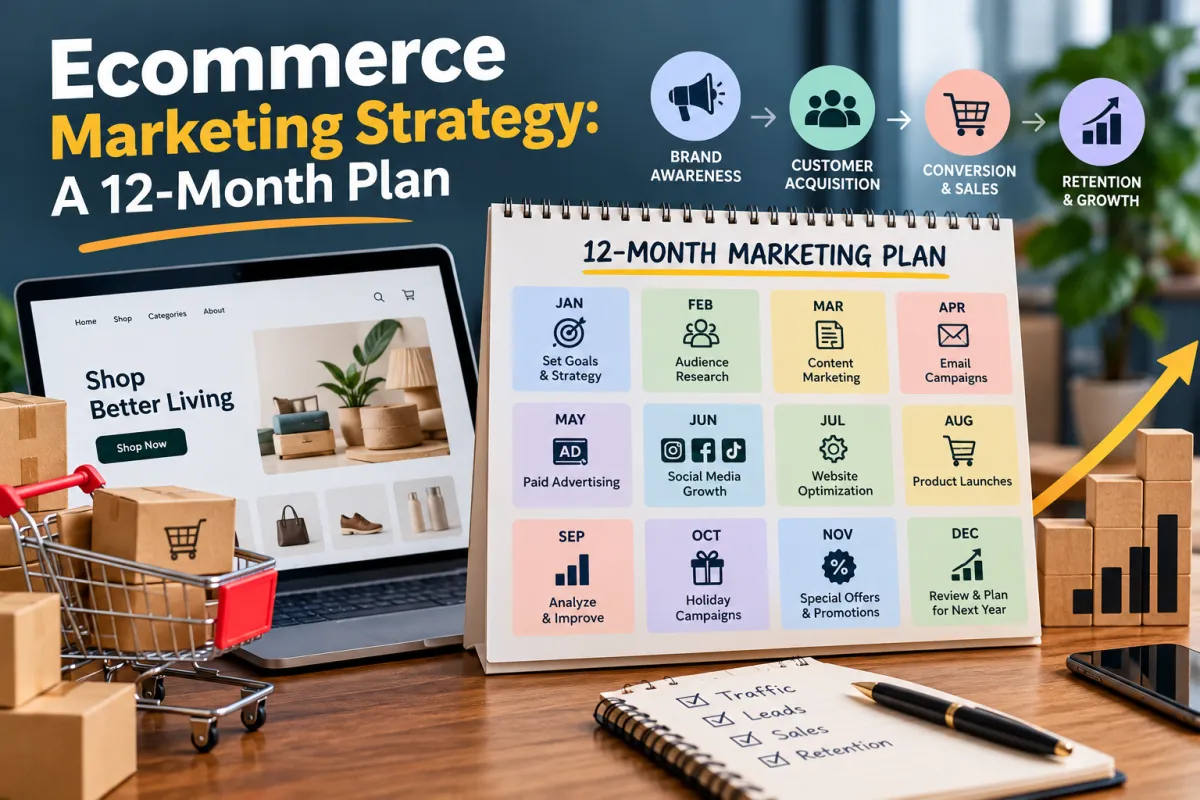
Ecommerce Marketing Strategy: A 12-Month Plan
The strategy in 60 seconds: A successful 12-month ecommerce marketing plan shouldn't begin with “Which ads should we run?” It should begin with the numbers. Establish your revenue target, margins, customer acquisition cost (CAC), conversion rate, average order value (AOV), customer lifetime value (LTV) and repeat purchase rate. Audit your store and tracking, identify the biggest leaks in the customer journey, then prioritise marketing channels according to potential return. Months 1–3 should build the foundations: audit, measurement, conversion rate optimisation, customer research and channel preparation. From there, acquisition, retention and scale can be introduced deliberately. Measure → fix → acquire → convert → retain → scale is the principle that holds the entire 12-month roadmap together.
Ecommerce Marketing Strategy: A 12-Month Plan
Twelve months sounds like a long time.
In ecommerce, it isn't.
You have product launches. Seasonal peaks. Quiet months. Rising ad costs. Competitors entering auctions. Google updates. Customers discovering you on Instagram and returning through email three weeks later. Black Friday somehow arrives approximately five minutes after summer ends.
Without a plan, ecommerce marketing can quickly become a collection of reactions.
Sales dip? Increase PPC.
Traffic falls? Publish more content.
Competitor launches a promotion? Discount.
Meta Ads have a good week? Increase the budget.
Revenue jumps? Increase it again.
That isn't really an ecommerce marketing strategy. It's a series of responses to whatever happened most recently.
A proper Ecommerce Marketing Strategy: A 12-Month Plan works differently. It connects marketing goals, customer acquisition, conversion rate optimisation, customer retention, budget allocation and profitability into one coherent ecommerce growth plan.
Most importantly, it establishes when things should happen.
Because timing matters.
There's little value pouring money into paid advertising when your checkout is leaking conversions. There is little sense obsessing over customer acquisition while ignoring repeat purchases. And spending six months growing organic traffic without reliable conversion tracking leaves you knowing surprisingly little about whether that traffic is commercially valuable.
A 12-month marketing roadmap gives every activity a job.
The 12-Month Ecommerce Growth Framework
The easiest way to understand the plan is to divide the year into four stages:
Period | Primary Focus | What You're Trying to Achieve |
|---|---|---|
Months 1–3 | Foundations | Audit performance, fix measurement, understand customers and improve conversion |
Months 4–6 | Acquisition | Build predictable traffic and customer acquisition channels |
Months 7–9 | Retention & Scale | Increase repeat purchases, LTV and profitable channel spend |
Months 10–12 | Peak & Optimisation | Capitalise on seasonal demand, improve profitability and prepare the next annual plan |
This isn't a rigid calendar.
A retailer whose peak season is summer should obviously organise seasonal campaigns differently from one generating a disproportionate share of ecommerce sales during Black Friday and Christmas.
Think of it as an operating system rather than a calendar carved into stone.
The sequence matters more than the dates:
Audit → Foundations → Acquisition → Conversion → Retention → Scaling → Peak Season → Optimisation → Annual Review
That sequence prevents one of the most expensive mistakes in digital marketing: scaling something that isn't working properly.
Before Month One: Know What Growth Actually Means
“Grow sales by 30%.”
Sounds like a marketing objective.
It isn't much of a strategy.
Where will that extra 30% come from?
More website visitors?
A higher conversion rate?
A larger average order value?
More repeat customers?
Higher purchase frequency?
New products?
Higher prices?
Usually, revenue growth comes from several of these working together.
At its simplest:
Traffic × Conversion Rate × Average Order Value = Revenue
Imagine an ecommerce store currently generates:
50,000 monthly sessions
2% conversion rate
£60 average order value
That's approximately:
50,000 × 2% × £60 = £60,000 monthly revenue
Suppose your marketing objectives require £90,000 a month.
You could try increasing traffic by 50%.
Or you could improve several parts of the ecommerce funnel simultaneously.
For example:
60,000 sessions × 2.3% conversion rate × £65 AOV = £89,700
Almost the same target.
But achieved through a combination of acquisition, CRO and increased order value rather than demanding 25,000 additional visitors every month.
That's why an ecommerce growth strategy should never be reduced to “get more traffic.”
Sometimes the cheapest new revenue is already sitting inside your existing funnel.
Establish Your Baseline Ecommerce KPIs
Before creating a monthly action plan, document your starting numbers.
At minimum, track:
Revenue
Gross profit and profit margin
Website sessions
Conversion rate
Average order value (AOV)
Customer acquisition cost (CAC)
Return on ad spend (ROAS)
Marketing efficiency ratio (MER)
New versus returning customer revenue
Repeat purchase rate
Customer lifetime value (LTV/CLV)
Email subscriber growth
Cart and checkout abandonment
Revenue by marketing channel
Contribution margin
Don't simply record the figures.
Record their relationships.
A £25 CAC might be fantastic for one business and disastrous for another.
If the first order generates £18 contribution margin but customers frequently return and eventually produce £120 of contribution margin, you may deliberately accept a higher initial customer acquisition cost.
If customers rarely make repeat purchases, the calculation changes dramatically.
CAC without LTV lacks context. ROAS without margin lacks context. Revenue without profit lacks context.
That distinction becomes increasingly important as the year progresses.
If you're unsure whether the current numbers and marketing setup provide a strong enough starting point, an ecommerce marketing audit can help expose gaps before additional budget is committed.
Month 1: Audit Before You Accelerate
Month one isn't glamorous.
Good.
Your objective isn't to make the marketing calendar look busy. It's to understand what is actually happening.
Before launching campaigns, conduct an ecommerce audit covering four areas:
1. Tracking and Attribution
Can you trust your data?
Review:
GA4 ecommerce tracking
Google Ads conversion tracking
Meta pixel and Conversions API implementation
Google Merchant Center
Email platform revenue attribution
Consent and cookie configuration
UTM conventions
Attribution models
Product-level revenue data
New versus returning customer reporting
A broken measurement setup contaminates everything downstream.
If purchases are double-counted, ROAS looks better than reality.
If email receives excessive last-click credit, another acquisition channel may appear weaker than it actually is.
If tracking misses purchases, profitable campaigns may be paused.
The first rule of performance measurement is simple:
Don't optimise from numbers you don't trust.
Perfect marketing attribution doesn't exist. A customer might discover your product through organic social, return through Google, subscribe to email, see a Meta retargeting ad and finally purchase after searching your brand.
The goal isn't omniscience.
It's reliable enough data to make better decisions.
Audit Your Customer Journey
Next, stop looking at marketing channels individually and walk through the experience as a customer.
Search for a product.
Land on the website.
Navigate a collection.
Open a product page.
Read the copy.
Check reviews.
Add something to the basket.
Try the checkout.
Do it again on mobile.
Where is the friction?
Common conversion problems include:
Slow mobile pages
Weak product photography
Generic product descriptions
Unclear delivery information
Missing product reviews
Poor navigation
Weak search functionality
Unexpected checkout costs
Limited payment options
Confusing returns information
Distracting product pages
Poorly positioned calls to action
Lack of social proof
Traffic acquisition becomes expensive when the website fails to convert that traffic efficiently.
This is where conversion rate optimisation (CRO) becomes part of acquisition economics.
Suppose 10,000 paid visitors cost £10,000.
At a 1% conversion rate, that's 100 orders and £100 in media cost per order.
Improve conversion to 2%, with everything else unchanged, and the same traffic produces 200 orders.
Your effective media cost per order falls to £50.
You haven't found a cheaper advertising platform.
You've made the store better.
Month 2: Build the Measurement and Conversion Foundations
Month one tells you what's wrong.
Month two starts fixing it.
This stage of the 12-month marketing plan should concentrate on the issues most likely to affect every future marketing campaign.
That usually means tracking, product pages, landing pages, checkout optimisation and conversion rate optimisation.
Don't try to repair 73 things simultaneously.
Rank problems using three questions:
Question | Why It Matters |
|---|---|
How many customers encounter this problem? | Establishes scale |
How severely could it affect conversion? | Establishes potential impact |
How difficult is it to fix? | Establishes effort |
A broken mobile add-to-cart button affecting 40% of visitors deserves considerably more attention than changing the font size in the footer.
Start a CRO Testing Programme
Once obvious problems have been corrected, move from opinion to experimentation.
A/B testing opportunities might include:
Product page layouts
Calls to action
Product photography
Delivery messaging
Social proof
Product reviews
Bundles
Upselling
Cross-selling
Product recommendations
Free-delivery thresholds
Cart design
Checkout messaging
But don't A/B test for entertainment.
Each test should have a commercial hypothesis.
Weak hypothesis:
“Let's try a green button.”
Better hypothesis:
“Displaying the free-delivery threshold beside Add to Cart will increase conversion rate and average order value because customers can understand the delivery incentive before entering checkout.”
That gives you something meaningful to learn even when a test loses.
Calculate What You Can Afford to Spend
This is also the point where the marketing budget becomes real.
Not aspirational.
Not “10% of revenue because somebody said that's normal.”
Real.
Before scaling paid search, Google Shopping, Meta Ads or other paid social activity, determine what acquiring an order is actually worth.
Your calculation should consider:
Selling price − product cost − fulfilment − payment fees − shipping subsidy − returns allowance − variable operating costs = contribution before marketing
Then decide how much of that contribution you're prepared to spend acquiring the customer.
For a more practical starting point, use an ecommerce ROI calculator to model how changes in advertising spend and returns affect commercial performance.
This is also where break-even ROAS becomes far more useful than celebrating an arbitrary number.
A 4x ROAS isn't automatically good.
A 2x ROAS isn't automatically bad.
Margin determines what the business can tolerate.
Customer lifetime value changes the picture further.
A first purchase may be barely profitable while the cohort becomes extremely valuable over the following twelve months.
That means your ecommerce KPIs need to graduate from:
“How much revenue did this campaign make?”
to:
“What did it cost to acquire these customers, what contribution did they generate, and what are those customers subsequently worth?”
That's a much more powerful question.
Month 3: Know Exactly Who You're Trying to Acquire
By month three, the technical foundations should be considerably stronger.
Now we turn outward.
Who is the target audience?
Not:
“Women aged 25–45 interested in shopping.”
That's targeting syntax.
It's not customer understanding.
Real customer research asks:
Why do people buy this product?
What problem are they trying to solve?
What alternatives did they consider?
What nearly stopped them buying?
What language do customers use to describe the problem?
What matters most: price, quality, convenience, status, sustainability, speed or something else?
What questions appear before purchase?
What causes repeat purchases?
Why do customers leave?
Which products tend to be bought together?
How long is the typical buying cycle?
Use product reviews, customer-service conversations, site-search data, email responses, surveys and post-purchase questionnaires.
Talk to customers.
Five genuine customer conversations can sometimes teach you more than fifty slides of demographic assumptions.
Turn Customer Research Into Buyer Intent
Customer research should feed directly into your channel strategy.
Imagine you discover three recurring groups.
Customer A: Already knows exactly what they want and searches Google using specific product terms.
Customer B: Has the problem your product solves but doesn't know your brand or perhaps even the product category.
Customer C: Has already purchased and needs a reason to buy again.
Would you market to all three identically?
Of course not.
Customer A might be captured through ecommerce SEO, Google Ads or Google Shopping.
Customer B may require blog content, video, organic social, influencer marketing, TikTok marketing or Meta Ads to generate discovery.
Customer C might respond to email automation, SMS marketing, personalised product recommendations, replenishment messages, loyalty incentives or a well-timed post-purchase campaign.
This is channel prioritisation.
The question isn't:
“Should we do Instagram marketing?”
It's:
“Which part of our customer journey can Instagram influence, and can we measure whether it's doing that economically?”
The same logic applies to every marketing channel.
Build the Marketing Channel Map Before Scaling
At the end of the first quarter, your ecommerce marketing plan should begin connecting customer intent to specific channels.
A simple map might look like this:
Customer Stage | Primary Objective | Potential Channels |
|---|---|---|
Unaware | Generate discovery | Organic social, influencers, video, paid social |
Problem-aware | Educate | Ecommerce content marketing, SEO, social, video |
Product-aware | Build consideration | Product content, reviews, email, retargeting |
Purchase intent | Capture demand | Google Ads, Google Shopping, ecommerce SEO |
Checkout | Convert | CRO, checkout optimisation, cart recovery |
Existing customer | Retain | Email, SMS, loyalty, personalised marketing |
Advocate | Generate referrals | UGC, reviews, referral marketing, social |
Notice what this prevents.
Channel chaos.
Instead of trying SEO, PPC, Facebook advertising, email marketing, influencer marketing and affiliate marketing simultaneously because “we should probably be doing all of them,” every channel receives a purpose.
And purpose makes measurement possible.
A search campaign capturing high-intent demand shouldn't necessarily be judged in exactly the same way as an influencer campaign introducing thousands of people to the brand for the first time.
This is where your wider ecommerce marketing services should ultimately connect: not as isolated tactics, but as parts of one acquisition, conversion and retention system.
Your First 90-Day Action Plan
By the end of month three, the business should have moved from guessing to measuring.
Your first-quarter checklist should look something like this:
Establish baseline ecommerce KPIs
Complete an ecommerce and conversion audit
Validate GA4 and conversion tracking
Review marketing attribution
Identify customer-journey friction
Fix major checkout and mobile issues
Begin a CRO testing programme
Calculate contribution margin
Establish target CAC and break-even ROAS
Review AOV and customer lifetime value
Conduct customer research
Define meaningful audience segments
Map intent to marketing channels
Prioritise acquisition opportunities
Create the next 90-day action plan
And here's the crucial bit:
You still haven't scaled aggressively.
That's intentional.
The first quarter creates the machine.
The next phase feeds it.
Months 4–6 are where the strategy begins turning those foundations into systematic customer acquisition through ecommerce SEO, content, paid search, Google Shopping, paid social and email list growth—while watching CAC, ROAS, conversion rate and profitability closely enough to know which channels deserve more budget.
Because the goal of a 12-month ecommerce strategy isn't to do more marketing.
It's to discover what deserves to be scaled.
Month 4: Build an Ecommerce SEO Engine That Compounds
The first three months built the foundations.
Month four is where we start putting them to work.
And one of the first places to invest is ecommerce SEO.
Why now?
Because organic growth takes time.
Paid advertising can generate traffic this afternoon. Search engine rankings generally don't work like that. Product pages need to be optimised. Category pages need authority. Content needs to be discovered, crawled and indexed. Internal links need to accumulate. Competitors need to be displaced.
Starting SEO in month ten because Christmas is approaching is rather like planting tomatoes in December and wondering why dinner isn't ready.
Start early.
Begin With Commercial Keyword Research
Ecommerce keyword research should begin with buying intent.
Not traffic volume.
A keyword generating 500 highly relevant searches can be considerably more valuable than a broad informational phrase attracting 20,000 people who have little intention of buying anything.
Divide your keyword research into four broad groups:
Product keywords — searches for specific products.
Category keywords — broader searches describing groups of products.
Problem and informational keywords — searches made while researching a need.
Brand and comparison keywords — searches made closer to a purchasing decision.
Then map those keywords to the correct page type.
Search Intent | Best Destination |
|---|---|
Specific product | Product page |
Product category | Collection/category page |
Problem or question | Blog/guide |
Comparison | Comparison or buying guide |
Brand search | Brand/category/product page |
This matters because attempting to rank a blog article for a strongly transactional ecommerce query can leave you fighting search intent.
Give Google—and customers—the page they're actually looking for.
Strengthen Your Ecommerce Category Pages
Collection and category pages are often some of the most commercially important pages on an ecommerce website.
Treat them accordingly.
Review:
Page titles
Meta descriptions
H1 headings
Category descriptions
Product naming
Internal linking
Filter and faceted navigation
Structured data
Canonicalisation
Mobile usability
Page speed
Core Web Vitals
Avoid stuffing category descriptions with keywords merely to make them longer.
Useful content wins.
Explain what the products are, who they're for, important differences between options and what a customer should consider before choosing.
The objective of product page SEO and category optimisation isn't simply to increase organic traffic.
It's to attract commercially relevant organic traffic.
Turn Content Marketing Into a Sales Asset
Next comes ecommerce content marketing.
This is where many stores go wrong.
They publish articles because somebody once told them blogging helps SEO.
Monday: Five Things We Love About Spring.
Thursday: Meet The Team.
Three weeks later: Happy National Something Day.
Then everyone wonders why blog content isn't generating ecommerce sales.
A proper content strategy begins with the customer journey.
Ask:
What does somebody search before they realise they need our product?
What do they search while comparing solutions?
What questions prevent them purchasing?
What information would make choosing easier?
That might lead to:
Buying guides
Product comparisons
How-to articles
Problem-solving guides
Gift guides
Size or selection guides
Product-care content
FAQs
Seasonal guides
Expert advice
Each article should have somewhere useful to send the reader next.
That could be a relevant category, product, guide or email signup.
Content shouldn't become a cul-de-sac.
It should become part of the ecommerce funnel.
Month 5: Capture Existing Demand With Paid Search and Shopping
SEO builds momentum.
Paid search buys access to demand that already exists.
Month five is the point at which Google Ads, Google Shopping and other PPC campaigns can begin scaling more deliberately—assuming your conversion tracking and commercial numbers are now trustworthy.
That last part matters.
Paid advertising is remarkably good at amplifying things.
Unfortunately, that includes mistakes.
A profitable store with strong conversion can use advertising to accelerate.
A weak store with poor economics can use advertising to lose money much faster.
Get the Product Feed Right First
For ecommerce businesses, your product feed deserves far more attention than it usually receives.
Before increasing Shopping campaign budgets, review the data being supplied through Google Merchant Center.
Look at:
Product titles
Product descriptions
Product categories
Images
Pricing
Availability
GTINs and identifiers
Product types
Brand information
Promotional data
Product feed optimisation can affect which searches your products appear for and how compelling those listings are.
Don't treat the feed as an administrative task.
It's marketing infrastructure.
Separate Revenue From Profitable Revenue
Imagine two campaigns:
Campaign | Spend | Revenue | ROAS |
|---|---|---|---|
Campaign A | £5,000 | £20,000 | 4.0x |
Campaign B | £5,000 | £15,000 | 3.0x |
Campaign A wins.
Right?
Not necessarily.
Suppose Campaign A primarily sells a low-margin product while Campaign B sells products with substantially higher contribution margins and stronger repeat purchase behaviour.
Suddenly, the answer isn't obvious.
This is why mature ecommerce marketing performance should move beyond surface-level ROAS.
Consider:
Revenue → Gross Margin → Contribution → CAC → Repeat Purchases → LTV
Your marketing analytics should increasingly tell you not merely which campaign generated an order, but what kind of customer and commercial value it created.
Don't Let Performance Max Become a Black Box
Automation can be extremely useful.
So can Performance Max.
But automated campaigns don't remove the need for strategy.
They make your inputs more important.
Feed quality matters.
Creative matters.
Conversion tracking matters.
Audience signals matter.
Margins matter.
Budget allocation matters.
If your measurement is poor, giving an advertising platform more automation doesn't magically repair the underlying information.
It simply automates decisions using imperfect inputs.
Keep asking:
Which products are receiving spend?
Which products are actually profitable?
Are new customers being acquired?
What is the customer acquisition cost?
How does performance change by product category?
Are branded searches influencing reported performance?
What happens after the first purchase?
The goal isn't to micromanage every click.
It's to understand whether automation is serving your ecommerce growth strategy.
Month 6: Expand Customer Acquisition With Paid Social
By month six, your acquisition strategy can broaden.
Search captures demand.
Paid social can help create it.
That's an important distinction.
Someone searching Google for a specific product is already telling you something about their intent.
Someone scrolling Instagram or Facebook probably wasn't waiting for your advert.
You interrupted them.
Your creative therefore has a much bigger job to do.
Build Creative Around the Customer, Not the Brand
The strongest paid social creative often answers one of several questions quickly:
What's this?
Why should I care?
Why is it different?
Can I trust it?
Why should I act now?
This creates several useful creative angles:
Problem/solution
Product demonstration
Before and after
Customer testimonial
User-generated content
Product comparison
Founder story
Educational content
Social proof
Lifestyle creative
Offer-led creative
Don't launch one advert and call that a Meta Ads strategy.
Creative testing should be continuous.
Test hooks.
Test formats.
Test messages.
Test customer problems.
Test demonstrations.
Test social proof.
Test different stages of awareness.
Sometimes a campaign appears to have an audience problem when it actually has a creative problem.
Prospecting and Retargeting Have Different Jobs
Your paid social structure should recognise where somebody is in the customer journey.
Prospecting reaches people who may never have encountered your brand.
Retargeting reaches people who have already interacted with it.
That could include:
Website visitors
Product viewers
Cart abandoners
Video viewers
Social engagers
Email subscribers
Previous customers
Remarketing is powerful because familiarity already exists.
But there's a trap.
If your retargeting audience mostly contains people acquired through SEO, paid search, influencers and other channels, retargeting shouldn't automatically receive all the credit for creating the demand.
Again, marketing attribution matters.
Channels interact.
Treat them as an ecosystem rather than twelve departments fighting over the same sale.
Your Half-Year Review: Stop, Measure, Decide
You've reached month six.
Don't immediately rush into month seven.
Review.
A useful quarterly marketing plan should include deliberate moments where activity slows down long enough for decisions to be made.
Your six-month review should answer:
Acquisition
Which channels are generating new customers?
What is CAC by channel?
Which campaigns have the strongest contribution margin?
Which products are easiest to acquire customers for?
Which channels appear to be reaching genuinely incremental customers?
Conversion
Has conversion rate improved?
Which CRO tests have won?
Where are customers abandoning?
Is mobile conversion improving?
Have product pages improved?
Has checkout abandonment fallen?
Customer Value
Has AOV increased?
Which products drive cross-selling?
Which first purchases produce the highest LTV?
How quickly do customers make a second purchase?
Which customer segments have the strongest repeat purchase rate?
Organic Growth
Are search engine rankings improving?
Is non-brand organic traffic increasing?
Which content generates assisted conversions?
Are important ecommerce category pages gaining visibility?
Profitability
Has revenue increased?
Has gross profit increased?
What has happened to contribution margin?
Is MER improving?
How much incremental profit has marketing created?
This last section is crucial.
Revenue growth and business growth aren't always the same thing.
You can increase ecommerce sales while simultaneously reducing profitability.
Month 7: Turn Email Marketing Into a Revenue System
Acquisition receives enormous attention because it feels like growth.
New clicks.
New visitors.
New customers.
But constantly paying to reacquire attention is expensive.
Month seven shifts more focus towards customer retention.
And email marketing is one of the first places to look.
Not newsletters.
Not “20% OFF THIS WEEKEND” every Friday until your subscribers become immune.
A proper email marketing strategy should respond to behaviour throughout the customer lifecycle.
Build the Core Email Automation Flows
At minimum, consider:
Welcome Flow
Introduce new email subscribers to the brand.
Don't immediately behave like a market trader shouting a discount at somebody who just walked past.
Use the sequence to communicate:
What makes the brand/product different
Your strongest value proposition
Social proof
Best-selling products
Common objections
A relevant first-purchase incentive, where commercially sensible
Abandoned Cart Automation
Cart abandonment emails should do more than say:
You forgot something.
Customers often haven't forgotten.
They hesitated.
Perhaps they were unsure about delivery.
Perhaps the price felt high.
Perhaps they wanted to compare alternatives.
Perhaps checkout distracted them.
A strong abandoned cart email can address those objections using reviews, delivery information, guarantees, product benefits and FAQs.
Browse Abandonment
Some customers never reach the basket.
Browse-abandonment automation can reintroduce products they've viewed and provide useful reasons to return.
Post-Purchase Emails
The customer journey doesn't finish at checkout.
Use post-purchase email to:
Set delivery expectations
Explain how to use the product
Reduce buyer's remorse
Request reviews
Introduce complementary products
Encourage user-generated content
Prepare the second purchase
Win-Back Campaigns
Eventually customers stop purchasing.
Define what “lapsed” means for your category.
Thirty days?
Ninety?
Six months?
Then build a win-back campaign designed around expected purchase frequency rather than sending arbitrary reminders.
Customer Segmentation Beats Sending Everything to Everyone
Your email list isn't one audience.
A first-time visitor who downloaded a guide isn't the same as somebody who has ordered seven times.
Segment using signals such as:
Purchase history
Product purchased
Average order value
Purchase frequency
Last purchase date
Email engagement
Browsing behaviour
Customer lifetime value
Location
Product preferences
This allows personalised marketing to become useful rather than creepy.
A customer who recently purchased Product A may need instructions first, Product B as a cross-sell later and a replenishment reminder several months afterwards.
That's lifecycle marketing.
Relevant message.
Relevant person.
Relevant moment.
Month 8: Increase Customer Lifetime Value
By month eight, acquisition channels are operating and retention infrastructure is developing.
Now ask a different question:
How can each acquired customer become more valuable without damaging their experience?
This is where customer lifetime value (CLV/LTV) becomes one of your most important ecommerce KPIs.
There are several broad levers:
Increase average order value.
Use bundles, product recommendations, upselling, cross-selling and intelligently chosen free-shipping thresholds.
Increase purchase frequency.
Use replenishment reminders, useful post-purchase communication, product launches and lifecycle campaigns.
Increase retention.
Give customers genuine reasons to remain engaged with the brand.
Encourage advocacy.
Reviews, referrals and UGC can transform customers into an acquisition channel of their own.
Increase AOV Without Turning the Checkout Into a Bazaar
Upselling is useful.
So is cross-selling.
But restraint matters.
Someone buying a £30 product doesn't necessarily need seventeen pop-ups recommending another £280 of merchandise before they're allowed to pay.
Good product recommendations feel helpful.
Ask:
What would genuinely improve this purchase?
That could be:
A complementary product
A bundle
A larger quantity
A premium version
An accessory
A subscription
A free-shipping threshold
Measure the effect on both average order value and conversion rate.
An upsell increasing AOV by 8% isn't impressive if it simultaneously causes enough customers to abandon checkout to reduce total contribution.
Optimise the system, not the isolated metric.
Build a Loyalty Strategy Before Building a Loyalty Programme
Points aren't loyalty.
They're points.
Before launching a complicated loyalty programme, understand why your best customers return.
It might be:
Product quality
Convenience
Range
Service
Community
Exclusivity
New product access
Personalisation
Price
Trust
Then reinforce those reasons.
A loyalty programme can certainly support customer retention, but it shouldn't become an expensive mechanism for discounting purchases customers would have made anyway.
Likewise, referral marketing works best when customers already have something worth recommending.
Fix the experience first.
Then amplify advocacy.
Month 9: Scale What Has Earned the Right to Scale
Nine months into the plan, you should have something extraordinarily valuable:
evidence.
Not predictions.
Not marketing trends.
Not what a competitor appears to be doing.
Your own evidence.
You should know considerably more about:
Which acquisition channels work
Which products convert
Which customer segments are valuable
What your target CAC should be
What your repeat purchase rate looks like
Which automated email campaigns generate revenue
Which content attracts commercial traffic
Which CRO changes improve conversion
Which creative angles resonate
Which products generate strong LTV
Which campaigns produce actual contribution
Now budget allocation becomes easier.
Not easy.
Easier.
Use Marginal Performance, Not Just Average Performance
Suppose a Google Shopping campaign has historically generated a 5x ROAS.
Excellent.
Does that mean you should double the budget?
Not necessarily.
The next £1,000 of spend may perform differently from the previous £1,000.
As budgets increase, platforms often have to reach less efficient inventory or audiences.
This is the difference between average performance and marginal performance.
Scaling should therefore happen incrementally.
Increase budget.
Measure.
Watch CAC.
Watch contribution margin.
Watch new-customer acquisition.
Watch total marketing efficiency.
Then decide again.
A marketing budget shouldn't be set once in January and blindly defended until December.
It should move towards evidence.
Use the LTV Ratio Carefully
The relationship between customer lifetime value and customer acquisition cost can help determine how aggressively a business can acquire customers.
But don't let an attractive spreadsheet number create false confidence.
Lifetime value is realised over time.
Advertising bills aren't.
If you spend £100 acquiring a customer today because you expect £300 of future value over three years, the business still needs enough cash to fund that acquisition now.
Forecasting matters.
Cash flow matters.
Payback period matters.
Contribution margin matters.
That's why an ecommerce growth plan should connect marketing performance to financial reality.
Growth can consume cash surprisingly quickly.
Your Months 4–9 Scorecard
At this stage, the ecommerce strategy has moved through three distinct phases:
Foundation → Acquisition → Retention & Scale
Before entering the final quarter, your scorecard should show progress across the whole commercial system.
Area | Questions to Answer |
|---|---|
SEO | Are rankings, relevant organic traffic and organic revenue growing? |
Content | Is content assisting discovery and conversion? |
Paid Search | Are CAC, ROAS and contribution commercially sustainable? |
Paid Social | Which creatives and audiences acquire valuable customers? |
CRO | Is conversion rate improving? |
What percentage of revenue comes from lifecycle automation? | |
Retention | Is repeat purchase rate increasing? |
AOV | Are bundles, upsells and cross-sells increasing order value profitably? |
LTV | Are newer cohorts becoming more valuable? |
Profit | Is marketing generating contribution, not merely revenue? |
And one more:
What should we stop doing?
This question doesn't get asked often enough.
An ecommerce marketing strategy isn't only a plan for adding activities.
It's a mechanism for removing weak ones.
Kill campaigns that continually fail.
Stop producing content nobody needs.
Reduce investment in channels that cannot demonstrate a credible role.
Automate repetitive work.
Move marketing budget towards opportunities supported by evidence.
Because month ten changes the environment again.
For many ecommerce businesses, the final quarter contains Black Friday, Cyber Monday, Christmas and the year's biggest concentration of commercial demand.
That is not the moment to begin preparing.
Your peak-season strategy, promotional calendar, inventory planning and revenue forecast need to be ready before the rush begins—which is exactly where the final phase of this 12-month ecommerce marketing plan starts.
Month 10: Prepare for Peak Season Before Everyone Else Does
Peak season rewards preparation.
It punishes improvisation.
Whether your biggest commercial opportunity is Black Friday, Cyber Monday, Christmas, Valentine's Day, Mother's Day, summer, back-to-school or something specific to your product category, the principle is the same:
The campaign begins long before the promotion goes live.
Month ten is therefore about preparation.
By now, you should already know:
Which products convert best
Which products have the strongest margins
Which acquisition channels perform reliably
Which customer segments have the highest LTV
Which creative messages resonate
Which email automations generate revenue
Which landing pages convert
Which products are frequently purchased together
Which offers actually change purchasing behaviour
Now use that information to build your promotional calendar.
Build Your Promotional Calendar Around Commercial Moments
A promotional calendar shouldn't simply contain dates.
It should contain decisions.
For every major seasonal campaign, document:
Decision | Question |
|---|---|
Objective | What are we trying to achieve? |
Audience | Who is this campaign for? |
Product | Which products are being promoted? |
Offer | Is an incentive actually necessary? |
Margin | What happens to profitability? |
Inventory | Can stock support forecast demand? |
Channels | Where will the campaign run? |
Creative | What assets need producing? |
Landing Page | Where will campaign traffic arrive? |
Email/SMS | What lifecycle communication is required? |
Budget | How much can we profitably spend? |
KPI | How will success be measured? |
This transforms seasonal marketing from:
“Black Friday is next week. What discount should we run?”
into:
“Here is the campaign objective, audience, inventory position, margin model, acquisition budget, creative schedule, channel strategy and revenue forecast.”
One is reactive.
The other is a marketing strategy.
Black Friday Doesn't Automatically Require Your Biggest Discount
Discounting feels safe because it's easy to understand.
Take £100.
Cross it out.
Write £70.
Customers save £30.
But the commercial impact isn't quite so simple.
Suppose a product sells for £100 and contributes £40 before marketing.
A 20% discount reduces the selling price to £80.
Assuming most underlying variable costs remain unchanged, you haven't merely reduced revenue by 20%.
You've potentially removed half of the original £40 contribution.
That means considerably more orders may be required simply to generate the same contribution.
This is why promotional campaigns should be modelled before launch.
Consider alternatives such as:
Product bundles
Gift with purchase
Free delivery
Spend thresholds
Exclusive products
Early access
Tiered incentives
Loyalty rewards
Multi-buy offers
Cross-sell incentives
Sometimes a straightforward discount is absolutely the right commercial decision.
Just make it a decision rather than a reflex.
Segment Your Peak-Season Customers
Not everyone needs the same offer.
A loyal customer who has purchased six times may respond to early access without requiring a huge discount.
A first-time visitor may need stronger reassurance, reviews and social proof.
A lapsed customer might need a reason to return.
A high-LTV customer could receive VIP access.
A cart abandoner may simply need a reminder before stock disappears.
This is where the customer segmentation and email automation work completed earlier in the year pays off.
Your peak-season audiences might include:
VIP/high-LTV customers
Recent purchasers
Repeat customers
Email subscribers who haven't purchased
Lapsed customers
Product viewers
Cart abandoners
New prospects
Different audience.
Different relationship.
Potentially different message.
Forecast Peak-Season Revenue Before Setting the Budget
Forecasting doesn't mean pretending you can predict the future precisely.
It means creating a commercially useful expectation.
Start with your historical performance where available, then consider:
Expected traffic
Conversion rate
Average order value
Planned promotions
Paid media budget
Organic growth
Email list size
Repeat customer behaviour
Inventory
Seasonality
Product launches
Current trading performance
Build at least three scenarios:
Conservative.
What happens if demand is weaker than expected?
Expected.
What does the most reasonable sales forecast look like?
Stretch.
What happens if campaigns outperform expectations and additional inventory and marketing budget are required?
This gives the business options.
More importantly, connect the revenue forecast to profit.
£500,000 of sales at terrible margins isn't automatically preferable to £400,000 of sales at healthy margins.
Revenue makes impressive screenshots.
Profit pays bills.
Month 11: Execute, Monitor and Optimise
Month eleven is where months of preparation collide with reality.
Campaigns go live.
Traffic increases.
Budgets move.
Email volume rises.
Customers behave differently.
Competitors become louder.
CPMs and CPCs can change quickly.
This isn't the month for blindly following the spreadsheet created six weeks earlier.
It's the month for active campaign optimisation.
Build a Daily Ecommerce Dashboard
During high-volume periods, monthly reporting isn't enough.
You need faster feedback.
Your ecommerce dashboard should make it easy to monitor:
Revenue
Orders
Conversion rate
Average order value
New customer revenue
Returning customer revenue
Ad spend
CAC
ROAS
MER
Contribution margin
Email revenue
Cart abandonment
Inventory
Revenue versus forecast
Don't react to every tiny movement.
But don't wait until January to discover that a campaign spent £20,000 promoting a product with almost no margin either.
Know Which Metrics Need Immediate Attention
Different ecommerce KPIs operate on different timescales.
Some demand rapid intervention.
If checkout suddenly stops working, fix it now.
If conversion tracking breaks, investigate now.
If a paid campaign begins spending heavily without generating expected orders, investigate.
Other metrics need more patience.
SEO performance doesn't need to be judged every three hours.
Customer lifetime value doesn't reveal itself overnight.
Retention rate needs cohorts and time.
The skill is knowing the difference between:
noise
and
signal.
Good marketing performance management isn't constant interference.
It's informed intervention.
Don't Let Peak Season Destroy the Customer Experience
A huge sales day followed by weeks of customer complaints isn't necessarily a successful campaign.
Marketing doesn't stop when the payment clears.
Peak-season planning should include:
Realistic delivery promises
Stock availability
Customer-service capacity
Returns processes
Order-status communication
Post-purchase emails
Review requests
Complaint handling
Remember the objective isn't simply to create transactions.
It's to acquire customers.
That distinction matters.
A first-time Black Friday customer who receives a brilliant experience can become a repeat customer.
A first-time customer who waits three weeks for an unexplained delivery may never return.
Your retention strategy begins with fulfilling the promise your marketing made.
Month 12: Turn Peak-Season Customers Into Long-Term Customers
December—or month twelve in your particular commercial calendar—isn't the finish line.
It's the handover.
You've potentially just acquired a large group of new customers.
Now the question becomes:
What happens next?
For many ecommerce businesses, the answer is disappointingly little.
Order confirmation.
Dispatch confirmation.
Silence.
Then, several weeks later:
SALE! 20% OFF!
That's a missed opportunity.
Create a Post-Purchase Journey
The right post-purchase sequence depends on the product, but it might look something like this:
Immediately after purchase:
Confirm the order and reinforce the purchasing decision.
Before delivery:
Set expectations and provide useful information.
After delivery:
Explain how to get the best from the product.
Once the customer has had time to use it:
Request a review or UGC.
At the appropriate interval:
Recommend a genuinely complementary product.
When replenishment is likely:
Send a replenishment reminder.
When a customer appears to be lapsing:
Trigger a win-back campaign.
This is marketing automation doing what automation should do:
making relevant communication happen at the right time without somebody manually remembering every customer.
Measure Cohorts, Not Just Customers
This is also a good time to introduce cohort analysis.
Instead of asking:
“What's our repeat purchase rate?”
ask:
“How do customers acquired during Black Friday behave compared with customers acquired through organic search in March?”
You might discover that:
Discount-acquired customers have lower LTV
Organic customers make more repeat purchases
Influencer-acquired customers have higher AOV
Certain first products create better long-term customers
Some paid campaigns look mediocre initially but acquire excellent repeat buyers
This changes future budget allocation.
A campaign that appears expensive using first-order CAC may become attractive once customer lifetime value is considered.
The reverse can also happen.
A campaign with excellent first-order ROAS might continually acquire low-value customers who never return.
That is why a mature ecommerce marketing strategy measures customer quality as well as customer quantity.
Your Annual Ecommerce Marketing Review
Now the 12-month roadmap comes full circle.
Go back to the baseline numbers recorded in month one.
Compare them with month twelve.
Not selectively.
All of them.
KPI | Month 1 | Month 12 | Change |
|---|---|---|---|
Revenue | £___ | £___ | ___% |
Gross Profit | £___ | £___ | ___% |
Conversion Rate | ___% | ___% | ___% |
Average Order Value | £___ | £___ | ___% |
Customer Acquisition Cost | £___ | £___ | ___% |
Customer Lifetime Value | £___ | £___ | ___% |
Repeat Purchase Rate | ___% | ___% | ___% |
Organic Revenue | £___ | £___ | ___% |
Email Revenue | £___ | £___ | ___% |
Paid Media ROAS | ___x | ___x | ___% |
MER | ___x | ___x | ___% |
Contribution Margin | ___% | ___% | ___% |
But numbers alone aren't enough.
Conduct a qualitative review too.
Ask:
What worked?
Which channels, campaigns, products, content, automations and CRO tests produced meaningful results?
What failed?
Not everything will work.
Good.
Failures become useful when they change the next decision.
What surprised us?
Perhaps an unexpected product became a bestseller.
Perhaps a small SEO category generated disproportionately valuable customers.
Perhaps SMS worked brilliantly.
Perhaps influencer marketing didn't.
Perhaps email drove considerably more repeat revenue than expected.
What should we stop?
Every annual review should remove something.
What should we scale?
Look for activities that have demonstrated repeatable commercial value.
What should we test next?
Your next ecommerce strategy shouldn't merely repeat the previous year with 10% added to every target.
It should incorporate what the previous twelve months taught you.
Build Next Year's Revenue Forecast
Once you've reviewed the year, create the next forecast.
Don't begin with:
“We want to grow 50%.”
Begin with the mechanics.
If revenue needs to increase, where can it realistically come from?
Perhaps:
Organic traffic grows 25%
Conversion rate moves from 2.1% to 2.4%
AOV increases from £62 to £67
Repeat purchase rate increases by five percentage points
Email contributes more lifecycle revenue
Paid acquisition scales within CAC targets
New product launches create incremental revenue
Now you have assumptions that can be challenged.
And measured.
And changed.
That's a forecast.
How to Allocate Next Year's Marketing Budget
Your annual budget allocation should reflect evidence from the previous year while leaving room for experimentation.
One practical framework is to divide marketing investment into three categories:
Proven
Channels and campaigns with established commercial performance.
These receive the largest share.
Developing
Activities showing promising evidence but requiring further optimisation.
These receive controlled investment.
Experimental
New channels, audiences, formats and ideas.
These receive enough budget to generate useful evidence without threatening the wider marketing plan.
The exact percentages depend on the business.
The principle is more important:
Protect what works, develop what might work, and reserve enough capacity to discover what works next.
Don't allocate the entire marketing budget according to last year's winners.
Markets change.
Platforms change.
Customers change.
Competitors change.
Your strategy needs enough stability to compound and enough flexibility to adapt.
The Complete 12-Month Ecommerce Marketing Plan
Put everything together and your year looks like this:
Month | Strategic Focus | Core Activities |
|---|---|---|
1 | Audit | Analytics, tracking, attribution, customer journey and ecommerce audit |
2 | Conversion Foundations | CRO, checkout optimisation, margins, CAC and break-even ROAS |
3 | Customer Research | Target audience, buyer intent, segmentation and channel prioritisation |
4 | Organic Growth | Ecommerce SEO, keyword research, product/category SEO and content strategy |
5 | Paid Search | Google Ads, Google Shopping, Merchant Center and product feed optimisation |
6 | Paid Social | Meta Ads, creative testing, prospecting and retargeting |
7 | Email Automation | Welcome, abandoned cart, browse abandonment and post-purchase flows |
8 | Retention | LTV, AOV, upselling, cross-selling, loyalty and referrals |
9 | Scale | Budget allocation, marginal ROAS, LTV and profitable growth |
10 | Peak Preparation | Seasonal campaigns, forecasting, inventory and promotional calendar |
11 | Peak Execution | Campaign optimisation, daily reporting and customer experience |
12 | Retention & Review | Cohort analysis, win-back, annual review and next-year planning |
There it is.
An entire year.
But remember:
The table isn't the strategy.
The thinking behind it is.
Your Ecommerce Marketing Strategy Should Be a System
The biggest mistake with a 12-month marketing plan is treating it as a checklist.
January: done.
February: done.
SEO: done.
Email: done.
Meta Ads: done.
Marketing doesn't work like that.
Everything connects.
Better customer research improves advertising creative.
Better creative reduces customer acquisition cost.
Better landing pages improve conversion rate.
Higher conversion improves paid media economics.
Better product recommendations increase average order value.
Higher AOV creates more room for acquisition.
Better email automation increases repeat purchases.
More repeat purchases increase LTV.
Higher LTV may allow a higher CAC.
A higher sustainable CAC can unlock more acquisition volume.
More customers create more reviews, referrals and first-party data.
That improves acquisition again.
This is the flywheel you're trying to build.
Not twelve disconnected monthly campaigns.
The Metrics That Matter Most
It's tempting to build a dashboard containing 97 metrics.
Resist.
Most businesses need a hierarchy.
Business-Level Metrics
These tell you whether growth is commercially worthwhile:
Revenue
Gross profit
Contribution margin
New customer revenue
Returning customer revenue
Acquisition Metrics
These tell you whether customer acquisition is efficient:
CAC
ROAS
MER
New customer rate
Cost per order
Conversion Metrics
These tell you whether the store converts demand effectively:
Conversion rate
Add-to-cart rate
Checkout completion
Cart abandonment
Average order value
Retention Metrics
These tell you whether customers remain valuable:
Repeat purchase rate
Purchase frequency
Customer lifetime value
Retention rate
Churn rate
Channel Metrics
These help diagnose performance:
Organic traffic
Search engine rankings
Paid search performance
Paid social performance
Email revenue
Email engagement
Affiliate revenue
Referral revenue
Channel metrics explain.
Business metrics decide.
Never lose sight of that distinction.
Five Rules for Your 12-Month Ecommerce Strategy
If the entire article had to be reduced to five principles, keep these.
1. Fix Before You Scale
More traffic magnifies both strengths and weaknesses.
Get measurement, conversion and commercial fundamentals right before aggressively increasing acquisition.
2. Measure Profit, Not Just Revenue
Revenue is necessary.
Profitability determines whether the growth is sustainable.
Know your margins, CAC, contribution and break-even ROAS.
3. Acquisition and Retention Belong Together
A customer shouldn't disappear from the marketing strategy after their first order.
Customer retention, repeat purchases and LTV determine how valuable acquisition really is.
4. Give Every Marketing Channel a Job
SEO, Google Shopping, Meta Ads, email, SMS, influencer marketing and organic social don't need to perform identical roles.
Understand where each channel influences the customer journey.
5. Treat the Plan as a Living Document
Your January assumptions will not all survive contact with December.
Good.
Update the strategy when the evidence changes.
What If You're Starting From Scratch?
Don't panic because the plan looks substantial.
You don't need twelve marketing channels.
You don't need an enormous marketing budget.
You don't need sophisticated marketing attribution software before you've made your first sale.
Start with the constraint.
If traffic is low but conversion is strong, focus on acquisition.
If traffic is healthy but sales are weak, investigate conversion.
If acquisition is working but profitability is poor, investigate margins, CAC and AOV.
If first purchases are plentiful but customers rarely return, prioritise retention.
If you're drowning in data but can't explain which marketing activity creates profit, fix measurement.
Find the bottleneck.
Work on it.
Measure again.
Then find the next one.
Ecommerce Marketing Strategy: A 12-Month Plan — Final Checklist
Before you finish building your own marketing roadmap, make sure you can answer these questions:
What are our annual revenue and profit objectives?
What are our current ecommerce KPIs?
Is conversion tracking reliable?
What is our current conversion rate?
What is our average order value?
What is our customer acquisition cost?
What is our break-even ROAS?
What is our customer lifetime value?
Which customer segments are most valuable?
Which products have the strongest contribution margin?
Which acquisition channels are profitable?
What is our ecommerce SEO strategy?
What content supports the customer journey?
How are paid search and paid social being measured?
Which email automation flows are active?
What is our repeat purchase rate?
How will we increase customer retention?
What is our promotional calendar?
When is our peak season?
What inventory will marketing activity require?
What are our conservative, expected and stretch revenue forecasts?
How often will budget allocation be reviewed?
What will we stop doing if it doesn't work?
What evidence will determine what we scale?
When will we conduct the annual review?
If several answers are currently “we don't know,” that's useful information.
Those unknowns tell you where the strategy should begin.
Final Thoughts: Build the Machine, Not Just the Campaign
A strong Ecommerce Marketing Strategy: A 12-Month Plan isn't about cramming every available marketing tactic into a calendar.
It's about sequencing the right work.
Start with measurement.
Understand the customer.
Fix conversion problems.
Build organic visibility.
Capture existing demand.
Create new demand.
Develop email automation.
Improve retention.
Increase customer lifetime value.
Scale what works.
Prepare for seasonal demand.
Then review everything and begin again with better information than you had twelve months earlier.
Some campaigns will fail.
Some forecasts will be wrong.
Some marketing channels will surprise you.
That's normal.
The purpose of a marketing strategy isn't to predict every result perfectly.
It's to create a framework that helps you make better decisions when reality inevitably differs from the forecast.
The businesses that grow sustainably aren't necessarily those running the most campaigns.
They're the ones that understand why customers buy, what acquiring those customers costs, what those customers are worth and where the next profitable unit of growth is most likely to come from.
That's the real purpose of the 12-month roadmap.
Not more marketing.
Better marketing, compounded over twelve months.
Frequently Asked Questions About a 12-Month Ecommerce Marketing Strategy
1. How long does it take for an ecommerce marketing strategy to start producing results?
It depends on the marketing channels involved. Paid search and paid social can generate traffic and sales relatively quickly, while ecommerce SEO, content marketing, customer retention and organic social usually need more time to compound.
A 12-month plan is useful because it accommodates both. Early months can produce quick wins through conversion improvements, email automation and paid advertising, while longer-term investments such as SEO and customer lifetime value develop alongside them.
The important thing is not to expect every part of your ecommerce strategy to produce results on the same timescale.
2. How often should an ecommerce marketing plan be reviewed?
A 12-month marketing plan shouldn't be written in January and ignored until December.
Review headline ecommerce KPIs at least monthly, with a more substantial strategic review every quarter. Paid advertising and peak-season campaigns may require daily or weekly monitoring, whereas SEO, customer lifetime value and retention trends generally need longer measurement periods.
Quarterly reviews are particularly useful for deciding whether marketing budget should be reallocated, campaigns stopped, experiments expanded or priorities changed.
The 12-month roadmap provides direction; the reviews keep it relevant.
3. How far in advance should an ecommerce marketing calendar be planned?
Build the broad marketing calendar for the full year, but don't attempt to specify every email, advert and social post twelve months in advance.
Annual planning should identify major product launches, seasonal campaigns, promotional periods, content themes and important commercial dates. Detailed campaign planning can then happen quarterly or monthly.
For major periods such as Black Friday, Cyber Monday and Christmas, preparation should begin months rather than weeks in advance—particularly when inventory, photography, creative production, landing pages and promotional offers are involved.
4. Should a small ecommerce business follow the same 12-month marketing plan as a large retailer?
The strategic principles can be similar, but the execution shouldn't be.
A smaller ecommerce business may concentrate on two or three high-potential marketing channels rather than trying to operate SEO, PPC, Meta Ads, TikTok, influencers, affiliates, email, SMS and organic social simultaneously.
Larger retailers may have the budget and specialist teams required to operate many channels at once.
For a smaller store, focus is often an advantage. Establish reliable tracking, identify the biggest commercial opportunities and concentrate resources where they can make a measurable difference.
5. What marketing team do you need to execute a 12-month ecommerce strategy?
There is no universal team structure.
Depending on the size and complexity of the business, an ecommerce growth plan could involve specialists covering:
Ecommerce management
SEO and content
PPC and Google Shopping
Paid social
Email and CRM
Conversion rate optimisation
Design and creative
Copywriting
Analytics
Development
A smaller business might have one internal ecommerce manager supported by freelancers or an agency. A larger operation may have dedicated specialists for individual channels.
What matters is ownership. Every significant part of the marketing roadmap should have somebody responsible for execution, measurement and reporting.
6. How much content should an ecommerce business publish each month?
There isn't a magic number.
Publishing four genuinely useful pieces of content can be more valuable than producing twenty generic articles purely to hit a publishing target.
Start with keyword research, search intent and customer research. Identify topics that support product discovery, comparison and purchasing decisions, then prioritise them according to commercial relevance.
Content quality should also include existing pages. Updating an important buying guide, improving product content or strengthening an ecommerce category page can sometimes create more value than publishing something new.
Measure content by what it contributes to the customer journey—not simply by how many articles you publish.
7. Should ecommerce businesses use the same marketing strategy in every country?
Usually not without adaptation.
International ecommerce marketing can require changes to keyword research, advertising, pricing, currency, payment methods, delivery expectations, returns, seasonality and customer behaviour.
Even when two countries share a language, customers may use different terminology and respond differently to offers or creative.
Rather than simply copying an existing campaign into another market, validate local demand, economics and customer behaviour first. International expansion should have its own targets and performance measurement within the wider ecommerce marketing strategy.
8. How should new product launches fit into a 12-month ecommerce marketing plan?
Add product launches to the marketing calendar early enough to coordinate inventory, content, SEO, email, paid advertising, social media and creative production.
A launch can be divided into three stages:
Pre-launch: build awareness, collect interest and prepare campaign assets.
Launch: coordinate email, paid media, organic social, influencers and relevant landing pages.
Post-launch: retarget interested visitors, collect product reviews, analyse customer behaviour and optimise campaigns.
Don't judge a launch solely by first-day revenue. Monitor product-page conversion, CAC, AOV, repeat purchasing and the performance of customers acquired through the launch.
9. What should you do if your ecommerce marketing plan falls behind schedule?
Reprioritise rather than attempting to complete everything simultaneously.
Return to the commercial objectives and identify which delayed activities have the greatest likely impact on revenue, profit, conversion or customer retention.
Some activities will also depend on others. Reliable conversion tracking, for example, is more fundamental than launching another advertising campaign. Fixing a serious checkout problem is generally more urgent than publishing the next blog article.
A 12-month plan is a decision-making framework, not a deadline sheet.
Move the highest-impact work forward and deliberately postpone or remove lower-priority activity.
10. What should an ecommerce business do after completing its first 12-month marketing plan?
Don't start again from zero.
Your second annual plan should be significantly better because you now have twelve months of first-party evidence about customers, conversion rates, acquisition costs, marketing channels, products, seasonality and retention.
Use that information to establish the next year's marketing objectives, revenue forecast, marketing budget and channel priorities.
Keep successful systems.
Improve promising ones.
Remove activities that repeatedly failed to demonstrate value.
Then introduce carefully selected experiments.
The biggest advantage of a 12-month ecommerce marketing strategy appears when one year feeds the next. Your first year creates data. Your second year uses that data to make better decisions.
That's when the marketing roadmap begins to compound.
