How to Tell If Your Ecommerce Product Idea Will Actually Sell (Interactive Scorecard)
Most ecommerce businesses don't fail because the founder picked the wrong platform, ran bad ads, or hired the wrong agency. They fail because the product itself was never viable — and no amount of execution downstream could fix it.
This is the most expensive lesson in ecommerce, and almost everyone learns it the hard way. You fall in love with an idea. You order inventory. You build the store. You launch the ads. The numbers don't work. You blame the ads. You hire a Meta consultant. The numbers still don't work. Six months and £8,000 later, you realise the problem was never the ads — it was that the product couldn't profitably support the ad spend required to sell it.
The good news is that this failure mode is entirely preventable. Every viable ecommerce product passes the same set of tests. If you can score your idea against them before committing capital, you can skip the painful version of this lesson entirely.
This article walks you through the eight criteria that separate winning products from money pits, with an interactive scorecard at the bottom so you can stress-test any product idea in under a minute.
The Eight Criteria That Separate Winners From Money Pits
1. Profit Margin Multiplier
The single most important number in ecommerce. Take your selling price and divide by your landed cost — the all-in cost including manufacturing, freight, duties, and packaging.
Below 2x: unviable for paid ads. You'll lose money on every sale.
2–3x: workable only with strong organic traffic. Risky.
3–4x: the minimum threshold for paid acquisition. Standard for healthy ecommerce.
4x+: strong. This is where scalable businesses live.
If your margin is below 3x, every other criterion on this list becomes irrelevant. Fix the margin or pick a different product.
2. Demand Validation
The graveyard of ecommerce is full of "I had a unique idea" products that nobody was searching for. Demand needs to already exist — you cannot create it from scratch on a startup budget.
Look for evidence: Google Trends data, Amazon best-seller rankings, active TikTok or Instagram hashtags, established competitors. If you find none, you don't have a green-field opportunity. You have a warning sign.
3. Differentiation (Your USP)
If a customer can buy something functionally identical from Amazon faster and cheaper, why would they buy from you? "Higher quality at a lower price" is not a USP — it's a wish. Real differentiation looks like a specific audience focus, a meaningful product improvement, a strong brand identity, or a service element competitors don't provide.
4. Price Point
This one surprises new founders. Counterintuitively, higher prices are usually easier to make work than lower ones — because customer acquisition cost (CAC) doesn't scale down proportionally.
Below £20: almost impossible to make work with paid ads
£20–£30: workable only with very strong organic traffic
£30–£100: the sweet spot for most ecommerce categories
£100+: strong unit economics, but longer sales cycles
If your product needs to sell for £15 to be competitive, the maths probably doesn't work.
5. Size, Weight, and Fragility
Shipping economics make or break products. Heavy items rack up freight costs. Bulky items eat warehouse space. Fragile items generate returns and complaints. Small, light, durable products are vastly easier to operate profitably — which is why so many successful DTC brands sell skincare, supplements, accessories, and apparel rather than furniture or appliances.
6. Repeat Purchase Potential
One-time-purchase products force you to acquire a new customer for every sale, forever. Consumables, refillables, and subscription-friendly products let you amortise CAC across multiple purchases — which is how ecommerce businesses become genuinely profitable rather than just gross-margin profitable.
Coffee, skincare, vitamins, pet food, candles — these are powerful product categories partly because of their repeat profile.
7. Year-Round Demand
Seasonal products (Christmas decorations, summer-only gear, back-to-school) can be profitable but compress your earning window into a few months a year. Cashflow becomes brutal: you tie up capital in inventory for nine months to earn in three.
Unless you specifically want a seasonal business, prioritise products with stable year-round demand.
8. Regulatory and Compliance Risk
Some categories carry hidden compliance costs that founders only discover after launch. Supplements require ingredient testing and labelling compliance. Cosmetics require safety assessments. Electronics require certifications. Children's products carry stricter safety requirements. Food has its own regulatory layer.
None of these are dealbreakers — but they all add cost, time, and risk that need to be factored in before committing.
The Trap Most Founders Fall Into
Reading these criteria, most founders nod along — and then ignore them when evaluating their own idea. It's a predictable cognitive bias: we're rigorous about other people's ideas and forgiving about our own.
The fix is to externalise the judgement. Score the product quantitatively, against a checklist that doesn't care how excited you are. This is why pre-launch scorecards exist — they force the analysis you'd otherwise rationalise away.
Score Your Product Idea Now
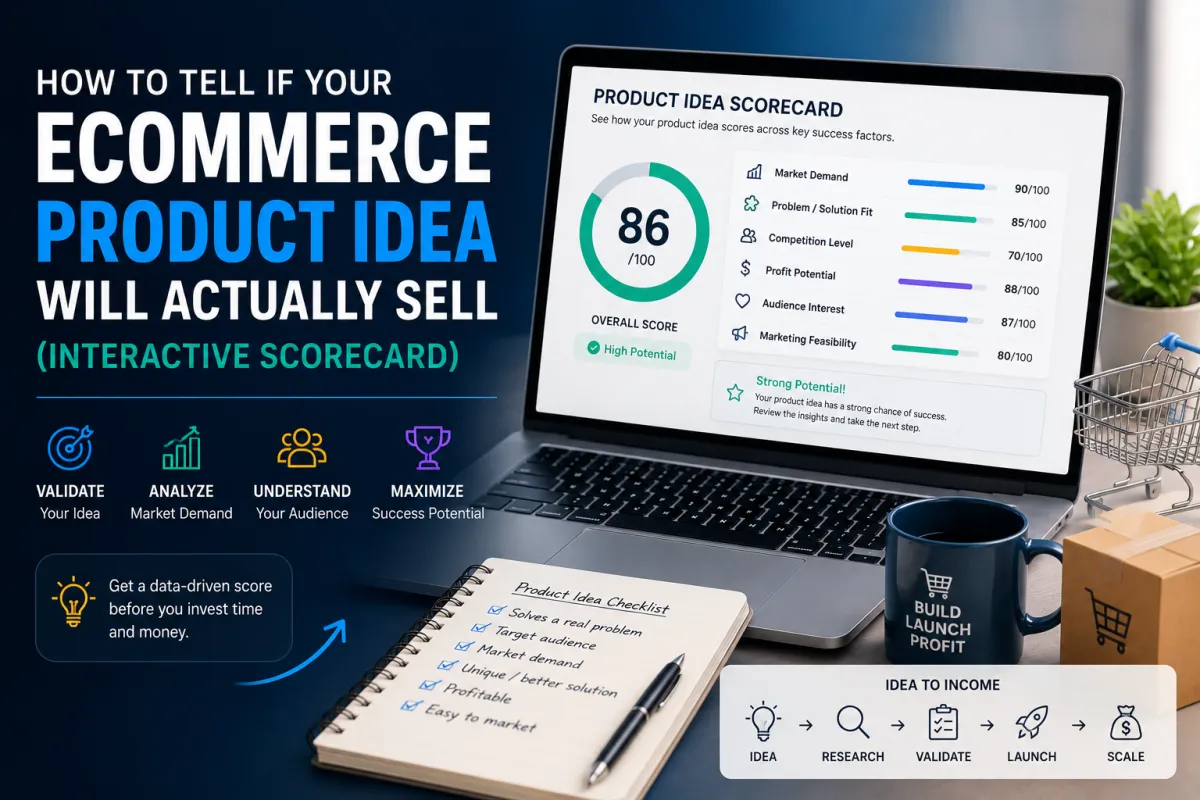
The interactive scorecard below evaluates any product idea against all eight criteria, weighted by how predictive each one is of long-term success. You'll get a viability score out of 100 and a clear verdict on whether to proceed, fix something first, or move on.
How to Read Your Score
75+ — strong candidate. Proceed to sample orders and supplier vetting.
55–74 — workable with caveats. Identify your weakest criteria and fix them before committing capital.
35–54 — risky. Multiple weak fundamentals will fight you from launch.
Below 35 — unviable as scored. Save your capital and go back to product research with stricter filters.
The score isn't a verdict — it's a diagnostic. A product that scores 60 might still be viable if you can lift the weak criteria. A product that scores 80 but has a fatal flaw (say, a one-time purchase with no repeat profile) might still be wrong for your goals. Use the score to know where to focus, not as a yes/no answer.
What Comes After Product Validation
Qualifying the product is the start, not the finish. Once you have an idea that scores well, you still need to source it, brand it, sell it, market it, and scale it — and every one of those phases has its own failure modes that sink otherwise promising products.
The framework I use with founders covers every step from idea validation through post-launch scaling. It's the same checklist I'd hand a friend launching their first store tomorrow.
The Complete Ecommerce Business Startup Checklist is a free, 14-section operational roadmap covering:
A complete launch framework from validation to post-launch scaling
Every legal, financial, and compliance task you need to handle before launch
Product page, checkout, and email flow setups used by high-converting stores
A pre-launch QA checklist to bulletproof your store before going live
A post-launch growth framework to turn first-time buyers into repeat customers
If your product scored 75+ on the scorecard above, this is your next step.
👉 [Download The Complete Ecommerce Business Startup Checklist — Free]
Score the product. Pass the test. Then launch it properly. That's the playbook.
