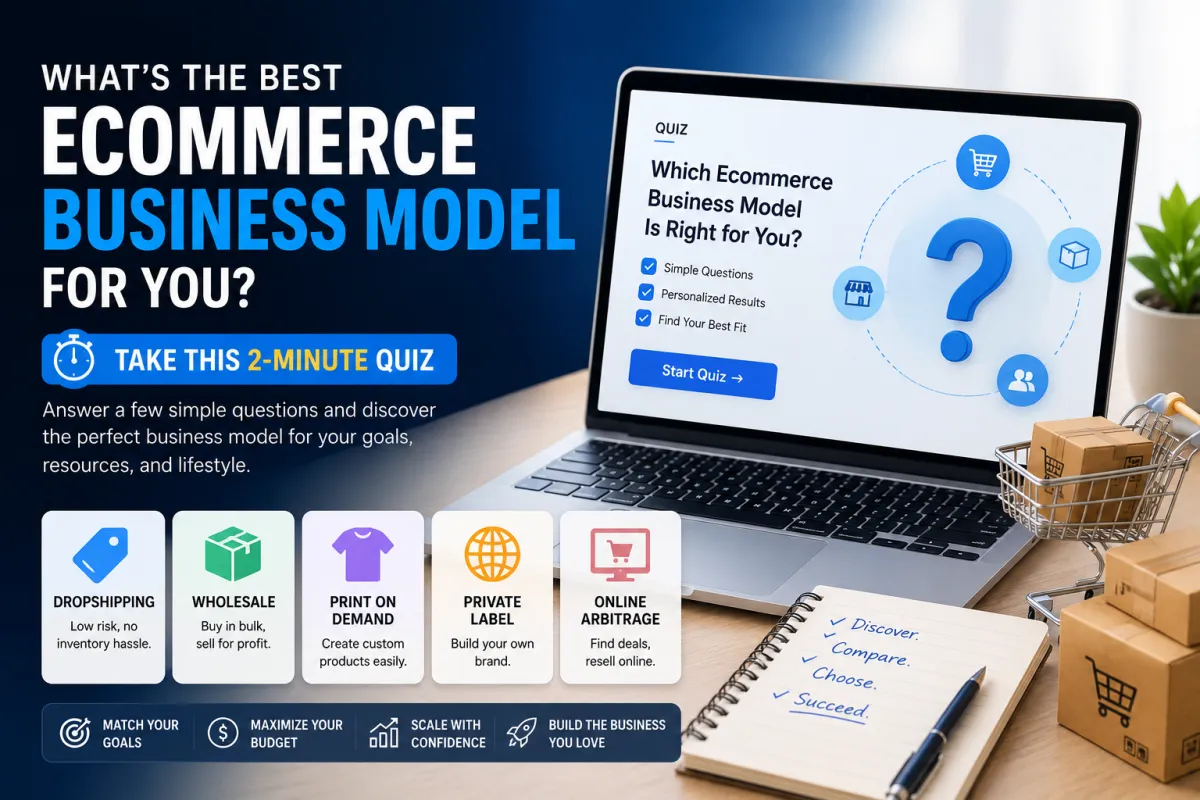
What's the Best Ecommerce Business Model for You? Take This 2-Minute Quiz
Every aspiring ecommerce founder eventually runs into the same paralysing question: which business model should I actually choose? Dropshipping promises low risk but slim margins. Private label promises a real brand but demands real capital. Print-on-demand looks creative-friendly but feels crowded. Wholesale sounds practical but requires operational muscle. Digital products sound effortless until you realise you need an audience first.
Spend an hour on YouTube and you'll find five gurus confidently recommending five different models — each one the answer, conveniently aligned with whatever course they happen to be selling.
The truth is messier and more useful: there is no universally "best" ecommerce model. There's only the model best suited to your capital, your time, your risk appetite, and your skills. A model that prints money for one founder is a slow-motion bankruptcy for another with different constraints.
This article walks you through the five major ecommerce models, the variables that actually determine which one will work for you, and an interactive quiz that gives you a personalised recommendation in under two minutes.
The Five Ecommerce Business Models, Honestly Compared
1. Dropshipping
You sell products from a supplier who ships directly to your customer. You never touch inventory.
Best for: founders with little capital (under £1,000), limited time, and a high tolerance for marketing experimentation.
Reality check: margins are typically 15–30%, which sounds fine until you realise ad costs alone can eat 20%+. Competition is brutal because the barrier to entry is near-zero. Building a real brand is genuinely difficult when your fulfilment partner is also fulfilling for 500 other stores selling the same product.
2. Print-on-Demand
You design products (t-shirts, mugs, posters, phone cases) that a partner prints and ships when an order comes in. Zero inventory risk.
Best for: creatives, designers, and founders with a sharp niche audience or strong content angle.
Reality check: per-unit margins are slim, so you live or die by your design and your audience targeting. "Cat lovers" won't work. "Rescue cat foster parents in the UK" might. Success here is almost entirely about niche specificity and design quality.
3. Private Label
You source unbranded products from a manufacturer (often via Alibaba or a sourcing agent), apply your own branding, and sell at premium margins.
Best for: founders with £3,000+ in capital, the patience to build a real brand, and the appetite for inventory cashflow risk.
Reality check: margins are excellent (60–80% is realistic), and this is the model behind most 7-figure DTC brands. But it's slow to launch, requires upfront investment, and your money is tied up in inventory long before you know whether the product sells.
4. Wholesale / Reselling
You buy proven products in bulk from established brands or suppliers and resell them at retail prices.
Best for: founders with capital, operational appetite, and a category where demand is already proven.
Reality check: less risk than private label because demand is validated, but lower margins and almost zero brand differentiation. You're competing on selection, price, and service — not on product uniqueness.
5. Digital Products
Courses, templates, presets, ebooks, design assets, software — anything that doesn't ship physically.
Best for: founders with genuine expertise, an existing audience (even a small one), and a willingness to build personal brand.
Reality check: 80–95% margins are genuinely possible, and there's no inventory, no fulfilment, no logistics. But you'll struggle to drive cold traffic — these businesses live and die on warm audiences. If you're starting from zero, you're really building two businesses at once: the product and the audience.
The Five Variables That Actually Determine Which Model Suits You
Most "which ecommerce model" articles compare features. That's the wrong lens. The right lens is: which model fits your constraints?
Capital. Under £1,000 rules out private label and wholesale almost entirely. £10,000+ opens up everything but makes dropshipping a strange choice given the opportunity cost.
Time. A genuine 5-hours-a-week side hustle is incompatible with the operational demands of wholesale or scaled private label. It's well-suited to digital products or dropshipping.
Risk tolerance. If the idea of £5,000 of unsold inventory in your spare room would keep you awake at night, you need a model with no inventory exposure.
Skill alignment. Do you enjoy marketing and growth experiments? Design and creativity? Operations and systems? Teaching and content? Different models reward different strengths — picking against your skills is the slowest possible path.
Brand ambition. Are you trying to build a brand you might one day sell, or generate income as efficiently as possible? Both are valid — but they point to completely different models.
Mapping yourself against all five variables in your head is hard. That's what the quiz is for.
Take the Quiz: Find Your Best-Fit Ecommerce Model
The quiz below scores you across six dimensions — capital, time, risk, work style, brand ambition, and expertise — and recommends the model most likely to suit your situation. It also gives you a runner-up, the strengths and watch-outs of your best-fit model, and a concrete first move.
It takes around two minutes. There are no wrong answers — only honest ones, which produce a more useful recommendation.
What to Do With Your Result
Whatever model the quiz recommends, treat it as a starting point — not a verdict. The recommendation gives you a model to commit to, which is far more valuable than the model itself. Founders who commit to any viable model and execute consistently outperform founders who spend six months oscillating between dropshipping and private label and never actually shipping.
That said, knowing your model is just the first decision. You still need to validate specific products, register your business, build a brand, set up legal and financial systems, build a converting website, configure email automations, plan your launch, and structure post-launch growth. Each of those phases has its own failure modes, and most new founders quietly skip half of them.
That's exactly why I built The Complete Ecommerce Business Startup Checklist — a 14-section operational roadmap covering every task you need to complete before, during, and after launch. It's the difference between launching with a plan and launching on vibes.
Inside the free checklist:
A complete 14-section operational framework from idea validation to post-launch scaling
Every legal, financial, and compliance task you need to handle before launch
Product page, checkout, and email flow setups used by high-converting stores
A pre-launch QA checklist to bulletproof your store before going live
A post-launch growth framework to turn first-time buyers into repeat customers
👉 [Download The Complete Ecommerce Business Startup Checklist — Free]
Take the quiz. Commit to a model. Then build it properly. That's the entire game.
