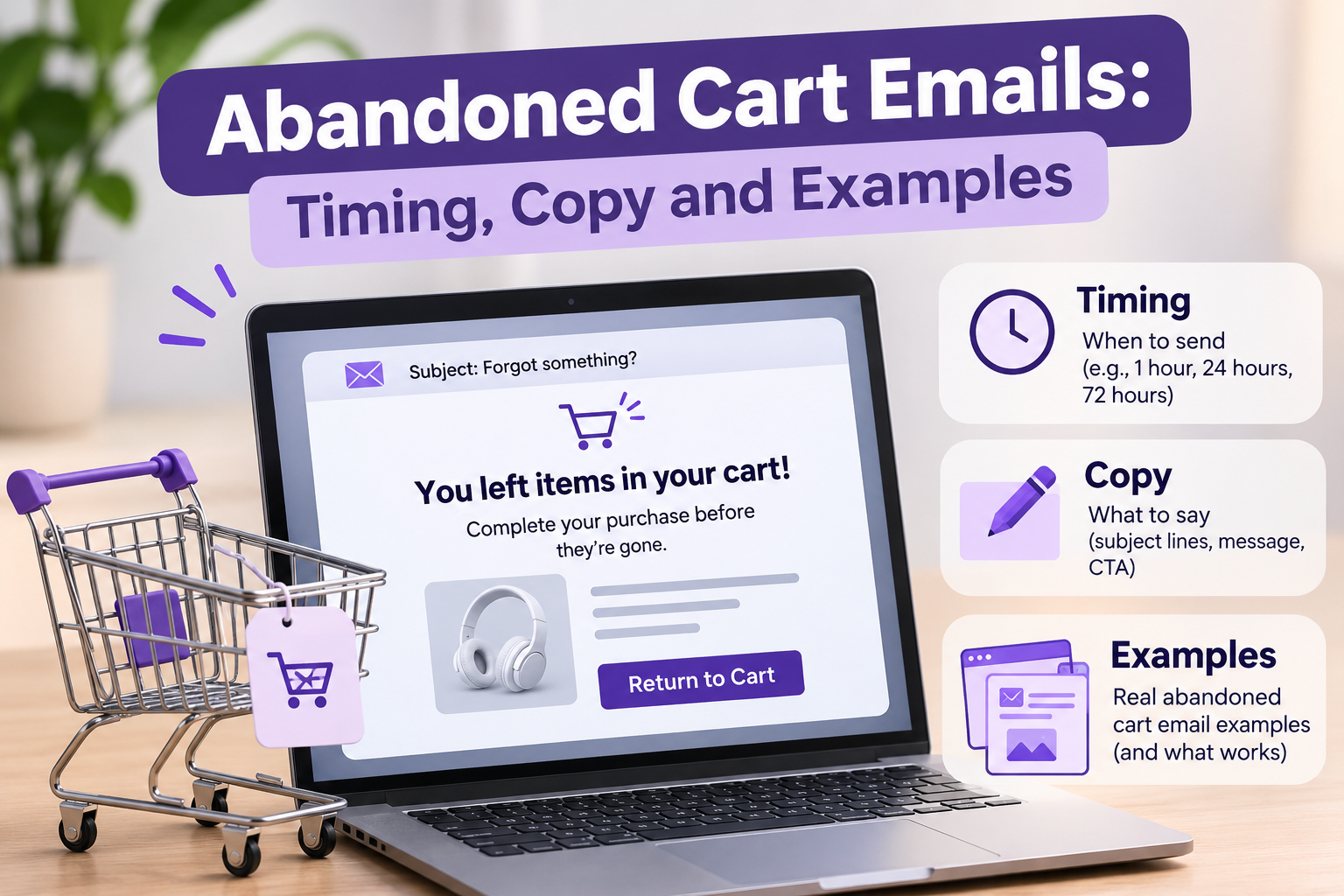
Abandoned Cart Emails: Timing, Copy and Examples
Someone visits your online store. They browse your products, find something they like, add it to their basket and head towards checkout.
Then they disappear.
No purchase. No explanation. Just another abandoned cart sitting in your ecommerce analytics.
Sound familiar?
Here's the thing: an abandoned cart doesn't always mean a lost customer. Sometimes shoppers get distracted. Sometimes delivery charges catch them off guard. And sometimes they simply need a little reassurance before committing.
That's where abandoned cart emails come in.
A well-timed, thoughtfully written email can bring hesitant shoppers back, answer their objections and turn an unfinished checkout into a completed order. But there's a considerable difference between sending a generic "You forgot something" message and building an abandoned cart email strategy that consistently recovers revenue.
This guide to Abandoned Cart Emails: Timing, Copy and Examples explains how to get the timing right, write messages people actually want to open and build automated recovery sequences that work without constantly relying on discounts.
Abandoned Cart Emails: The Essentials at a Glance
Want the important information without reading the entire guide? Here's what you need to know.
-
What they are: Abandoned cart emails are automated messages sent to shoppers who add products to their basket but leave without completing their purchase.
-
When to send them: Start by testing your first reminder between 30 minutes and two hours after abandonment. Follow up around 24 hours later, then consider a final email after 48–72 hours.
-
How many to send: A three-email abandoned cart sequence is a useful starting point, although your ideal frequency depends on customer behaviour, product price and purchase intent.
-
What to write: Keep the message personal, remind customers what they left behind, address likely objections and include one clear call to action.
-
Subject lines that work: Clear, relevant subject lines such as "Still thinking it over?" or "Your basket is waiting" give shoppers a reason to reopen the conversation.
-
Should you offer discounts? Not immediately. Start with a helpful reminder, introduce reassurance or social proof, and reserve incentives for situations where they're commercially justified.
-
What to measure: Track click-through rates, recovered orders, revenue per recipient, cart recovery rate and the profitability of your email campaigns.
-
What to automate: Use behavioural triggers, dynamic product information, customer segmentation and purchase-based exit conditions to make recovery emails timely and relevant.
-
What to avoid: Aggressive urgency, misleading scarcity claims, excessive follow-ups, unnecessary discounts and sending marketing emails without the appropriate permissions.
The biggest takeaway? Successful cart recovery emails don't simply remind customers that they haven't purchased. They make returning to checkout feel easy, worthwhile and reassuring.
Let's explore how.
What Is an Abandoned Cart Email?
An abandoned cart email is an automated message sent to a potential customer who adds one or more products to their online shopping basket but leaves before completing their order.
Imagine someone browsing an online homeware store.
They find a lamp they love, add it to their basket and begin comparing delivery options. Before checking out, their phone rings. They close the browser, deal with something else and forget about the lamp entirely.
An hour later, they receive an email:
Subject: Still thinking about that lamp?
Your perfect finishing touch is waiting.
We noticed you left something lovely in your basket. We've made it easy to pick up exactly where you left off.
[Return to My Basket]
That simple reminder creates another opportunity to complete the purchase.
Unlike traditional promotional campaigns, cart abandonment emails respond to a specific customer action. The shopper has already shown interest in a product, which makes the message more relevant than a general sales announcement.
This is what makes abandoned cart recovery such an important part of ecommerce email marketing.
How Do Abandoned Cart Emails Work?
Most abandoned cart email automation systems follow a straightforward process:
-
A shopper adds products to their basket. Your ecommerce platform records the products and associated shopping session.
-
The shopper leaves without purchasing. The system detects that checkout hasn't been completed after a defined period.
-
The platform checks whether the shopper can be contacted. An email address must be available, and the message must meet applicable marketing and privacy requirements.
-
An automated email is triggered. The customer receives a reminder featuring their abandoned products and a link back to checkout.
-
The customer returns or continues browsing. If they complete their purchase, the automation should stop sending further reminders.
-
Additional emails may follow. If the basket remains abandoned, subsequent messages can address objections, offer reassurance or introduce an appropriate incentive.
This process is commonly called an abandoned cart email flow, cart recovery workflow or triggered email sequence.
Platforms such as Shopify, WooCommerce and Klaviyo can support different elements of this process, although the available triggers and automation features vary.
The important distinction is that these emails are behaviour-driven.
You're not asking a random subscriber to consider buying something.
You're helping someone finish a purchase they already started.
Abandoned Cart Emails vs Abandoned Checkout Emails
Although the terms are frequently used interchangeably, there's a difference worth understanding.
| Abandoned cart emails | Abandoned checkout emails |
|---|---|
| Target shoppers who add products to their basket but don't purchase. | Target shoppers who begin checkout but don't finish. |
| May be triggered before the shopper reaches checkout. | Are triggered after checkout has started. |
| Often require an existing customer profile or captured email address. | May use contact details entered during checkout. |
| Can address product interest and buying hesitation. | Can focus on checkout friction, delivery costs and payment concerns. |
This distinction matters because not every abandoned basket contains an identifiable customer.
If someone adds a product to their basket and leaves without providing an email address or being recognised as an existing customer, you generally won't have the information needed to send them a recovery email.
That's why collecting customer information appropriately, improving the checkout experience and maintaining accurate customer records are essential parts of a broader abandoned cart email strategy.
It also explains why improving your ecommerce website design can be just as important as writing better recovery emails. A confusing checkout can create abandonment that email marketing alone cannot fix.
Why Do Shoppers Abandon Their Carts?
Before deciding when to send abandoned cart emails, you need to understand why customers leave in the first place.
Because here's an uncomfortable truth:
Not every abandoned cart is a problem that an email can solve.
Some people are browsing. Others are comparing prices. Some are researching a future purchase without any intention of buying today.
And then there are customers who genuinely want to purchase but encounter something that changes their minds.
Understanding these differences helps you write more persuasive abandoned cart email copy without making assumptions about every shopper.
1. Unexpected Shipping Costs
Picture this.
A customer finds a product advertised at £39.99. They're happy with the price, add it to their basket and proceed to checkout.
Then they discover an additional £7.95 delivery charge.
Suddenly, the purchase doesn't feel quite as attractive.
Unexpected shipping costs can create friction at the precise moment a customer is deciding whether to commit.
What your recovery email should do:
Be transparent about delivery charges and explain the value of the shipping service. If free delivery is available above a genuine spending threshold, communicate that clearly.
Don't automatically offer free shipping to everyone who abandons a basket. You could end up sacrificing margin on orders that would have converted anyway.
2. Customers Aren't Ready to Buy
Not every shopper arrives with their payment card ready.
Some are researching options. Others are waiting until payday, discussing a purchase with someone else or deciding whether a product suits their needs.
For these customers, aggressive discounting can be unnecessary.
A gentle abandoned cart reminder email may be enough.
Subject: Need a little more time?
No rush. Your selected items are easy to find whenever you're ready to take another look.
Have questions before ordering? We're here to help.
Notice what this message doesn't do.
It doesn't invent a deadline. It doesn't pretend stock is disappearing. And it doesn't pressure the shopper into making an immediate decision.
Instead, it keeps the conversation open.
3. A Complicated Checkout Process
Long forms, confusing navigation, unnecessary account creation and limited payment methods can all make purchasing harder than it needs to be.
Imagine asking a customer to create an account, verify their email address, complete multiple forms and navigate several checkout pages just to buy one product.
Every additional obstacle creates another opportunity for hesitation.
This is why checkout optimisation and abandoned cart recovery should work together.
Your emails can encourage customers to return, but they shouldn't repeatedly send people back into the same frustrating experience.
A strong cart recovery strategy therefore combines:
-
A clear, mobile-friendly checkout.
-
Transparent pricing and delivery information.
-
Convenient payment methods.
-
Guest checkout where appropriate.
-
Simple navigation between basket and payment.
-
Reassurance about security, returns and customer support.
If your store experiences significant abandonment, a free ecommerce marketing audit can be a useful starting point for identifying opportunities across the customer journey.
4. Concerns About Trust and Security
Customers may hesitate when they're unfamiliar with your brand.
They might wonder:
-
Is this store legitimate?
-
Will my order arrive when promised?
-
What happens if the product isn't suitable?
-
Can I return it easily?
-
Is my payment information secure?
These aren't necessarily objections to your product.
They're objections to the perceived risk of purchasing.
An effective abandoned cart email can address these concerns through genuine customer reviews, accurate delivery information, clear returns policies and accessible customer support.
This is where social proof and risk reversal become particularly useful.
A real testimonial from a satisfied customer may provide more reassurance than a discount code.
Likewise, clearly explaining an existing returns policy can remove uncertainty without reducing your selling price.
5. Price Comparison and Buying Hesitation
Online shoppers can compare alternatives in seconds.
Someone might add your product to their basket, open another browser tab and discover several competing options.
That doesn't necessarily mean you've lost the sale.
It means your value proposition needs to be convincing.
Instead of immediately lowering your price, remind customers why your product is worth choosing.
Depending on what you sell, that might include:
-
Distinctive product features.
-
Quality materials or craftsmanship.
-
Useful warranties or guarantees.
-
Reliable customer support.
-
Genuine customer feedback.
-
Product benefits that competing alternatives don't offer.
For a single-brand ecommerce store, this is especially important.
You're not simply competing on the number of products available. You're communicating why your particular products deserve a place in someone's life.
A useful rule: Match the recovery message to the likely objection. A customer worried about delivery needs different reassurance from someone who is uncertain about product quality.
When Should You Send Abandoned Cart Emails?
Timing can make or break an abandoned cart email campaign.
Send your reminder too quickly and the customer may still be shopping. Wait too long and their attention may have shifted elsewhere.
The goal isn't to email customers at the earliest possible opportunity.
It's to contact them when the reminder is likely to be helpful.
For many ecommerce stores, a practical starting point is a three-email abandoned cart sequence spread across approximately 72 hours.
However, there is no universally perfect abandoned cart email timing. Product price, customer behaviour, purchase complexity and brand positioning can all influence the most effective schedule.
Recommended Abandoned Cart Email Timing
| Suggested timing | Primary objective | |
|---|---|---|
| First email | 30 minutes–2 hours after abandonment | Helpful reminder and easy return to checkout |
| Second email | Around 24 hours later | Address objections and reinforce product value |
| Third email | 48–72 hours after abandonment | Final follow-up with reassurance or a justified incentive |
Treat this as a starting framework for testing, not a guaranteed formula.
A store selling inexpensive everyday accessories may benefit from a different approach than a business selling premium furniture or high-value electronics.
Let's break down what each message should accomplish.
First Abandoned Cart Email: 30 Minutes to 2 Hours
Objective: Remind, don't pressure.
Your first abandoned cart email should feel like a helpful nudge.
At this stage, the customer may simply have become distracted. They might have closed their browser accidentally, switched devices or been interrupted halfway through checkout.
You don't need an elaborate sales pitch.
You need to make returning easy.
What to Include in the First Email
Keep the structure simple:
-
A friendly, recognisable subject line.
-
A brief reminder about the abandoned basket.
-
The product name and image, where available.
-
A clear button returning the customer to their basket.
-
A short offer of assistance if they have questions.
Avoid overwhelming the reader with unrelated products, multiple promotions or competing calls to action.
The first email should have one job: help the customer resume their purchase.
First Abandoned Cart Email Example
Subject line: Did something get in the way?
Preheader: Your basket is ready whenever you are.
Looks like you got interrupted.
You were just a step away from completing your order.
We've made it easy to pick up where you left off. Take another look at your selected items and finish checking out whenever you're ready.
[Return to My Basket]
Need help deciding? Reply to this email and we'll be happy to answer your questions.
This example works because it acknowledges the unfinished purchase without making the customer feel guilty.
It also avoids offering an immediate discount.
That's important.
If customers learn that abandoning their basket automatically triggers a discount, you risk training them to delay purchases unnecessarily.
Should You Send an Abandoned Cart Email After 30 Minutes or One Hour?
Both timings are worth testing.
A 30-minute abandoned cart email may work well when customers typically make quick purchasing decisions and the shopping session has clearly ended.
A one-hour abandoned cart email gives shoppers slightly more breathing room and may reduce the likelihood of contacting someone who is still actively considering their order.
For more expensive or considered purchases, waiting closer to two hours may be appropriate.
Rather than choosing a timing based on guesswork, use an A/B test.
Split eligible abandoned carts into comparable groups, send the same email after different delays and measure the resulting performance.
Focus on recovered orders and incremental revenue, not simply open rates.
After all, an email that gets opened frequently but doesn't generate additional profitable sales isn't necessarily the better option.
Second Abandoned Cart Email: Around 24 Hours Later
Objective: Build confidence, overcome objections and remind customers why they wanted the product.
Your first email has gone out. The customer has had time to reconsider their purchase, but the order still hasn't been completed.
Now what?
Sending the same reminder again isn't particularly persuasive. If "You left something in your basket" didn't work yesterday, repeating it today probably won't change much.
Your second abandoned cart email needs to offer something new.
This is where you shift from reminding customers what they left behind to explaining why it's worth coming back for.
Perhaps they're unsure about the product's quality. Maybe they're comparing alternatives. Or they might have questions about delivery, returns or whether the product is right for them.
A well-written abandoned cart follow-up email can help resolve those concerns without sounding desperate for a sale.
What Should Your Second Abandoned Cart Email Include?
Focus on building trust and reinforcing value.
Depending on your products, consider including:
-
Customer reviews: Genuine feedback from people who've already purchased the product.
-
Product benefits: A reminder of the features that make the item useful, desirable or distinctive.
-
Delivery reassurance: Clear information about shipping times, charges and available options.
-
Returns information: An explanation of your actual returns policy.
-
Product imagery: A compelling photograph showing the product in use.
-
Customer support: An invitation to ask questions before purchasing.
-
One clear CTA: A direct link back to the customer's saved basket.
The trick is choosing the information most likely to matter.
If you sell premium skincare, customer reviews and product benefits might be particularly persuasive.
If you sell home furniture, dimensions, delivery information and returns policies could be more important.
And if you're selling specialist equipment, answering technical questions may be more valuable than offering a discount.
Your second email should make the buying decision easier, not simply louder.
Second Abandoned Cart Email Example: Social Proof and Reassurance
Subject line: Still deciding? Here's something that might help
Preheader: A little more information before you make your choice.
Good choices deserve a little thought.
We noticed you haven't completed your order, and that's absolutely fine.
Choosing the right product matters. That's why we wanted to share a little more about what makes your selection special.
Why customers choose us:
Thoughtfully designed products made with quality in mind.
Clear product information to help you buy confidently.
Friendly support if you have questions.
[Take Another Look]
Still unsure? Just reply to this email. We're happy to help.
This abandoned cart email copy uses reassurance rather than pressure.
If you have genuine product-specific testimonials, they can strengthen the message further.
For example:
"Exactly what I was looking for. The quality was even better than I expected."
— Verified customer review
Only include testimonials that come from real customers. Invented reviews undermine the very trust you're trying to establish.
Should the Second Email Include a Discount?
Not necessarily.
Discounts can be effective, but they're not the only way to recover abandoned carts.
Before offering money off, consider whether the customer actually needs a financial incentive.
A shopper who abandoned their basket because they were interrupted might purchase at full price after receiving a reminder.
Someone concerned about delivery might respond better to a clear shipping explanation.
Another customer may simply need reassurance about the product's suitability.
Offering discounts too early can reduce profitability and create an expectation that abandoning checkout leads to cheaper prices.
Instead, test different approaches.
| Second email approach | Best suited to |
|---|---|
| Customer reviews | Shoppers uncertain about product quality |
| Product benefits | Customers comparing alternatives |
| Delivery information | Shoppers concerned about shipping |
| Returns reassurance | Customers worried about purchase risk |
| Product demonstrations | Shoppers needing more information |
| Customer support | Customers with unanswered questions |
The best abandoned cart email strategy recognises that different customers abandon their baskets for different reasons.
Third Abandoned Cart Email: 48–72 Hours After Abandonment
Objective: Create a compelling final opportunity to return without damaging customer trust.
By the time your third abandoned cart email is due, the customer has already received two opportunities to complete their order.
They know the product is waiting.
They've been reminded why they considered buying it.
And they've had time to think.
Your final message should therefore introduce a fresh reason to act, where one genuinely exists.
For some brands, that might mean a limited-time discount. For others, free delivery, additional product reassurance or a simple final reminder may be more appropriate.
The important thing is to avoid manufacturing urgency.
There's a big difference between saying "Your genuine 10% offer ends tonight" and falsely claiming that a product is about to sell out.
One gives customers useful information.
The other risks damaging their confidence in your brand.
How to Write an Effective Final Cart Recovery Email
A strong final email usually includes four elements:
-
A clear subject line that communicates the purpose of the message.
-
A concise reminder of the products left behind.
-
A meaningful reason to return, such as a genuine offer or helpful reassurance.
-
A prominent call to action that makes checkout easy.
At this stage, simplicity matters.
Avoid lengthy paragraphs, unnecessary product recommendations and several competing buttons.
Your customer should immediately understand what you're offering and what they need to do next.
Third Abandoned Cart Email Example: A Genuine Limited-Time Offer
Subject line: A little something to help you decide
Preheader: Enjoy 10% off your basket for a limited time.
Still thinking it over?
We noticed your order hasn't quite made it across the finish line.
If you've been waiting for the right moment, here's a little encouragement.
Enjoy 10% off your order with code WELCOME10.
Your offer is available until midnight tomorrow.
[Complete My Order]
We'd love to help you find exactly what you're looking for.
Questions? Simply reply to this email.
This is an illustrative abandoned cart email template. The discount code, offer and deadline are examples only and should be replaced with a genuine promotion and its actual terms.
Why might this email work?
It introduces a new incentive without overwhelming the customer. The message remains friendly, the discount is easy to understand and the CTA points directly towards completing the purchase.
However, that doesn't mean every third email should include a discount.
Alternatives to Discount-Based Cart Recovery Emails
For single-brand ecommerce stores, maintaining healthy margins is essential.
Repeatedly offering discounts can make customers question your normal pricing and reduce the perceived value of your products.
Fortunately, there are other ways to encourage purchases.
Free shipping
If delivery charges are a common obstacle, a genuine free-shipping promotion may be more appealing than a percentage discount.
Product reassurance
A final reminder highlighting warranties, product quality or customer support can help hesitant shoppers make a confident decision.
Helpful product information
A sizing guide, compatibility explanation or short product demonstration can remove uncertainty.
Genuine stock availability
If inventory is genuinely limited, you can communicate that information accurately. Don't imply that stock is running out unless your inventory data supports the claim.
A simple final reminder
Sometimes the most effective approach is also the least complicated:
Subject: One last reminder about your basket
Still interested?
Your selected products are easy to find if you'd like to take another look.
[Return to My Basket]
No pressure. No artificial deadline. Just a useful reminder.
How Many Abandoned Cart Emails Should You Send?
Three emails provide a sensible starting point for many stores, but they're not a universal requirement.
A shorter sequence may suit inexpensive products, customers who purchase quickly or brands that prefer less frequent communication.
Longer consideration periods may justify a different approach for expensive products, although additional messages should provide genuinely useful information.
Your abandoned cart email frequency should reflect:
-
The average time customers take to purchase.
-
Product price and purchase complexity.
-
Previous customer engagement.
-
Existing promotional email frequency.
-
Customer preferences and marketing permissions.
-
The incremental revenue generated by each message.
Most importantly, stop the abandoned cart email sequence when the customer completes their purchase.
Nobody wants to receive a "You forgot something" email after they've already paid.
How to Write Abandoned Cart Email Copy That Converts
Timing gets your message in front of the customer.
Copywriting gives them a reason to act.
And while abandoned cart email automation can handle the technical side of sending reminders, it can't rescue a message that feels generic, confusing or irrelevant.
Think about the emails sitting in your own inbox.
Which ones do you open?
Which ones do you ignore?
And which ones make you immediately reach for the unsubscribe button?
The difference often comes down to relevance.
Good abandoned cart email copy doesn't feel like a sales script. It feels like a helpful continuation of the customer's shopping experience.
1. Start With the Customer, Not Your Business
One of the most common abandoned cart email mistakes is making the entire message about the retailer.
"We noticed you haven't purchased."
"We want you to complete your order."
"Don't forget to buy from us."
Technically, these statements communicate the purpose of the email.
But they don't give the customer much reason to care.
Instead, shift the focus towards what the shopper wants.
Weak copy:
You have abandoned your shopping cart. Please return to our website to complete your transaction.
Better copy:
Your favourites are still waiting. Pick up where you left off whenever you're ready.
The second version is more natural, less demanding and easier to engage with.
It also avoids making the customer feel they've done something wrong.
Remember, customers don't owe you a purchase simply because they added something to their basket.
Your job is to make completing that purchase worthwhile.
2. Remind Customers What They Wanted
One of the biggest advantages of abandoned cart email personalisation is the ability to show shoppers the products they were considering.
Instead of sending a generic reminder, include relevant information such as:
-
Product name.
-
Product image.
-
Selected size, colour or variation.
-
Quantity.
-
Current product price.
-
A link back to the saved basket.
Dynamic product content makes cart recovery emails immediately recognisable.
Imagine receiving an email that simply says:
You left something behind.
Now compare that with:
Still thinking about the navy linen shirt?
Your selected size is waiting in your basket. Take another look whenever you're ready.
The second message feels more relevant because it connects directly with the customer's original interest.
However, only include information your ecommerce platform can accurately retrieve.
Don't claim a product is reserved, in stock or available at a particular price unless that information is correct.
3. Write Like a Person, Not an Automation
Automated emails don't have to sound automated.
In fact, some of the most effective abandoned cart email examples use straightforward, conversational language.
Avoid unnecessarily formal phrases such as:
"Dear valued customer, we are contacting you regarding your incomplete ecommerce transaction."
Nobody talks like that.
Try:
Still have questions?
We noticed you were having a look at something earlier.
If there's anything we can help with before you order, just reply. We're happy to help.
Simple.
Friendly.
Human.
Of course, your tone should reflect your brand.
A luxury jewellery business may use more refined language than a playful accessories store. A specialist equipment retailer may need to be more technical.
But whatever your positioning, clarity should come first.
4. Focus on Benefits, Not Just Features
Customers don't buy products solely because of their specifications.
They buy because those products solve problems, improve experiences or help them achieve something they value.
Consider a premium insulated water bottle.
Feature-focused copy:
Double-wall stainless steel construction with vacuum insulation.
Benefit-focused copy:
Keep your drink refreshingly cold throughout a busy day, without constantly reaching for ice.
Both statements can be useful.
But the second connects the product feature to a practical customer benefit.
This principle applies across almost every ecommerce category.
| Product feature | Customer-focused benefit |
|---|---|
| Waterproof materials | Stay protected when the weather changes |
| Adjustable straps | Find a comfortable fit for everyday use |
| Rechargeable battery | Enjoy convenient use without constantly replacing batteries |
| Machine-washable fabric | Spend less time worrying about cleaning |
| Compact design | Save space at home or while travelling |
When writing abandoned cart emails, choose the benefit most likely to remind customers why they wanted the product in the first place.
5. Address Objections Before They Become Deal-Breakers
A customer may like your product but still feel uncertain about purchasing.
Perhaps they're worried about sizing.
Maybe they don't understand how something works.
Or they simply want reassurance that they'll receive good customer service if something goes wrong.
These objections create an opportunity for helpful copywriting.
For example:
Not sure which size is right?
Our sizing guide can help you find a comfortable fit before you order.
Or:
Wondering about delivery?
You can review available delivery options and charges before completing checkout.
Or:
Need a hand choosing?
Reply to this email with your questions and we'll help you find the information you need.
The goal is to remove uncertainty rather than create pressure.
This is particularly important for brands selling their own products, where explaining quality, design and practical benefits can help differentiate the business from competing alternatives.
6. Use One Clear Call to Action
Your abandoned cart email CTA should make the next step obvious.
Don't force customers to decide between five different buttons.
They've already shown interest in a product.
Make it easy to return.
Effective CTA examples include:
-
Return to My Basket
-
Complete My Order
-
Continue Shopping
-
Take Another Look
-
View My Selected Items
-
Finish Checking Out
The best choice depends on the email's purpose.
"Complete My Order" is direct and purchase-focused.
"Take Another Look" feels softer and may suit customers who need more time.
"Return to My Basket" is clear, familiar and works well for straightforward reminders.
Whichever you choose, ensure the button leads to the correct destination.
Sending someone to your homepage instead of their saved basket introduces unnecessary friction.
Best Abandoned Cart Email Subject Lines
Your email could contain beautifully written copy, compelling product photography and an irresistible offer.
But none of that matters if the customer never opens it.
That's why abandoned cart email subject lines deserve serious attention.
A good subject line should be clear, relevant and interesting enough to stand out in a crowded inbox.
It doesn't need to be clever for the sake of being clever.
And it certainly doesn't need to shout.
The strongest approach is often to make the message feel useful rather than promotional.
25 Abandoned Cart Email Subject Line Examples
Here are 25 ideas organised by the type of message you're sending.
Friendly Reminder Subject Lines
-
Did you forget something?
-
Your basket is waiting
-
Still thinking it over?
-
Pick up where you left off
-
Something caught your eye?
Personalised Subject Lines
-
Still interested in your [Product Name]?
-
[First Name], your basket is ready
-
Your [Product Name] is just a click away
-
Ready for another look, [First Name]?
-
Your favourites are waiting for you
Curiosity-Based Subject Lines
-
Something worth another look
-
A little reminder from us
-
Before you make your decision...
-
Need a little help choosing?
-
We thought you might like this
Reassurance-Focused Subject Lines
-
Questions before you order?
-
Let's make your decision easier
-
Here's what customers love about it
-
Still deciding? We're here to help
-
Everything you need to know before ordering
Discount and Incentive Subject Lines
-
A little something towards your order
-
Enjoy 10% off your basket
-
Your special offer is ready
-
Free delivery on your order
-
Your offer ends tomorrow
Only use discount, free-delivery or deadline-based subject lines when the advertised incentive is genuinely available and its terms are accurate.
What Makes an Abandoned Cart Subject Line Effective?
There isn't one magic formula.
However, strong subject lines generally share several characteristics.
They're easy to understand.
Customers should know why they're receiving the email.
They're relevant.
Referencing the abandoned product or shopping experience can make the message more meaningful.
They're concise.
Shorter subject lines are often easier to scan, particularly on mobile devices.
They're consistent with the email.
Don't promise a discount in the subject line if the message doesn't contain one.
They reflect your brand's personality.
A playful brand might use humour. A premium brand may prefer understated, elegant language.
Most importantly, test your assumptions.
The subject line you personally prefer won't necessarily be the one that produces the most profitable recovered orders.
Don't Forget Your Abandoned Cart Email Preheader
The preheader is the short preview text that many email clients display alongside or beneath the subject line.
It's a valuable opportunity to reinforce your message.
Consider these abandoned cart email preheader examples:
| Subject line | Preheader |
|---|---|
| Your basket is waiting | Pick up where you left off in just a few clicks. |
| Still thinking it over? | Here's another look at the products you selected. |
| Questions before you order? | We're happy to help you make the right choice. |
| Your favourites are waiting | Take another look whenever you're ready. |
| A little something towards your order | Your exclusive offer is available for a limited time. |
The subject line creates interest.
The preheader provides context.
Together, they should give the customer a clear and honest reason to open the message.
Abandoned Cart Email Templates and Examples You Can Adapt
Understanding copywriting principles is useful.
Seeing them in action is even better.
The following abandoned cart email templates demonstrate different approaches for different customer situations.
Each example is designed to be adapted to your brand, products and customer journey.
Example 1: The Simple Abandoned Cart Reminder
Best for: First-time reminders and low-friction purchases.
Subject: Your basket is ready when you are
Preheader: Everything you selected is easy to find.
Forgot something?
Life gets busy. We get it.
You were having a look at some of our products earlier, and we wanted to make it easy to pick up where you left off.
Your selected items are just a click away.
[Return to My Basket]
Need help? Reply to this email and we'll be happy to answer your questions.
Why it works: The copy is short, friendly and focused on convenience. It doesn't assume why the customer abandoned their basket or pressure them into purchasing.
Example 2: The Product Benefits Email
Best for: Customers considering a product that requires more thought.
Subject: Here's why your choice is worth another look
Preheader: A closer look at the details that make a difference.
The little details matter.
You recently added [Product Name] to your basket.
Before you make your decision, we thought we'd highlight a few things that make it special.
Designed for everyday convenience
[Explain a genuine product benefit.]
Made with quality in mind
[Highlight a verified material, feature or manufacturing detail.]
Created to make life easier
[Explain the practical problem your product solves.]
Ready to take another look?
[View My Basket]
Why it works: Rather than simply repeating the reminder, the email helps customers understand the product's value.
This approach is particularly useful when shoppers are comparing alternatives or questioning whether the purchase is worthwhile.
Example 3: The Customer Reassurance Email
Best for: Customers who may be concerned about delivery, returns or product suitability.
Subject: A few answers before you decide
Preheader: Everything you need to shop with confidence.
Still have a question or two?
Choosing the right product matters, and we want you to feel confident about your order.
Here's some information that might help:
Delivery: [Insert accurate delivery information.]
Returns: [Summarise your actual returns policy.]
Customer support: [Explain how customers can contact your team.]
Your selected products are still easy to find.
[Continue to My Basket]
If there's anything else you'd like to know, simply reply.
Why it works: The message tackles common purchase objections without relying on price reductions.
Example 4: The Genuine Incentive Email
Best for: Eligible customers who haven't responded to earlier reminders.
Subject: Enjoy a little extra towards your order
Preheader: A special offer to make your decision easier.
A little thank you from us.
We noticed you haven't completed your order, so we'd like to offer you something extra.
Enjoy 10% off your selected items with code THANKYOU10.
Enter your code at checkout before [Genuine Expiry Date].
[Complete My Order]
We'd love to welcome you as a customer.
Why it works: The incentive is simple, clearly communicated and connected to the customer's existing purchase interest.
The offer, code and deadline are illustrative. Use only genuine promotions with clear eligibility conditions.
Example 5: The Personal Customer Support Email
Best for: Premium products, specialist purchases and customers who may need additional guidance.
Subject: Can we help with anything?
Preheader: A quick note in case you have questions.
Hi [First Name],
I noticed you were looking at [Product Name] earlier.
I just wanted to check whether there's anything we can help you with before you make your decision.
If you'd like more information about the product, delivery or anything else, feel free to reply directly.
We're always happy to help.
[Take Another Look]
Best wishes,
[Team Member Name]
[Brand Name]
Why it works: The message feels personal and helpful, particularly when a customer might benefit from speaking to a real person.
If the email is presented as coming from an individual, make sure the sender identity and reply process are genuine.
What the Best Abandoned Cart Email Examples Have in Common
Despite their different styles, effective cart recovery emails tend to follow a few consistent principles.
They remind customers about something they've already expressed interest in.
They make returning to checkout simple.
They provide useful information rather than unnecessary noise.
And they respect the customer's ability to make their own purchasing decision.
For a single-brand ecommerce business, the most persuasive emails often reinforce what makes the brand and its products distinctive.
You don't need to compete solely on price.
You need to communicate value.
That might mean highlighting craftsmanship, explaining product benefits, sharing genuine reviews or helping customers feel confident about ordering.
Ultimately, the best abandoned cart email isn't necessarily the one with the biggest discount or cleverest subject line. It's the one that removes the right obstacle at the right moment.
And once you've developed compelling messages, the next challenge is ensuring they reach the right customers automatically, perform consistently and generate measurable, profitable revenue.
Discounts, Free Shipping and Urgency: What Actually Works?
There's a temptation in abandoned cart recovery that's difficult to resist.
A customer leaves without purchasing. You send a reminder. Nothing happens.
So you offer 10% off.
Still nothing?
Perhaps 15% will do the trick.
Before long, your abandoned cart email strategy has become a discounting strategy. You're recovering orders, but potentially giving away profit you didn't need to sacrifice.
The goal isn't simply to recover abandoned carts. It's to recover profitable sales.
A well-designed cart recovery workflow should consider why customers abandon their purchases, how much each order is worth and whether an incentive genuinely changes purchasing behaviour.
When Should You Offer an Abandoned Cart Discount?
Discounts are most useful when price is a genuine barrier to purchase.
For example, a shopper considering a £120 product might respond positively to a modest incentive if they're comparing similar alternatives.
But someone who abandoned checkout because they were interrupted might return without any financial encouragement.
Offering both customers the same discount could be unnecessarily expensive.
A better approach is to introduce incentives selectively.
Consider factors such as:
-
Basket value: Higher-value orders may justify different incentives, depending on product margins.
-
Customer history: First-time shoppers and returning customers may respond differently.
-
Product profitability: Some products have enough margin to support discounts; others don't.
-
Previous engagement: Customers who ignored earlier reminders may need a different message.
-
Purchase intent: Someone who reached the payment stage may require less encouragement than an early-stage browser.
-
Promotional history: Frequent discount recipients may begin expecting reduced prices.
This is where abandoned cart email segmentation becomes valuable.
Instead of treating every abandoned basket identically, you can develop different recovery approaches for different customer groups.
Free Shipping vs Percentage Discounts
Which is better: free delivery or money off?
The answer depends on your products, shipping costs and customers.
Consider a £60 order.
A 10% discount reduces the selling price by £6.
Free shipping might cost your business £3.95, £5.95 or considerably more, depending on the product and delivery method.
The most appealing incentive isn't always the cheapest one to provide.
| Incentive | Potential advantage | Potential drawback |
|---|---|---|
| 10% discount | Easy to understand and communicate | Reduces product revenue |
| Fixed £5 discount | Clear monetary saving | May be disproportionate on smaller orders |
| Free shipping | Addresses delivery-related objections | Can be expensive for heavy products |
| Free gift | Can increase perceived value | Adds fulfilment and inventory costs |
| Genuine limited-time offer | Encourages timely decisions | Can create pressure or discount expectations |
| No incentive | Protects margins and brand positioning | May not overcome price objections |
For a single-brand store, a free gift or relevant product benefit may sometimes be more consistent with your positioning than a price reduction.
The key is to measure profitability, not simply the number of recovered orders.
How to Use Urgency Without Manipulating Customers
Urgency can encourage action when there's a legitimate reason to act quickly.
Examples include:
-
A genuine promotional offer approaching its expiry date.
-
A product with verified low inventory.
-
A published seasonal ordering deadline.
-
A time-sensitive delivery cut-off.
What doesn't work for long-term trust?
Invented countdown timers.
False claims that products are selling out.
Repeated "last chance" emails for offers that never actually expire.
Customers notice these tactics, particularly when they encounter them repeatedly.
Use urgency to communicate real constraints, not to manufacture anxiety.
How to Set Up an Automated Abandoned Cart Email Flow
Writing persuasive emails is only half the job.
The other half is ensuring those messages reach the right customers at the right time, with accurate product information and without unnecessary repetition.
That's where abandoned cart email automation becomes essential.
Rather than manually contacting every customer who leaves without purchasing, an automated workflow responds to qualifying shopping behaviour.
Once configured correctly, the system can operate continuously while you monitor results and improve performance.
Step 1: Choose Your Ecommerce Email Marketing Platform
Several platforms offer abandoned cart or checkout recovery functionality.
Popular options include:
-
Shopify: Provides abandoned checkout recovery capabilities, with additional automation options depending on the store's setup.
-
Klaviyo: Supports behavioural email flows, customer segmentation and dynamic product content.
-
Mailchimp: Offers ecommerce automation features for supported store integrations and plans.
-
Omnisend: Provides ecommerce-focused email and SMS automation.
-
WooCommerce: Can support cart recovery through compatible plugins and email marketing integrations.
The right platform depends on your ecommerce system, available customer data, budget and required automation features.
Don't select a tool purely because it offers an attractive email template.
Consider how reliably it identifies abandoned checkouts, tracks purchases and prevents irrelevant messages.
Step 2: Define the Abandoned Cart Trigger
Your automation needs a clear starting point.
Depending on the platform, a trigger might occur when:
-
A known customer adds products to their basket.
-
A shopper begins checkout and provides an email address.
-
A shopping session becomes inactive for a defined period.
-
No completed order is recorded within the qualifying window.
Not every platform can identify anonymous basket abandonment.
Some systems primarily support abandoned checkout emails because customer contact information becomes available during checkout.
Make sure you understand precisely what your chosen platform tracks.
A checkout abandonment trigger isn't necessarily the same as an add-to-cart trigger.
Step 3: Build Your Three-Email Sequence
A straightforward abandoned cart drip campaign might look like this:
| Stage | Timing | Message |
|---|---|---|
| Trigger | Customer abandons an eligible basket | Begin recovery workflow |
| Email 1 | After 1 hour | Friendly reminder and saved basket link |
| Email 2 | Approximately 24 hours after abandonment | Product benefits, reviews and reassurance |
| Email 3 | Approximately 72 hours after abandonment | Final reminder or eligible incentive |
| Exit | Customer purchases, withdraws consent or becomes ineligible | Stop the workflow |
These delays are examples, not universal rules.
You may find that a two-email sequence performs better for your customers, or that a longer interval suits higher-value purchases.
The important thing is to start with a manageable framework and improve it using actual performance data.
Step 4: Personalise the Email Content
Personalisation goes beyond inserting someone's first name.
Useful abandoned cart email personalisation can include:
-
Product names and images.
-
Selected sizes, colours and variations.
-
Accurate basket totals.
-
Relevant product benefits.
-
Customer purchase history.
-
First-time versus returning customer messaging.
-
Genuine offers based on eligibility.
-
Links that restore the correct shopping basket.
Dynamic product images are particularly useful because they instantly remind customers what they were considering.
However, always test how personalised content appears when data is missing.
An email beginning "Hi [FIRST_NAME]" isn't a great first impression.
Neither is a product recommendation showing an item that's no longer available.
Use sensible fallback text and verify that product information is current.
Step 5: Set Up Conditional Logic and Exit Conditions
One of the most important abandoned cart email best practices is preventing customers from receiving messages they no longer need.
Your workflow should check eligibility before each send.
For example:
If the customer has purchased:
Stop the abandoned cart sequence.
If the customer has unsubscribed or withdrawn relevant marketing consent:
Do not send further marketing emails.
If the customer has entered another qualifying cart recovery flow:
Apply your chosen suppression or workflow priority rules to prevent overlapping messages.
If the product is unavailable:
Avoid sending misleading reminders that imply it can still be purchased.
If a discount isn't applicable:
Don't display an incentive the customer cannot redeem.
These rules help prevent frustration, protect customer trust and improve the overall shopping experience.
Step 6: Test the Entire Cart Recovery Workflow
Before activating your automated sequence, complete a test purchase journey.
Check that:
-
The correct abandonment event triggers the flow.
-
Emails arrive after the intended delays.
-
Product names, images and prices display correctly.
-
Buttons return customers to the appropriate basket or checkout.
-
Discount codes work for eligible orders.
-
Emails display properly on mobile devices.
-
Unsubscribe links function.
-
Purchases stop further reminders.
-
Customers aren't accidentally entered into duplicate sequences.
A technically functioning email isn't necessarily a correctly functioning automation.
Test the full customer journey, including what happens after a purchase.
Customer Segmentation: Make Abandoned Cart Emails More Relevant
Not all abandoned shoppers behave alike.
A returning customer buying a familiar product has different needs from someone discovering your brand for the first time.
Likewise, someone considering a £15 accessory may make decisions differently from someone purchasing a £500 item.
Customer segmentation allows you to adjust your messaging accordingly.
First-Time Customers
New customers may need additional reassurance.
They don't yet have personal experience with your products or service.
Useful messages might include:
-
Genuine customer reviews.
-
Product quality information.
-
Delivery and returns details.
-
Customer support options.
-
An explanation of what makes your brand distinctive.
Returning Customers
Existing customers may already trust your business.
Their abandoned cart emails can therefore be shorter and more direct.
For example:
Welcome back.
Your selected items are ready whenever you are.
[Continue Shopping]
There's often little need to repeat an extensive introduction to your brand.
High-Value Baskets
High-value orders may justify more detailed product information or customer support.
Rather than immediately offering a large discount, consider whether customers need reassurance about specifications, warranties, delivery or suitability.
Low-Value Baskets
For inexpensive products, simplicity may work best.
A brief reminder with clear product information and a direct CTA can be more appropriate than a lengthy email sequence.
Customers Who Engage but Don't Purchase
A shopper who opens an email and clicks back to checkout but still doesn't buy may be experiencing friction.
That could be a reason to review the checkout experience rather than simply send more promotional messages.
Segmentation should make your communication more useful, not unnecessarily complicated.
Start with a few meaningful customer groups, then expand your approach as you collect reliable performance data.
Are Abandoned Cart Emails GDPR Compliant in the UK?
For UK ecommerce businesses, abandoned cart email consent and privacy requirements deserve particular attention.
An abandoned basket doesn't automatically give a retailer permission to send marketing emails.
Two areas of UK law are especially relevant:
-
UK GDPR: Governs the processing of personal data and requires an appropriate lawful basis.
-
Privacy and Electronic Communications Regulations (PECR): Establish rules for sending electronic marketing communications.
Under PECR, unsolicited marketing emails to individual subscribers generally require consent unless an applicable exception, commonly called the soft opt-in, is satisfied.
The soft opt-in has specific conditions, including requirements concerning how contact details were obtained, the marketing of similar products or services, and the opportunity to opt out.
Importantly, the soft opt-in should not be assumed to apply simply because someone placed an item in their basket. Whether it applies depends on the circumstances and the applicable rules.
UK requirements have also evolved, so businesses should check current Information Commissioner's Office guidance rather than relying on outdated email marketing advice.
Practical Compliance Considerations
Before activating abandoned cart emails:
-
Identify the lawful basis for processing customer information.
-
Determine whether your intended messages are permitted under PECR.
-
Record relevant consent or soft opt-in information where applicable.
-
Provide appropriate privacy information.
-
Include a clear way to unsubscribe from marketing messages.
-
Honour opt-out requests and suppression preferences.
-
Review how your email platform stores and processes customer data.
For official guidance, consult the Information Commissioner's Office.
Compliance is not merely a technical checkbox.
Respecting customer preferences is part of building a trustworthy ecommerce brand.
How to Measure Abandoned Cart Email Performance
An abandoned cart email campaign can look successful on the surface while delivering disappointing financial results.
Imagine recovering £2,000 in sales through an email sequence.
Sounds promising.
But what if those sales required £600 in discounts, £250 in additional fulfilment costs and a substantial amount of revenue would have happened without the emails anyway?
The picture becomes more complicated.
That's why abandoned cart email performance should be evaluated using several metrics rather than a single headline figure.
Essential Abandoned Cart Email Metrics
| Metric | What it measures | Why it matters |
|---|---|---|
| Open rate | Percentage of delivered emails recorded as opened | Useful directional engagement indicator, but affected by privacy features |
| Click-through rate | Percentage of delivered emails generating clicks | Shows whether recipients engage with the message |
| Placed order rate | Percentage of delivered emails associated with purchases | Helps assess purchase outcomes |
| Cart recovery rate | Percentage of abandoned carts subsequently recovered | Measures recovery effectiveness |
| Revenue per recipient | Attributed revenue divided by recipients | Helps compare email performance |
| Average order value (AOV) | Average value of completed orders | Shows the value of recovered purchases |
| Unsubscribe rate | Percentage of recipients opting out | Helps identify potential messaging fatigue |
| Incremental revenue | Additional revenue caused by the campaign | Helps establish actual business impact |
Open rates can be distorted by email privacy protections and automated image loading.
They should therefore be treated as a supporting metric rather than the ultimate measure of success.
How to Calculate Your Cart Abandonment Rate
Your cart abandonment rate indicates the proportion of shopping baskets that don't result in completed orders.
A simplified calculation is:
Cart Abandonment Rate = [(Shopping Carts Created − Completed Orders) ÷ Shopping Carts Created] × 100
For example:
-
Shopping carts created: 1,000
-
Completed orders: 300
-
Abandoned carts: 700
Your cart abandonment rate would be:
(700 ÷ 1,000) × 100 = 70%
This is a simplified illustration. Actual analytics systems may define carts, sessions and completed checkouts differently.
How to Calculate Your Cart Recovery Rate
Suppose your store records 700 abandoned carts and 70 are subsequently recovered through the process you're measuring.
Your recovery rate would be:
Cart Recovery Rate = (Recovered Carts ÷ Abandoned Carts) × 100
(70 ÷ 700) × 100 = 10%
However, distinguish between all recovered carts and those attributed to email.
Some customers return independently, while others may be influenced by multiple marketing channels.
What Is a Good Abandoned Cart Email Conversion Rate?
There isn't one conversion rate that every ecommerce business should expect.
Performance varies according to:
-
Industry and product category.
-
Product price.
-
Brand familiarity.
-
Audience quality.
-
Email timing.
-
Incentive strategy.
-
Checkout experience.
-
Attribution settings.
A store selling low-cost consumables may experience very different results from a retailer selling expensive, considered purchases.
Instead of relying exclusively on broad industry benchmarks, establish your own baseline and measure improvement over time.
The question isn't simply:
"Are our abandoned cart emails converting?"
It's:
"Are our abandoned cart emails generating additional profitable orders that we wouldn't otherwise have received?"
Measure Incremental Revenue, Not Just Attributed Sales
Email platforms often attribute purchases to campaigns when customers open or click an email before ordering.
But attribution doesn't necessarily prove that the email caused the purchase.
Some customers would have returned and purchased anyway.
To investigate the difference, consider holdout testing.
For example:
-
Randomly divide eligible abandoned-cart customers into comparable groups.
-
Send the recovery sequence to one group.
-
Withhold that sequence from the control group, while maintaining other appropriate customer communications.
-
Compare purchase rates, revenue and contribution margin over the same period.
-
Estimate the additional results generated by the email sequence.
This approach can help you understand abandoned cart email incrementality.
For a more complete view of profitability, use your actual margins, discounts and fulfilment costs alongside a marketing ROI calculator.
Recovered revenue matters.
Recovered profit matters more.
A/B Testing Your Abandoned Cart Emails
Even a carefully planned abandoned cart email sequence can be improved.
The challenge is knowing what to test.
Changing the subject line, email design, discount, send time and CTA simultaneously makes it difficult to identify which change influenced performance.
Instead, test one meaningful variable at a time.
What Should You Test?
| Element | Test A | Test B |
|---|---|---|
| First email timing | 30 minutes | 2 hours |
| Subject line | "Your basket is waiting" | "Still thinking it over?" |
| CTA | "Complete My Order" | "Return to My Basket" |
| Email copy | Short reminder | Benefit-focused message |
| Incentive | No discount | 10% discount |
| Product imagery | Single product image | Full basket display |
| Sequence length | Two emails | Three emails |
| Social proof | No review | Genuine customer testimonial |
Run tests using comparable audiences and sufficient sample sizes.
Avoid declaring a winner after a handful of purchases.
And wherever possible, evaluate the results using orders, incremental revenue and profitability rather than open rates alone.
Why Email Timing Tests Matter
The best time to send abandoned cart emails isn't necessarily the same for every store.
Someone buying a low-cost accessory might respond well to a quick reminder.
A shopper considering a premium product may appreciate more time.
A useful experiment might compare:
-
Group A: First email after 30 minutes.
-
Group B: First email after 60 minutes.
-
Group C: First email after 120 minutes.
Keep the message and other relevant conditions consistent.
Then compare outcomes.
Over time, your own customer data can provide a more useful guide than generic timing recommendations.
Common Abandoned Cart Email Mistakes to Avoid
Even experienced ecommerce marketers can make mistakes that weaken cart recovery performance.
Here are some of the most important.
1. Sending Too Many Emails
Repeated reminders can become irritating, particularly when customers are also receiving newsletters, promotional campaigns and other automated messages.
Use frequency caps and consider the customer's wider email experience.
2. Offering Discounts Immediately
Not every customer needs an incentive.
Giving discounts to shoppers who would have purchased anyway reduces profit without necessarily creating additional sales.
3. Using Misleading Urgency
False stock warnings and artificial deadlines may generate short-term attention but can damage long-term trust.
Only communicate genuine limitations.
4. Ignoring Mobile Email Design
Many customers read emails on their phones.
Make sure your messages use readable text, clear product imagery and buttons that are easy to tap.
A mobile-friendly abandoned cart email should make returning to checkout effortless.
5. Sending Customers to the Wrong Page
A generic homepage link forces shoppers to search for products they've already selected.
Where technically possible, direct customers back to their saved basket or checkout.
6. Forgetting Purchase Suppression
Sending an abandoned cart reminder after a completed order creates confusion.
Ensure purchase events reliably remove customers from the recovery sequence.
7. Using Generic Copy for Every Customer
A first-time shopper may need reassurance.
A loyal customer may simply need a reminder.
A high-value customer may have detailed product questions.
Relevant segmentation can improve the customer experience.
8. Ignoring Deliverability
Even excellent copy is useless if messages never reach the inbox.
Monitor authentication, sender reputation, bounces, complaints and unsubscribe rates.
Use appropriate email authentication, including SPF, DKIM and DMARC, and maintain good list hygiene.
9. Measuring Revenue Without Profitability
A campaign that recovers substantial sales through aggressive discounts may generate less profit than a smaller, more selective campaign.
Include discounts and relevant costs in your analysis.
10. Treating Emails as a Substitute for Checkout Optimisation
If customers consistently abandon checkout because delivery charges are unclear, payment options are limited or the website is difficult to navigate, more emails won't solve the underlying problem.
Your recovery strategy should complement improvements to the shopping experience.
Abandoned Cart Email Optimisation Checklist
Before launching or reviewing your abandoned cart email flow, work through this checklist.
Strategy and Timing
-
Define what qualifies as an abandoned cart or checkout.
-
Choose an initial email timing based on customer behaviour.
-
Build a manageable two- or three-email sequence.
-
Give each email a distinct purpose.
-
Establish appropriate frequency limits.
Copy and Design
-
Write clear, relevant subject lines.
-
Include useful preheader text.
-
Personalise product information where possible.
-
Focus on customer benefits and likely objections.
-
Use genuine reviews and accurate claims.
-
Include one prominent CTA.
-
Test mobile layouts and accessibility.
Automation and Compliance
-
Confirm appropriate marketing permissions and lawful processing.
-
Check email trigger conditions.
-
Test dynamic product content.
-
Configure purchase-based exit conditions.
-
Prevent duplicate recovery messages.
-
Honour unsubscribe requests.
-
Verify discount eligibility and expiry dates.
Measurement and Improvement
-
Track click-through rates and completed orders.
-
Measure cart recovery rate.
-
Monitor revenue per recipient.
-
Account for discount and fulfilment costs.
-
Test email timing and messaging.
-
Investigate incremental revenue.
-
Review performance regularly.
A successful abandoned cart email programme isn't something you configure once and forget.
It should evolve alongside your customers, products and ecommerce business.
Abandoned Cart Email FAQs
What Is an Abandoned Cart Email?
An abandoned cart email is an automated message sent to an eligible shopper who adds products to their basket but leaves without completing a purchase.
These emails typically remind customers about their selected items and provide a convenient link back to checkout.
When Should You Send an Abandoned Cart Email?
A practical starting point is between 30 minutes and two hours after abandonment.
However, the ideal timing depends on your products, customers and purchasing behaviour.
Test different delays to determine which generates the best results for your store.
How Many Abandoned Cart Emails Should You Send?
Many ecommerce stores begin with a three-email sequence.
A common approach is a first reminder within two hours, a second message around 24 hours and a final follow-up after 48–72 hours.
Some businesses may benefit from fewer messages.
What Should an Abandoned Cart Email Say?
A good abandoned cart email should remind customers about their selected products, make returning easy and address relevant purchase concerns.
Use friendly language, accurate product information and a clear call to action.
Avoid unnecessary pressure.
What Are the Best Abandoned Cart Email Subject Lines?
Effective subject lines are clear, relevant and consistent with the message.
Examples include:
-
"Your basket is waiting"
-
"Still thinking it over?"
-
"Pick up where you left off"
-
"Questions before you order?"
-
"Your favourites are ready"
Test different approaches with your audience.
Should You Offer a Discount in an Abandoned Cart Email?
Not automatically.
Begin with helpful reminders and product reassurance.
Introduce discounts when there's a commercial reason to believe they will generate additional profitable purchases.
Do Abandoned Cart Emails Work?
They can recover sales by reminding interested customers about unfinished purchases and helping overcome buying objections.
However, performance varies between businesses.
The most useful measure is additional profitable revenue generated by the emails, rather than attributed sales alone.
What Is a Good Abandoned Cart Email Conversion Rate?
There is no universal benchmark that applies to every ecommerce store.
Conversion rates depend on product type, price, customer intent, timing, audience quality and how conversions are attributed.
Use your historical performance as a baseline and test improvements.
How Do You Automate Abandoned Cart Emails?
Use an ecommerce platform or compatible email marketing tool to identify eligible abandoned baskets, trigger messages after specified delays and personalise content using customer and product data.
Ensure completed purchases and marketing opt-outs stop further messages.
What Is the Difference Between Cart Abandonment and Checkout Abandonment?
Cart abandonment occurs when a shopper adds products to their basket but doesn't purchase.
Checkout abandonment refers specifically to customers who begin the checkout process but leave before completing their order.
The distinction affects which customer data is available and how recovery automation can be triggered.
Are Abandoned Cart Emails GDPR Compliant?
They can be lawful when the relevant UK GDPR and PECR requirements are satisfied.
However, adding a product to a basket doesn't automatically establish permission to send marketing emails.
Businesses should assess the applicable consent or soft opt-in requirements and provide appropriate opt-out mechanisms.
How Do You Stop Abandoned Cart Emails After Purchase?
Configure your automation to check for completed purchases before each message.
When a qualifying order is detected, the customer should exit the recovery workflow.
Test these conditions carefully to prevent unnecessary reminders.
Final Thoughts: Turn Abandoned Baskets Into Better Customer Experiences
Abandoned carts are an unavoidable part of ecommerce.
People get distracted.
They compare alternatives.
They hesitate over delivery charges, question product suitability or simply decide they're not ready to buy.
You can't eliminate every abandoned basket.
But you can make it easier for interested customers to return.
The most effective approach combines three things:
The right timing. Contact customers while their interest is still relevant, without overwhelming them.
The right copy. Use clear, persuasive messaging that answers questions, reinforces product value and makes the next step obvious.
The right automation. Deliver personalised reminders, respect customer preferences and stop messaging when the purchase is complete.
And remember, not every recovered order requires a discount.
Sometimes customers need reassurance.
Sometimes they need better information.
Sometimes they simply need a reminder that the product they liked is still available.
For single-brand ecommerce businesses, that creates an opportunity to build something more valuable than a short-term sales tactic.
A thoughtful abandoned cart email strategy can reinforce your brand, improve the shopping experience and support sustainable revenue growth.
At Easy Ecommerce Marketing, the focus is on connecting the different parts of ecommerce performance, from customer acquisition and website experience to conversion and retention.
Because recovering abandoned carts isn't just about sending more emails.
It's about understanding why customers hesitate, removing the barriers that stop them buying and making every interaction with your brand more useful.
Start with a simple recovery sequence.
Write emails that sound human.
Measure what genuinely works.
Then keep improving.
The next abandoned basket might not be a lost sale after all.