How Much Does Ecommerce Marketing Cost in the UK?
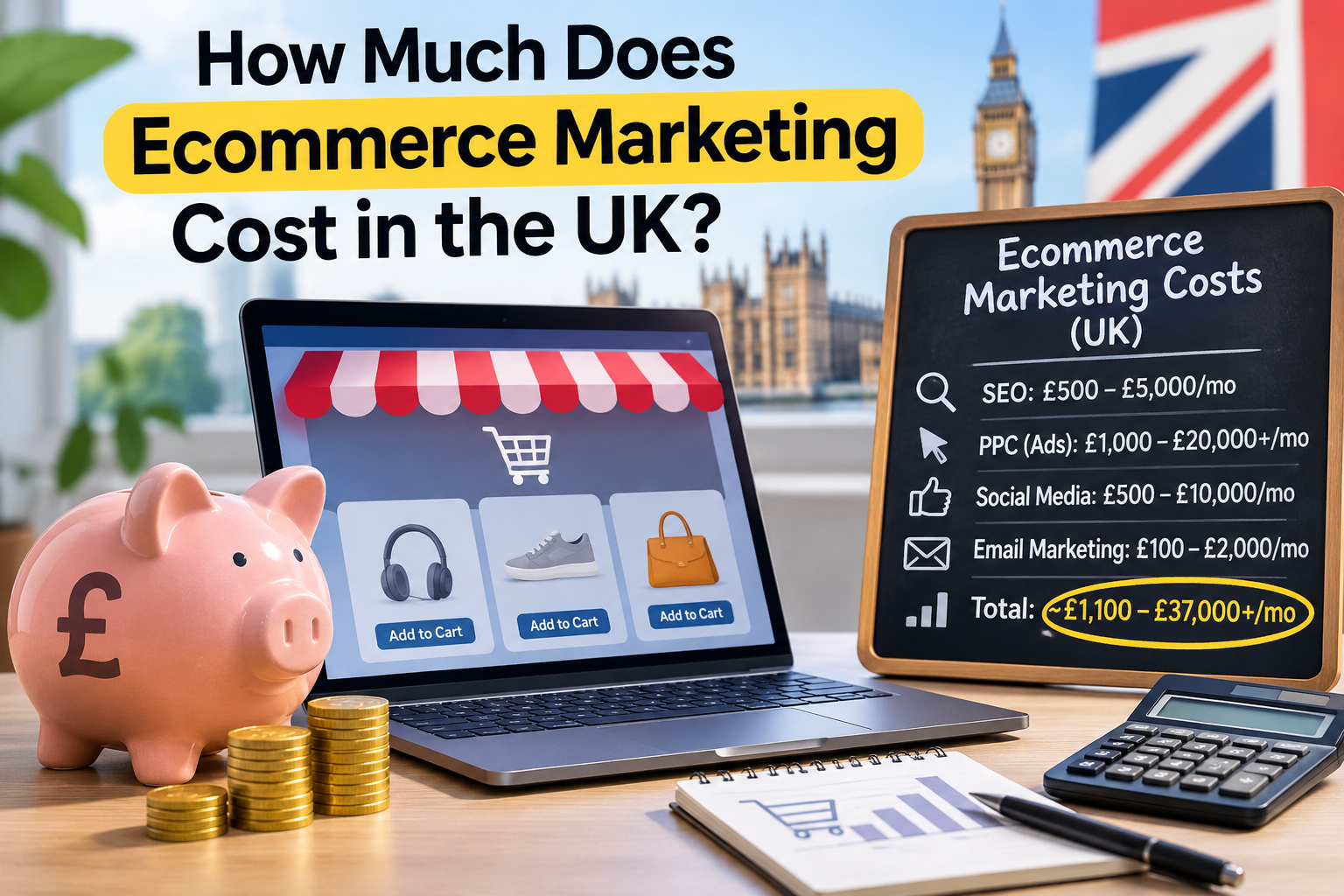
If you're running an online store, you've probably asked yourself one expensive question: How Much Does Ecommerce Marketing Cost in the UK?
The short answer? It depends on what you're selling, how competitive your market is, and how quickly you want to grow.
But that's not particularly helpful when you're trying to put together a budget.
So, let's talk actual numbers.
For UK ecommerce businesses, monthly marketing expenditure can range from a few hundred pounds for a small, owner-managed store to £10,000 or considerably more for established retailers investing heavily in SEO, paid advertising, content creation and customer retention.
The important thing isn't simply how much you spend. It's whether that investment generates profitable sales.
Ecommerce Marketing Costs in the UK: The Quick Answer
Here's what you need to know before committing a penny of your marketing budget.
-
Small ecommerce businesses: A working budget of £300–£1,500 per month can support basic SEO, email marketing and limited advertising.
-
Growing online stores: £1,500–£5,000 per month provides more room for professional campaign management, Google Ads, paid social and content marketing.
-
Established ecommerce brands: £5,000–£15,000+ per month may support multiple marketing channels, conversion optimisation and more sophisticated customer acquisition campaigns.
-
Ecommerce SEO: Professional SEO services might cost approximately £500–£2,500+ per month, depending on the size of your website and competition.
-
PPC advertising: Smaller businesses may begin with £300–£1,000 in monthly advertising spend, although agency management fees are usually additional.
-
Social media marketing: Expect anything from £300 per month for basic support to £2,000+ for more comprehensive management, excluding advertising spend where applicable.
-
Email marketing: Basic software can cost very little, while advanced automation and managed campaigns can run into hundreds or thousands of pounds monthly.
-
Marketing agency fees: Monthly retainers vary enormously depending on the services included, reporting requirements and campaign complexity.
These figures are illustrative UK planning ranges, not verified industry averages or guaranteed supplier quotations. They may exclude VAT, advertising expenditure, software subscriptions and one-off setup fees.
The bottom line: You don't necessarily need a massive marketing budget to grow an ecommerce business. You need the right channels, realistic expectations and a clear understanding of your customer acquisition costs.
That's what this guide will help you work out.
How Much Does Ecommerce Marketing Cost Per Month in the UK?
Let's start with the question that matters most to your bank balance.
How much should you realistically expect to spend every month?
Unlike a traditional shop, where rent, utilities and staffing are relatively predictable, ecommerce marketing costs can fluctuate significantly.
Your spending depends on several things:
-
The size and maturity of your online store.
-
Your average order value and product profit margins.
-
The competitiveness of your industry.
-
Whether you're targeting local, national or international customers.
-
Your chosen marketing channels.
-
Whether you manage campaigns yourself or hire specialists.
-
Your growth targets and customer acquisition strategy.
A business selling £15 accessories faces a completely different marketing challenge from a retailer selling £1,500 garden furniture.
Both might use Google Ads. Both might invest in SEO.
But their acceptable cost per acquisition, advertising budgets and return on investment requirements will be very different.
Typical Monthly Ecommerce Marketing Budgets
The following figures provide practical starting points for planning your ecommerce marketing investment.
| Business stage | Illustrative monthly budget | Typical marketing priorities |
|---|---|---|
| Startup ecommerce store | £300–£1,000 | Basic SEO, email marketing, small PPC tests |
| Small established retailer | £1,000–£2,500 | SEO, Google Shopping, paid social |
| Growing ecommerce business | £2,500–£5,000 | Multi-channel advertising, content, conversion optimisation |
| Established online retailer | £5,000–£10,000 | Advanced SEO, paid media, retention marketing |
| Large ecommerce brand | £10,000–£25,000+ | Integrated marketing, automation, extensive advertising |
These are suggested budget scenarios rather than published averages. They assume a mixture of marketing services and advertising expenditure, with the exact allocation varying by business.
And there's something important to understand here.
A £5,000 marketing budget doesn't necessarily mean £5,000 is being spent on advertising.
Some of that money may go towards:
-
Agency management fees.
-
SEO consultancy and technical improvements.
-
Advertising clicks and impressions.
-
Product photography and creative production.
-
Email marketing software.
-
Conversion tracking and analytics.
-
Website improvements.
-
Marketing automation subscriptions.
This distinction matters because your advertising spend and your marketing management costs are two separate expenses.
For example, imagine your monthly ecommerce marketing budget is £3,000.
You might allocate:
| Marketing activity | Monthly allocation |
|---|---|
| Google Ads advertising spend | £1,200 |
| PPC management | £450 |
| Ecommerce SEO | £650 |
| Email marketing and automation | £250 |
| Content creation | £300 |
| Analytics and marketing tools | £150 |
| Total monthly investment | £3,000 |
That's one possible allocation, not a universal recommendation.
A new ecommerce store might devote more money to paid advertising to generate its first customers. An established brand with strong organic traffic might prioritise retention marketing and conversion rate optimisation.
The right balance depends on what your business needs most.
If you're unsure where your money should go, reviewing your existing marketing performance is a sensible starting point. A free ecommerce marketing audit can help identify where your current strategy may be wasting money or missing opportunities.
Why the Cheapest Ecommerce Marketing Isn't Always the Best Value
Imagine two ecommerce businesses.
Business A spends £500 per month on marketing and generates £1,500 in sales.
Business B spends £3,000 per month and generates £15,000 in sales.
At first glance, Business B appears to be performing better.
But revenue alone doesn't tell us whether either business is profitable.
We also need to consider product costs, fulfilment, transaction fees, returns and the cost of acquiring each customer.
If Business B operates on extremely thin margins, its larger revenue figure might not translate into meaningful profit.
This is why ecommerce marketing pricing should never be judged on cost alone.
The best ecommerce marketing budget isn't necessarily the smallest. It's the amount your business can invest while generating sustainable, profitable growth.
Average Ecommerce Marketing Costs by Channel
Not all ecommerce marketing channels cost the same.
Some require a substantial upfront investment but can deliver benefits over time. Others can generate traffic almost immediately, provided you're willing to pay for it.
Understanding these differences is essential when deciding how to allocate your marketing budget.
Let's break down the main options.
1. Ecommerce SEO Costs in the UK
Typical planning range: £500–£2,500+ per month for ongoing professional SEO services.
Search engine optimisation (SEO) is one of the most valuable long-term marketing investments available to an ecommerce business.
Why?
Because it helps potential customers discover your products through unpaid search results.
Instead of paying every time someone clicks your advertisement, you're investing in improving your website's visibility for relevant searches.
For example, imagine you sell premium dog beds.
Potential customers might search for:
-
Orthopaedic dog beds UK.
-
Best washable dog beds.
-
Luxury dog beds for large dogs.
-
Memory foam dog beds.
-
Comfortable beds for older dogs.
A properly optimised ecommerce website can attract shoppers searching for those products without paying for every individual visit.
However, effective ecommerce SEO involves considerably more than adding keywords to product descriptions.
What Does Ecommerce SEO Pricing Include?
Depending on your agreement, professional ecommerce SEO services may include:
Technical ecommerce SEO
Ensuring search engines can crawl, understand and index your website efficiently.
This might involve resolving duplicate content, improving website speed, managing product variations and correcting indexing problems.
Product page optimisation
Improving product titles, descriptions, metadata, internal linking and structured data to make individual products easier to discover.
Category page SEO
Optimising collection pages for commercially valuable searches, particularly where customers are looking for a particular product type rather than a specific item.
Ecommerce keyword research
Identifying the phrases customers actually use when they're ready to buy, alongside informational searches that can attract shoppers earlier in their buying journey.
Content marketing
Creating helpful buying guides, product comparisons and educational articles that build topical relevance and attract organic traffic.
Link building and digital PR
Earning relevant links and brand mentions that can strengthen your website's authority.
Performance reporting
Monitoring organic traffic, keyword visibility, conversions and revenue generated through search.
For a detailed look at the work involved, explore our ecommerce SEO services.
What Affects Ecommerce SEO Costs?
Several factors influence your monthly SEO investment.
A Shopify store with 30 products will usually require a different level of technical work from a Magento website with 20,000 product URLs.
Competition matters too.
Ranking for a highly competitive product category can require considerably more resources than targeting a specialist niche.
Your website's current condition is another factor. If it has significant technical problems, poor content or complicated URL structures, additional work may be necessary before meaningful improvements can be made.
And then there's geography.
A UK retailer competing nationally will generally face a different SEO challenge from a business serving a narrow regional market.
Is Ecommerce SEO Worth the Investment?
SEO can be extremely valuable, but it isn't an instant sales machine.
A new ecommerce website may take months to build meaningful organic visibility, especially in competitive markets.
Established websites with strong foundations may see improvements sooner.
Unlike PPC, however, organic visibility doesn't automatically disappear the moment you stop paying for clicks.
That doesn't mean SEO is free or permanent. Rankings can change, competitors continue investing, and websites require ongoing maintenance.
The potential advantage is that successful SEO can reduce your reliance on paid advertising over time.
For ecommerce businesses with a long-term growth strategy, that can make it an important part of the marketing mix.
2. Google Ads and Google Shopping Costs
Typical starting advertising budget: £300–£1,500+ per month, with management fees charged separately where applicable.
If SEO is about building long-term visibility, Google Ads is about paying to reach potential customers when they're searching.
And for ecommerce businesses, that can be particularly powerful.
Someone searching for "buy waterproof hiking boots UK" is demonstrating considerably stronger purchase intent than someone casually browsing social media.
Google Ads allows retailers to compete for visibility across relevant search results and shopping placements.
But how much does it actually cost?
That depends heavily on your products, competitors, targeting and campaign performance.
Understanding Ecommerce PPC Costs
Pay-per-click advertising means you generally pay when someone clicks your advertisement.
The amount you pay for a click is known as your cost per click (CPC).
For illustration, suppose your average CPC is £0.80.
With a monthly advertising budget of £800, you could theoretically generate approximately 1,000 clicks.
But clicks aren't customers.
If 2% of those visitors purchase, you'd generate 20 orders.
Now suppose your average order value is £75.
Your advertising would produce:
-
Advertising spend: £800.
-
Website visitors from ads: 1,000.
-
Conversion rate: 2%.
-
Orders generated: 20.
-
Revenue generated: £1,500.
-
Return on ad spend (ROAS): 1.875x.
In other words, every £1 spent on advertising generates approximately £1.88 in sales revenue.
That might sound promising.
But whether it's profitable depends on your product margins and other costs.
If your products have a gross margin of 30%, those £1,500 in sales would generate £450 in gross profit before deducting advertising expenditure and other relevant operating costs.
You would therefore be losing money on the campaign's immediate contribution.
This is why managing ecommerce PPC effectively requires more than simply generating traffic.
It requires an understanding of conversion rates, customer acquisition costs, average order values and profitability.
Google Shopping Ads Costs
Google Shopping is particularly relevant for ecommerce businesses because it allows products to appear with information such as images, prices and retailer names.
<blockquote> **Example:** A customer searches for "men's black running trainers". Rather than seeing only traditional text advertisements, they may also see relevant product listings from multiple retailers. </blockquote>
Shopping campaigns can help reach people who are actively comparing products and prices.
However, your costs will depend on factors including:
-
Competition within your product category.
-
Product pricing and competitiveness.
-
Product feed quality.
-
Geographic targeting.
-
Bidding strategy.
-
Seasonal demand.
-
Conversion performance.
Your Google Merchant Center product data also needs to be accurate and properly maintained.
Poor product titles, missing attributes or feed errors can limit campaign performance before a customer even reaches your website.
Performance Max Campaign Costs
Performance Max is another Google Ads campaign type frequently used by ecommerce retailers.
It uses Google's automation to serve advertising across eligible Google channels, including Search, Shopping inventory, YouTube, Display, Discover, Gmail and Maps.
Rather than manually controlling every placement, advertisers provide assets, conversion goals, audience signals and product information while Google's systems optimise delivery.
Performance Max doesn't have one fixed advertising price.
Your actual costs depend on your budget, campaign settings, competition and results.
For ecommerce businesses, the important question isn't simply whether Performance Max generates conversions.
It's whether those conversions are valuable enough to justify the expenditure.
Google Ads Management Fees in the UK
If you hire a professional to manage your campaigns, you'll normally pay an additional fee.
Common ecommerce PPC management pricing models include:
-
Fixed monthly retainer: A predetermined monthly management charge.
-
Percentage of advertising spend: An agency fee calculated as a percentage of your advertising budget.
-
Hybrid pricing: A base monthly fee plus a percentage of spend.
-
Project-based pricing: A one-off charge for account setup, restructuring or campaign optimisation.
-
Hourly consultancy: Payment for specialist advice or defined management work.
For example, an agency charging £400 per month to manage £1,500 of advertising would bring your total monthly PPC investment to £1,900, excluding other expenses.
Some providers also charge separately for initial campaign setup, conversion tracking, product feed optimisation or creative assets.
Always establish exactly what's included before signing an agreement.
If you're considering paid advertising, our ecommerce PPC services explain how a more structured approach to campaign management can support online store growth.
One final consideration: Advertising platforms can generate traffic quickly, but that traffic isn't guaranteed to convert.
If your website is difficult to navigate, your products are overpriced or your checkout process creates friction, increasing your advertising budget may simply increase your losses.
That's why profitable ecommerce marketing requires advertising performance and website conversion performance to work together.
3. Paid Social Media Advertising Costs for Ecommerce Businesses
Typical planning range: £300–£2,000+ per month for advertising, with management and creative production costs potentially charged separately.
Google Ads captures people who are already searching for products.
Social media advertising works differently.
It helps you reach potential customers who might not even know they need your products yet.
And for certain ecommerce businesses, that distinction can be incredibly valuable.
Imagine you sell premium skincare products.
Someone scrolling through Instagram might not be actively searching for a new moisturiser. But an engaging video demonstrating your product, explaining its benefits and showing genuine customer experiences could spark their interest.
That's where paid social advertising comes in.
Platforms such as Facebook, Instagram, TikTok and Pinterest allow ecommerce businesses to reach audiences based on various signals, interests, behaviours and interactions.
However, the cost of social media advertising in the UK varies considerably depending on your audience, products, creative assets and competition.
How Much Do Facebook and Instagram Ads Cost in the UK?
Meta advertising, which includes Facebook and Instagram, is a popular option for ecommerce brands.
You can advertise individual products, promote collections, build brand awareness and reconnect with people who have previously interacted with your business.
For budgeting purposes, consider these illustrative monthly advertising levels:
| Monthly ad spend | Potential use |
|---|---|
| £300–£500 | Small-scale testing of products, audiences and creatives |
| £500–£1,000 | Testing and refining campaigns with a modest budget |
| £1,000–£3,000 | Supporting ongoing customer acquisition and remarketing |
| £3,000–£5,000 | Running multiple campaigns and creative tests |
| £5,000+ | Scaling campaigns with established conversion performance |
These figures are planning examples, not platform minimums or guaranteed performance thresholds.
A £500 monthly budget works out at approximately £16.67 per day over a 30-day month.
That may be sufficient for a focused test, but spreading it across too many products, audiences and campaigns can make it difficult to gather meaningful performance data.
The biggest mistake? Assuming more advertising spend automatically means more sales.
If your product positioning, creative content or website experience isn't convincing, increasing your budget may simply expose more people to an offer that isn't converting.
Understanding Social Media Advertising Metrics
Paid social media campaigns commonly involve several performance metrics.
Cost per thousand impressions (CPM)
The amount you pay for every 1,000 advertising impressions.
CPM helps you understand the cost of reaching audiences, although it doesn't tell you whether those people are interested in buying.
Cost per click (CPC)
The average amount paid when someone clicks your advertisement, using the relevant click metric.
A lower CPC can be useful, but inexpensive traffic isn't necessarily valuable traffic.
Cost per acquisition (CPA)
The average advertising cost associated with generating a desired conversion, such as a purchase.
For ecommerce retailers, purchase CPA is often more commercially meaningful than engagement or traffic metrics.
Return on ad spend (ROAS)
The revenue attributed to advertising divided by advertising expenditure.
For example:
-
Advertising spend: £1,000.
-
Attributed revenue: £4,000.
-
ROAS: 4x.
This means your campaign generated £4 in attributed sales for every £1 spent on advertising.
However, that doesn't automatically mean you've made £3,000 in profit.
You still need to account for product costs, fulfilment, returns, payment processing and other business expenses.
TikTok Advertising Costs for Ecommerce
TikTok can be particularly useful for ecommerce brands selling visually appealing, demonstrable or trend-driven products.
Think beauty products, fashion accessories, home gadgets and lifestyle items.
Unlike traditional product advertising, successful TikTok campaigns often rely on content that feels natural within the platform.
That might include:
-
Short product demonstrations.
-
Before-and-after videos where claims can be substantiated.
-
Customer testimonials.
-
Unboxing videos.
-
User-generated content.
-
Educational product videos.
-
Creator collaborations.
The cost isn't limited to advertising expenditure.
You may also need to budget for video editing, content creators, product samples and ongoing creative testing.
Some campaign types and account configurations also have minimum budget requirements, so check the current platform rules before planning a small test.
For ecommerce businesses with limited resources, it's usually better to test a manageable number of strong creative concepts than produce dozens of low-quality advertisements.
Organic Social Media Management Costs
Not every social media activity requires paid advertising.
Organic social media marketing involves creating and publishing content without paying for each impression or click.
Typical activities include:
-
Planning a content calendar.
-
Creating product photography and videos.
-
Writing captions and promotional content.
-
Responding to customer comments.
-
Managing community engagement.
-
Analysing content performance.
-
Coordinating product launches and promotions.
Basic outsourced social media management might cost approximately £300–£750 per month.
More comprehensive services involving strategy, frequent posting, video production and community management could cost £750–£2,000+ monthly.
These are illustrative service pricing ranges; the number of platforms, posts, videos and hours included will affect actual quotations.
For many ecommerce businesses, combining organic social media with carefully targeted advertising can create a more balanced approach than relying entirely on one or the other.
4. Email Marketing and Automation Costs
Typical planning range: £0–£300+ per month for software, with professional management and advanced automation potentially costing considerably more.
Email marketing is sometimes overlooked by ecommerce businesses chasing their next sale.
That's a mistake.
Because acquiring a new customer is only part of the challenge.
What happens after they've purchased?
Do they come back?
Do they recommend your products?
Do they buy something else?
Or do they disappear forever?
Email marketing helps ecommerce businesses maintain relationships with existing customers, recover abandoned checkouts and encourage repeat purchases.
And unlike paid advertising, you aren't normally paying a search engine or social platform for every visit generated by an email campaign.
You are, however, paying for software, content creation, management and potentially customer data integrations.
How Much Does Ecommerce Email Marketing Software Cost?
Popular email marketing platforms include Klaviyo, Mailchimp and Shopify's own email marketing tools.
Pricing typically depends on factors such as:
-
Number of contacts or active profiles.
-
Monthly email sending volume.
-
SMS messaging requirements.
-
Automation capabilities.
-
Customer segmentation features.
-
Reporting and analytics.
-
Integration requirements.
For smaller online stores, basic email marketing software may be free or relatively inexpensive.
As your subscriber database grows and you introduce more advanced automation, costs can increase significantly.
For budgeting, a smaller ecommerce business might initially allocate £20–£100 per month to email software.
A larger retailer with thousands of contacts, complex automations and SMS campaigns may need a much higher allowance.
Always check current provider pricing because subscription tiers and billing structures change.
Essential Ecommerce Email Automations
One of the biggest advantages of ecommerce email marketing is automation.
Instead of manually emailing customers every time something happens, you can create automated sequences triggered by customer behaviour.
Some of the most useful include:
1. Welcome email sequences
Introduce new subscribers to your brand, explain your products and encourage their first purchase.
2. Abandoned cart recovery
Remind shoppers about products they've added to their basket without completing checkout.
3. Abandoned checkout emails
Reach customers who have started checkout but haven't finished their purchase.
4. Post-purchase email sequences
Provide useful information after an order, request feedback and introduce complementary products.
5. Customer win-back campaigns
Reconnect with customers who haven't purchased for an extended period.
6. Product recommendations
Suggest relevant products based on purchase history, browsing behaviour or customer preferences.
7. Loyalty and repeat purchase campaigns
Reward returning customers and encourage long-term relationships.
These automations can improve customer retention without requiring a completely new campaign every time.
But setting them up properly takes work.
You'll need appropriate customer permissions, accurate tracking, thoughtful messaging and careful testing.
Professional Email Marketing Management Fees
If you outsource email marketing, costs will depend on the services provided.
| Service | Illustrative cost |
|---|---|
| Basic email campaign setup | £100–£300 per campaign |
| Welcome email automation setup | £150–£500 |
| Abandoned cart automation setup | £150–£600 |
| Monthly email campaign management | £300–£1,000+ |
| Advanced ecommerce lifecycle marketing | £1,000–£3,000+ per month |
These figures are indicative estimates rather than standardised UK agency rates.
More sophisticated projects involving customer segmentation, copywriting, design, multiple integrations and extensive testing may cost considerably more.
Why Customer Retention Matters to Your Marketing Budget
Imagine your ecommerce business spends £25 acquiring a new customer.
That customer places an order worth £70.
If they never return, your opportunity to recover the acquisition cost is limited to that first transaction.
But suppose the customer makes another two purchases over the following year.
Your original £25 acquisition cost is now spread across three orders rather than one.
Of course, additional fulfilment costs, retention expenditure and discounts still need to be considered.
Nevertheless, repeat purchasing can improve customer lifetime value and make your original marketing investment more sustainable.
Ecommerce growth isn't just about acquiring more customers. It's about increasing the value of the customers you've already worked hard to win.
This is one reason email marketing deserves a place in almost every established ecommerce marketing strategy.
5. Content Marketing and Influencer Marketing Costs
Typical planning range: £300–£2,000+ per month, depending on content volume, format and production requirements.
Content marketing can mean many different things.
For one ecommerce business, it might involve writing helpful buying guides.
For another, it could mean producing professional product videos, working with influencers or creating detailed comparison articles.
The costs vary accordingly.
And unlike advertising, where expenditure is closely tied to media delivery, content marketing often involves paying for assets that can be reused across multiple channels.
A high-quality product demonstration video, for example, might support your website, email campaigns, organic social media and paid advertisements.
Ecommerce Blog Writing Costs
Blog content can support organic search visibility, educate potential customers and help shoppers make purchasing decisions.
Useful ecommerce content might include:
-
Product buying guides.
-
Product comparisons.
-
Frequently asked questions.
-
How-to tutorials.
-
Seasonal shopping guides.
-
Product care instructions.
-
Industry advice.
-
Educational articles addressing customer problems.
For example, a retailer selling coffee machines could publish an article explaining the differences between espresso machines, bean-to-cup machines and pod machines.
That article might attract people researching their options before making a purchase.
Professional blog writing costs vary based on research requirements, subject complexity, length and SEO work.
An illustrative budget might be £100–£300 for a relatively straightforward article, while detailed specialist content could cost £300–£750 or more.
Publishing content simply to hit a monthly word count is rarely a good investment.
Each article should have a clear purpose, address genuine customer questions and support your wider ecommerce marketing strategy.
Product Photography and Video Production Costs
Product photography can have a direct influence on how customers perceive your brand.
Poor images can make even excellent products look unappealing.
High-quality images help shoppers understand what they're buying and may reduce uncertainty before checkout.
Professional product photography might cost a few hundred pounds for a small batch of straightforward images or considerably more for styled shoots involving models, locations and specialist equipment.
Video production introduces additional considerations:
-
Scripting.
-
Filming.
-
Editing.
-
Voiceovers.
-
Product demonstrations.
-
Animation.
-
Multiple aspect ratios.
-
Licensing and usage rights.
A simple product demonstration created in-house might cost very little beyond staff time and equipment.
A professionally produced advertising video could cost hundreds or thousands of pounds.
For smaller ecommerce businesses, creating authentic, informative content is often more practical than investing immediately in expensive production.
Influencer Marketing Costs in the UK
Influencer marketing involves working with creators who can introduce your products to their audiences.
The cost depends on the creator's audience, engagement, content requirements, platform and usage rights.
A smaller creator may accept gifted products or charge a modest fee.
A larger influencer with an established audience may charge thousands of pounds for a campaign.
But follower count alone isn't enough to determine value.
Consider two hypothetical influencers.
One has 100,000 followers but little connection to your target customers.
The other has 8,000 highly engaged followers who regularly purchase products similar to yours.
The smaller creator could potentially generate better commercial results.
This is why ecommerce influencer marketing should be evaluated using metrics such as referral traffic, tracked purchases, customer acquisition cost and attributed revenue.
Don't Forget Content Usage Rights
One hidden cost of influencer and user-generated content is licensing.
Paying a creator to publish a video on their own account doesn't necessarily give your business unrestricted permission to use that video in paid advertising.
Additional fees may apply for:
-
Paid advertising usage.
-
Extended licensing periods.
-
Exclusivity.
-
Editing rights.
-
Usage across multiple platforms.
-
Whitelisting or creator-authorised advertising.
Clarifying these terms before commissioning content can prevent unexpected expenses later.
How Much Should Ecommerce Businesses Budget for Marketing?
Now that we've explored the individual channels, it's time to answer a bigger question.
How much of your ecommerce revenue should actually go towards marketing?
You'll often encounter advice suggesting businesses should spend a fixed percentage of revenue on marketing.
That can be a useful starting point.
But ecommerce businesses need to be particularly careful with blanket recommendations.
A retailer operating on a 60% gross margin has considerably more flexibility than one operating on a 15% gross margin.
Likewise, a subscription-based brand with strong repeat purchasing may be able to justify a higher initial customer acquisition cost than a retailer selling products customers purchase only once.
Ecommerce Marketing Budget as a Percentage of Revenue
For initial planning, the following scenarios illustrate what different marketing expenditure levels could look like.
| Monthly ecommerce revenue | 5% marketing budget | 10% marketing budget | 15% marketing budget |
|---|---|---|---|
| £5,000 | £250 | £500 | £750 |
| £10,000 | £500 | £1,000 | £1,500 |
| £25,000 | £1,250 | £2,500 | £3,750 |
| £50,000 | £2,500 | £5,000 | £7,500 |
| £100,000 | £5,000 | £10,000 | £15,000 |
| £250,000 | £12,500 | £25,000 | £37,500 |
These percentages are budgeting scenarios, not recommended industry benchmarks.
A 15% marketing budget might be perfectly reasonable for one business and completely unsustainable for another.
The decision should depend on your contribution margins, growth objectives, repeat purchase behaviour and available cash flow.
How to Calculate Your Ecommerce Marketing Budget
A practical starting point is to work backwards from your revenue targets.
Suppose your ecommerce store currently generates £20,000 in monthly sales.
You want to increase that to £30,000.
Your average order value is £60.
To generate an additional £10,000 in revenue, you'd need approximately 167 additional orders at that average order value.
Now imagine you believe you can acquire those orders for an average advertising cost of £15 each.
Your estimated advertising expenditure would be:
167 orders × £15 = £2,505
But that's only the advertising cost.
You may also need to account for:
-
PPC management.
-
SEO services.
-
Content creation.
-
Email marketing.
-
Website improvements.
-
Analytics and tracking.
-
Creative production.
And crucially, you need to establish whether those additional orders will generate enough contribution profit to justify the investment.
If your product margins cannot support a £15 acquisition cost, your plan needs adjusting before you increase expenditure.
Why Revenue Alone Is a Dangerous Budgeting Metric
Let's compare two ecommerce stores.
Store A
-
Monthly revenue: £50,000.
-
Gross profit margin: 50%.
-
Gross profit: £25,000.
Store B
-
Monthly revenue: £50,000.
-
Gross profit margin: 20%.
-
Gross profit: £10,000.
Both stores generate identical revenue.
But Store A has considerably more gross profit available to cover marketing, staffing, overheads and other expenses.
If both businesses spend £7,500 on marketing, the financial impact will be very different.
Store A would have £17,500 of gross profit remaining before other expenses.
Store B would have just £2,500 remaining.
This is why your online store marketing budget should be based on profitability rather than revenue alone.
Before committing to substantial advertising expenditure, establish your product-level margins and understand how much you can afford to spend acquiring a customer.
Ecommerce Marketing Agency vs Freelancer vs In-House Costs
Once you've decided which marketing channels to invest in, there's another important decision.
Who's actually going to do the work?
You generally have three options:
-
Hire an ecommerce marketing agency.
-
Work with independent freelancers.
-
Build an in-house marketing team.
Each approach has advantages, disadvantages and different cost implications.
There's no universally correct answer.
The right choice depends on your budget, business size, internal expertise and growth ambitions.
1. Hiring an Ecommerce Marketing Agency
Illustrative monthly service cost: £500–£5,000+, excluding advertising spend and other separately billed expenses.
An ecommerce marketing agency can provide access to specialists across several disciplines.
Depending on the agency, those might include:
-
Ecommerce SEO.
-
Google Ads and PPC management.
-
Paid social media advertising.
-
Content marketing.
-
Email marketing.
-
Conversion rate optimisation.
-
Analytics and performance reporting.
-
Marketing strategy.
One of the biggest advantages is that you don't necessarily need to hire separate employees for every marketing discipline.
Instead, you pay for an agreed package of services.
However, ecommerce marketing agency pricing can vary significantly.
A small agency providing basic campaign management may charge a few hundred pounds per month.
A specialist agency managing complex multi-channel campaigns could charge several thousand pounds.
And a larger full-service agency supporting an established ecommerce brand may cost considerably more.
What Is Included in Ecommerce Marketing Agency Fees?
Before comparing quotations, establish exactly what you're paying for.
For example, does the monthly retainer include:
-
Initial marketing strategy?
-
Campaign creation and management?
-
Keyword research?
-
Advertising creative?
-
Product feed optimisation?
-
Technical SEO work?
-
Monthly reporting?
-
Conversion tracking?
-
Regular strategy meetings?
-
Email automation?
-
Landing page improvements?
Two agencies charging £1,000 per month might offer completely different levels of service.
One could provide comprehensive campaign management and reporting.
The other might provide only limited optimisation and a basic monthly report.
Price matters.
But deliverables, expertise, transparency and accountability matter just as much.
2. Hiring Ecommerce Marketing Freelancers
Illustrative hourly rate: £25–£100+, depending on experience and specialisation.
Freelancers can be an attractive option for smaller ecommerce businesses.
You might hire a freelance SEO specialist for technical improvements, a PPC consultant for campaign management or a copywriter for product descriptions.
This approach provides flexibility.
You're paying for specific expertise without necessarily committing to a broad monthly marketing package.
For example:
| Freelance service | Illustrative hourly rate |
|---|---|
| Ecommerce copywriting | £25–£60 |
| Social media management | £25–£65 |
| SEO consultancy | £40–£100+ |
| PPC management | £40–£100+ |
| Email marketing specialist | £35–£90+ |
| Conversion optimisation specialist | £50–£120+ |
These are estimated UK planning ranges rather than verified market averages.
Highly experienced specialists may charge considerably more.
Freelancers can be particularly useful when you already have a clear marketing strategy and need support with specific tasks.
The challenge arises when you're coordinating multiple specialists.
Your SEO consultant, PPC freelancer and email marketer may each be excellent at their jobs.
But who's ensuring their work supports the same commercial objectives?
Without a coordinated strategy, your marketing can become fragmented.
3. Building an In-House Ecommerce Marketing Team
Hiring an employee gives your business dedicated marketing support.
An in-house specialist can develop a deep understanding of your products, customers, brand positioning and commercial objectives.
However, employment costs extend beyond salary.
You also need to consider:
-
Employer National Insurance contributions.
-
Employer pension contributions.
-
Recruitment expenses.
-
Training and professional development.
-
Equipment and software.
-
Holiday and absence cover.
-
Management and supervision.
-
Potential additional recruitment as your business grows.
For illustration, a marketing employee earning £35,000 annually costs approximately £2,917 per month in gross salary alone.
That excludes employer contributions, benefits, equipment and other employment costs.
And one employee may not possess advanced expertise in SEO, Google Ads, email automation, creative production and conversion optimisation simultaneously.
A growing ecommerce business may eventually need multiple specialists.
This is why in-house marketing can become a substantial fixed operating expense.
Ecommerce Agency vs Freelancer vs In-House: Cost Comparison
| Factor | Agency | Freelancer | In-house team |
|---|---|---|---|
| Typical pricing | Monthly retainer or project fee | Hourly, project or retainer | Salary and employment costs |
| Access to multiple specialists | Often | Usually limited to individual expertise | Depends on team size |
| Flexibility | Contract-dependent | Often relatively flexible | Less flexible fixed commitment |
| Day-to-day brand familiarity | Develops over time | Develops over time | Typically strongest |
| Management requirements | Usually moderate | Can be significant with multiple freelancers | Internal management required |
| Scalability | Often straightforward | Depends on availability | Requires recruitment |
| Best suited to | Businesses needing coordinated specialist support | Specific projects or defined skills | Businesses needing continuous dedicated capacity |
Which Option Offers the Best Value?
For a startup with limited cash flow, hiring a specialist freelancer for a clearly defined project may be sensible.
For a growing ecommerce store managing multiple marketing channels, an agency could provide broader expertise without the fixed costs of employing a complete team.
For an established retailer with substantial ongoing marketing activity, building an in-house team may provide greater control and faster internal collaboration.
Some businesses combine all three approaches.
For example, an ecommerce retailer might employ an in-house marketing manager, outsource technical SEO to an agency and hire freelance creators for video production.
This hybrid model can work well when responsibilities are clearly defined.
Ultimately, the best option is the one that delivers the expertise your business needs at a cost your margins can support.
Remember: Whether you hire an agency, freelancer or employee, your marketing investment should be evaluated against commercial outcomes rather than activity alone.
More reports, more meetings and more campaigns don't automatically mean more profitable sales.
What matters is whether the work improves customer acquisition, conversion rates, customer retention and long-term business profitability.
What Factors Affect Ecommerce Marketing Pricing in the UK?
By now, one thing should be clear.
There isn't a universal price for ecommerce marketing.
Two online retailers generating identical revenue could have completely different marketing costs.
Why?
Because the amount you need to invest depends on your products, customers, competition, technology and business objectives.
Understanding these factors can help you build a realistic ecommerce marketing budget rather than spending money based on guesswork.
1. Your Industry and Level of Competition
Some ecommerce markets are considerably more competitive than others.
If you're selling products in a crowded industry such as fashion, skincare, electronics or home furnishings, you may be competing against established brands with substantial advertising budgets.
That competition can affect:
-
Google Ads cost per click.
-
Social media advertising costs.
-
Ecommerce SEO investment.
-
Content production requirements.
-
Customer acquisition costs.
-
The time required to achieve organic search visibility.
For example, a specialist retailer selling unusual craft supplies may face less competition for certain search terms than a business selling mainstream running shoes.
However, a niche audience can also mean fewer potential customers.
The objective isn't simply to find the cheapest keywords.
It's to identify commercially valuable opportunities where your business can compete profitably.
2. Your Product Prices and Profit Margins
Your average order value (AOV) and profit margins have a direct impact on how much you can afford to spend acquiring customers.
Imagine two ecommerce businesses.
Business A sells products for £25 with a 30% gross profit margin.
Business B sells products for £150 with a 50% gross profit margin.
Before advertising and other expenses, Business A generates £7.50 in gross profit per order.
Business B generates £75.
Business B therefore has considerably more room to absorb customer acquisition costs.
That doesn't automatically make its marketing easier. Higher-priced products may have longer buying journeys and lower conversion rates.
But it demonstrates why ecommerce advertising costs must always be considered alongside product economics.
3. Your Website's Conversion Rate
A website receiving 10,000 visitors per month at a 1% conversion rate generates approximately 100 orders.
Increase that conversion rate to 2%, and the same traffic could generate 200 orders.
That's twice as many orders without increasing visitor numbers.
Of course, actual results depend on traffic quality, product availability and other factors.
But the principle is important.
Improving your conversion rate can sometimes be more cost-effective than buying additional traffic.
This is where professional ecommerce web design and conversion rate optimisation can become valuable investments.
Elements worth reviewing include:
-
Mobile responsiveness.
-
Website loading speed.
-
Product photography.
-
Product descriptions.
-
Navigation and search functionality.
-
Customer reviews.
-
Delivery information.
-
Returns policies.
-
Checkout simplicity.
-
Payment options.
-
Trust signals.
A beautiful website isn't necessarily a profitable website.
It needs to help customers find products, understand their value and complete purchases with minimal friction.
4. Your Ecommerce Platform
Your choice of ecommerce platform can also influence marketing expenditure.
Shopify, WooCommerce, Magento (Adobe Commerce) and BigCommerce all support ecommerce marketing, but their technical requirements and associated costs differ.
For example:
| Ecommerce platform | Potential marketing cost considerations |
|---|---|
| Shopify | Marketing apps, subscriptions, SEO configuration and integrations |
| WooCommerce | Hosting, plugins, maintenance, tracking and technical SEO |
| Magento / Adobe Commerce | Developer resources, complex technical SEO and enterprise integrations |
| BigCommerce | Marketing integrations, product feed management and technical optimisation |
Shopify marketing costs may include paid apps for email automation, product reviews, upselling and customer retention.
A WooCommerce marketing budget might need to account for plugin subscriptions, hosting improvements and developer support.
Larger Magento websites may require more extensive technical SEO, analytics implementation and product catalogue management.
None of these platforms automatically guarantees cheaper marketing.
What matters is how effectively your website supports your chosen acquisition and retention strategy.
5. Your Growth Objectives
A retailer aiming for steady, sustainable growth may take a different approach from a brand attempting to double revenue within twelve months.
Aggressive growth targets often require greater investment in:
-
Customer acquisition.
-
Paid advertising.
-
Creative testing.
-
Marketing automation.
-
Product launches.
-
Conversion optimisation.
-
Additional specialist support.
But faster growth can also create financial pressure.
If advertising costs rise faster than contribution profit, increasing sales may actually damage cash flow.
Your marketing strategy should therefore reflect both your ambitions and your business's financial capacity.
Hidden Ecommerce Marketing Costs to Consider
Here's where many online retailers get caught out.
They agree to a monthly marketing package, allocate money to advertising and assume everything is covered.
Then the additional expenses start appearing.
A new software subscription.
An unexpected website development bill.
Additional product photography.
A tracking implementation fee.
Individually, these costs might seem manageable.
Together, they can significantly increase your actual ecommerce marketing expenditure.
Common Hidden Marketing Expenses
| Expense | Why it matters |
|---|---|
| Agency onboarding fees | Some agencies charge separately for account audits, strategy and initial setup |
| Conversion tracking | Accurate ecommerce tracking may require specialist implementation |
| Product feed management | Google Shopping and marketplace feeds need ongoing maintenance |
| Marketing software | Email, analytics, reporting and automation tools may have recurring fees |
| Creative production | Advertising images, videos and copy may not be included in management retainers |
| Website development | Landing pages, checkout changes and technical fixes may require additional work |
| App subscriptions | Ecommerce plugins and integrations can increase monthly operating costs |
| Influencer usage rights | Paid advertising rights may cost extra |
| Analytics dashboards | Custom reporting and attribution tools can carry additional charges |
| VAT | Supplier quotations may exclude VAT, affecting the amount payable |
Are Advertising Costs Included in Agency Retainers?
Often, no.
Many ecommerce marketing agencies charge a management fee separately from advertising expenditure.
For example, imagine you're quoted:
-
PPC management: £600 per month.
-
Google Ads budget: £2,000 per month.
-
Reporting software: £50 per month.
-
Creative production: £250 per month.
Your total monthly commitment would be £2,900 before any applicable VAT or additional expenses.
That's substantially different from assuming the £600 management fee covers everything.
Always request an itemised quotation.
Questions to Ask Before Hiring an Ecommerce Marketing Agency
Before signing an agreement, ask:
-
What services are included in the monthly retainer?
-
Is advertising spend charged separately?
-
Are there initial setup or onboarding fees?
-
Who owns the advertising accounts and campaign data?
-
Are content creation and design included?
-
How frequently will campaigns be reviewed?
-
What performance metrics will be reported?
-
Are there minimum contract periods?
-
What happens if we want to cancel?
-
Are software subscriptions included in the quotation?
You should also establish whether the agency measures performance using revenue, conversions, customer acquisition cost or profitability.
A campaign generating impressive traffic figures isn't necessarily generating a worthwhile commercial return.
How to Calculate Ecommerce Marketing ROI, ROAS and Customer Acquisition Cost
This is arguably the most important section of the entire guide.
Because knowing how much ecommerce marketing costs is only half the equation.
The other half is understanding what you're getting back.
Three particularly useful metrics are:
-
Return on ad spend (ROAS).
-
Customer acquisition cost (CAC).
-
Return on marketing investment (ROMI).
Each measures something different.
And confusing them can lead to expensive decisions.
1. Return on Ad Spend (ROAS)
ROAS measures the revenue attributed to advertising relative to the amount spent on that advertising.
The formula is:
ROAS = Revenue attributed to ads ÷ Advertising spend
Suppose you spend £2,000 on Google Ads and generate £8,000 in attributed sales.
Your ROAS would be:
£8,000 ÷ £2,000 = 4x ROAS
That means you generated £4 in attributed revenue for every £1 spent on advertising.
Sounds good, doesn't it?
Possibly.
But ROAS doesn't account for product costs, agency fees, fulfilment expenses or overheads.
A 4x ROAS could be highly profitable for one business and unprofitable for another.
2. Customer Acquisition Cost (CAC)
Customer acquisition cost measures how much you spend acquiring a new customer.
The formula is:
CAC = Customer acquisition expenditure ÷ New customers acquired
Imagine your ecommerce business spends £3,000 on acquisition-related marketing activities during a month.
You acquire 100 new customers.
Your CAC would be:
£3,000 ÷ 100 = £30 per new customer
The important distinction is that CAC should focus on new customers, rather than treating every order as a new acquisition.
If existing customers account for a substantial proportion of your orders, dividing marketing spend by total orders can give you a misleading impression of acquisition efficiency.
You should also define which costs are included in the calculation.
Advertising-only CAC and fully loaded CAC are not interchangeable.
3. Return on Marketing Investment (ROMI)
ROMI attempts to measure the financial return generated by marketing after accounting for marketing expenditure.
One useful contribution-based approach is:
ROMI = (Incremental contribution before marketing costs − Marketing investment) ÷ Marketing investment × 100
Suppose a campaign generates £12,000 in genuinely incremental sales.
After deducting variable product and fulfilment costs, those sales contribute £5,000 before marketing expenditure.
Your total marketing investment is £2,000.
Your calculation would be:
(£5,000 − £2,000) ÷ £2,000 × 100 = 150% ROMI
In this example, the campaign produces £3,000 in contribution after marketing expenditure, before any remaining fixed overheads.
The challenge is accurately determining which sales were genuinely incremental.
Not every sale attributed to an advertisement would necessarily have been lost without that advertisement.
This is why attribution data should be interpreted carefully.
You can explore different revenue and expenditure scenarios using our ecommerce ROI calculator.
4. Understanding Break-Even ROAS
Break-even ROAS tells you the minimum advertising return required to cover advertising expenditure, based on the contribution margin available before advertising.
For a simplified calculation:
Break-even ROAS = 1 ÷ Pre-advertising contribution margin
Suppose your contribution margin before advertising is 40%.
Your break-even ROAS would be:
1 ÷ 0.40 = 2.5x
This means you need £2.50 in attributed sales revenue for every £1 spent on advertising to cover that advertising cost under the assumptions used.
However, this simplified calculation excludes any additional agency fees or fixed overheads not already incorporated into your margin.
If those expenses are significant, your actual profitability threshold will be higher.
5. Customer Lifetime Value (CLV)
Customer lifetime value estimates the economic value a customer generates throughout their relationship with your business.
This matters because not every customer makes just one purchase.
For example, imagine your average customer:
-
Spends £60 per order.
-
Makes three purchases per year.
-
Remains a customer for two years.
Their estimated lifetime revenue would be:
£60 × 3 × 2 = £360
But £360 is revenue, not profit.
If your contribution margin before acquisition expenditure is 35%, the corresponding estimated lifetime contribution would be £126.
That figure provides a more meaningful starting point for evaluating how much you might afford to spend acquiring the customer.
Of course, future purchases aren't guaranteed.
Customer retention rates, refunds, discounts and changing costs all affect actual lifetime value.
For that reason, avoid using optimistic lifetime revenue projections to justify acquisition campaigns that your current cash flow cannot support.
6. Marketing Efficiency Ratio (MER)
Marketing efficiency ratio provides a broader view of marketing performance.
A common calculation is:
MER = Total ecommerce revenue ÷ Total marketing spend
Suppose your store generates £50,000 in revenue and spends £10,000 on marketing.
Your MER is:
£50,000 ÷ £10,000 = 5x
Unlike platform-specific ROAS, MER considers overall revenue relative to total marketing expenditure.
That can be useful when customers interact with multiple channels before purchasing.
However, MER is not a measure of incremental return or profitability.
Revenue may also be influenced by existing customers, brand awareness, seasonality and factors unrelated to current marketing expenditure.
It's best used alongside contribution margins, CAC, customer lifetime value and cash flow.
Don't scale ecommerce marketing simply because revenue is increasing. Scale when the economics demonstrate that additional expenditure can create sustainable value.
Example Ecommerce Marketing Budgets for UK Online Stores
Let's bring everything together.
The following examples demonstrate how ecommerce businesses at different stages might distribute their marketing expenditure.
These are hypothetical budgets, not fixed recommendations.
Example 1: Startup Ecommerce Business — £750 Per Month
Imagine you've recently launched a Shopify store selling specialist home accessories.
You have a small product catalogue, limited brand awareness and a modest marketing budget.
Your priority is generating initial sales while learning which products and channels perform best.
| Marketing activity | Monthly budget |
|---|---|
| Google Shopping advertising | £300 |
| Meta advertising | £150 |
| Basic SEO and content | £150 |
| Email marketing software | £30 |
| Creative production | £70 |
| Analytics and miscellaneous tools | £50 |
| Total | £750 |
At this stage, you may need to manage most marketing activities yourself.
Spreading £750 across too many platforms could dilute your results, so you might initially concentrate on one paid acquisition channel and build your email marketing foundations alongside it.
Main objective: Validate demand, understand conversion rates and establish realistic acquisition costs.
Example 2: Growing Ecommerce Store — £3,500 Per Month
Now imagine your business generates consistent monthly sales.
You know which products sell well, your website converts reasonably effectively and you're ready to invest in more structured growth.
| Marketing activity | Monthly budget |
|---|---|
| Google Ads advertising | £1,200 |
| Paid social advertising | £650 |
| PPC and paid social management | £550 |
| Ecommerce SEO | £600 |
| Email marketing | £200 |
| Content and creative production | £200 |
| Analytics and software | £100 |
| Total | £3,500 |
This budget allows for a more coordinated approach.
Google Ads can target high-intent shoppers, social advertising can introduce products to new audiences, and SEO can develop longer-term organic visibility.
Meanwhile, email marketing can support repeat purchases and abandoned checkout recovery.
Main objective: Increase profitable customer acquisition while reducing dependence on any single marketing channel.
Example 3: Established Ecommerce Brand — £10,000 Per Month
An established ecommerce business may have thousands of customers, a larger product catalogue and multiple acquisition channels.
Its marketing strategy may involve more sophisticated segmentation, attribution and creative testing.
| Marketing activity | Monthly budget |
|---|---|
| Google Ads advertising | £3,000 |
| Meta and other paid social advertising | £2,000 |
| Paid media management | £1,200 |
| Ecommerce SEO | £1,200 |
| Email and retention marketing | £800 |
| Content and creative production | £900 |
| Conversion rate optimisation | £600 |
| Analytics and software | £300 |
| Total | £10,000 |
At this level, the business should have a clearer understanding of acquisition costs, product margins and customer lifetime value.
That information can guide decisions about which campaigns deserve additional investment.
Main objective: Scale profitable revenue while improving retention, conversion efficiency and marketing performance.
What About Enterprise Ecommerce Marketing Budgets?
Large retailers may invest £25,000, £50,000 or substantially more per month in marketing.
Their budgets may cover:
-
National advertising campaigns.
-
Multiple paid media platforms.
-
Enterprise SEO.
-
Advanced customer segmentation.
-
Marketing automation.
-
Influencer partnerships.
-
Affiliate marketing.
-
Marketplace advertising.
-
Conversion experimentation.
-
Data analytics and attribution.
-
Dedicated marketing teams.
For businesses selling through marketplaces, additional costs might include Amazon PPC, Sponsored Products campaigns, marketplace management and platform-specific creative assets.
At this scale, even small improvements in conversion rate, average order value or customer retention can have a meaningful financial impact.
But larger budgets also create greater exposure to wasted expenditure.
Strong measurement and commercial discipline become increasingly important as marketing investment grows.
How to Reduce Ecommerce Marketing Costs Without Sacrificing Growth
Reducing marketing expenditure doesn't always mean cutting campaigns.
Sometimes the most effective approach is to make your existing budget work harder.
Here are seven practical ways to improve ecommerce marketing efficiency.
1. Improve Your Website Conversion Rate
Before spending more money attracting visitors, make sure your website gives them a good reason to purchase.
Review your product pages, checkout process, mobile experience and delivery information.
Even relatively small improvements can make existing traffic more valuable.
2. Focus on Your Most Profitable Products
Not every product deserves the same advertising budget.
Some products may generate strong revenue but weak contribution margins.
Others may have lower sales volumes but much better profitability.
Use product-level performance data to identify where additional marketing investment is most likely to create value.
3. Build Your Organic Search Visibility
Paid advertising can provide immediate exposure, but relying exclusively on paid traffic can become expensive.
Investing in technical SEO, useful content and well-optimised product and category pages can help develop an additional acquisition channel over time.
4. Use Email Marketing to Encourage Repeat Purchases
Acquiring new customers is important.
But encouraging existing customers to purchase again can improve customer lifetime value.
Welcome sequences, post-purchase emails and relevant product recommendations can support retention without requiring a fresh advertising click for every interaction.
5. Eliminate Wasted Advertising Spend
Review your PPC campaigns regularly.
Look for:
-
Irrelevant search queries.
-
Poorly performing products.
-
Ineffective audience targeting.
-
Tracking errors.
-
Underperforming creative assets.
-
Unprofitable acquisition costs.
-
Campaigns with insufficient conversion data.
Avoid making decisions based solely on clicks or impressions.
Focus on commercial outcomes.
6. Repurpose Existing Marketing Content
A single well-produced product video might be adapted for several channels.
For example, you could use it on a product page, in a social media campaign, within an email newsletter and as part of an advertising test.
Repurposing useful content can reduce production costs while maintaining consistency across your marketing.
7. Review Your Marketing Strategy Regularly
Your marketing budget shouldn't remain unchanged simply because it's what you've always spent.
Review performance as your business develops.
Customer behaviour changes.
Competitors change.
Advertising costs change.
Your product margins and stock availability may change too.
A strategy that worked brilliantly six months ago might not be the best approach today.
If you're looking for coordinated support across multiple marketing channels, explore our ecommerce marketing services to understand the different areas of your online store's marketing that may benefit from specialist attention.
Frequently Asked Questions About Ecommerce Marketing Costs in the UK
How Much Does Ecommerce Marketing Cost in the UK?
Ecommerce marketing can cost from a few hundred pounds per month for a small business managing basic activities internally to £10,000 or more for an established retailer investing across several channels.
The actual amount depends on advertising expenditure, agency fees, SEO, content creation, software and business objectives.
What Is the Average Ecommerce Marketing Budget in the UK?
There isn't one reliable average that applies to every UK ecommerce business.
A small specialist retailer and a national online brand have very different marketing requirements.
For initial planning, businesses might model budgets between 5% and 15% of revenue, but these are illustrative scenarios rather than universal benchmarks. Profit margins and cash flow should determine what is affordable.
How Much Does Ecommerce SEO Cost in the UK?
Ongoing professional ecommerce SEO services might cost approximately £500–£2,500+ per month.
Larger websites, competitive industries and technically complex ecommerce platforms may require greater investment.
How Much Should an Online Store Spend on Google Ads?
A smaller ecommerce business might begin by testing £300–£1,000 per month in advertising expenditure.
However, the appropriate budget depends on cost per click, conversion rates, product margins and the number of conversions needed to evaluate campaign performance.
Professional management fees may be additional.
How Much Does Shopify Marketing Cost Per Month?
Shopify marketing costs vary depending on the channels and software used.
A small store managing its own email campaigns, SEO and limited advertising might spend a few hundred pounds monthly.
A growing Shopify retailer using paid media, professional SEO and advanced automation could spend several thousand pounds.
Shopify subscription and app costs should also be considered separately where relevant.
How Much Do Facebook Ads Cost for Ecommerce Businesses?
There is no single fixed cost for Facebook advertising.
Advertisers control their budgets within applicable platform requirements, while actual advertising costs depend on competition, targeting, campaign objectives and performance.
A small ecommerce retailer might test a few hundred pounds monthly, while established brands may spend thousands.
What Is a Good Customer Acquisition Cost for Ecommerce?
A good CAC is one your business can afford while generating an acceptable financial return.
For example, a £20 acquisition cost may be sustainable for a business with strong margins and repeat purchases but unaffordable for a retailer selling low-margin products.
Always compare CAC with contribution profit, customer lifetime value and cash flow.
Is Hiring an Ecommerce Marketing Agency Worth It?
An agency may be worthwhile if it provides expertise your business lacks and helps generate sufficient additional commercial value to justify its fees.
However, hiring an agency doesn't guarantee profitable growth.
Compare deliverables, experience, reporting quality, contract terms and performance expectations before committing.
What Is the Most Cost-Effective Ecommerce Marketing Channel?
There isn't one channel that consistently delivers the best results for every online store.
SEO can be valuable for long-term organic visibility.
Google Shopping can reach customers with strong purchase intent.
Paid social can introduce products to new audiences.
Email marketing can support repeat purchases and customer retention.
The best combination depends on your products, margins, customers and business stage.
Are Ecommerce Marketing Agency Fees Tax Deductible in the UK?
Marketing and advertising expenditure incurred wholly and exclusively for business purposes will generally qualify as an allowable business expense, subject to the applicable UK tax rules.
The treatment of VAT, capital expenditure and particular arrangements may differ.
Consult a qualified accountant or HMRC guidance for advice relevant to your business.
How Long Does Ecommerce Marketing Take to Generate Results?
Paid advertising can begin generating website traffic shortly after campaigns launch, although profitable results may require ongoing testing and optimisation.
SEO generally takes longer because organic visibility develops over time.
Email marketing results depend on your existing subscriber base, customer behaviour and automation strategy.
Marketing should be evaluated over a timeframe appropriate to the channel rather than expecting every activity to produce immediate sales.
Can I Market My Ecommerce Store Without Hiring an Agency?
Yes.
Many small ecommerce businesses initially manage SEO, social media, email marketing and advertising themselves.
This can reduce direct service expenditure, but it still requires time, knowledge and consistent effort.
As the business grows, outsourcing specialist tasks may become more efficient.
How Can I Reduce Ecommerce Marketing Costs?
Start by reviewing conversion rates, advertising performance, product margins and customer retention.
Reducing wasted ad spend, improving product pages, developing organic visibility and encouraging repeat purchases can all improve marketing efficiency.
The goal should be to reduce the cost of generating profitable sales, not simply to spend less.
Final Thoughts: How Much Should You Really Spend on Ecommerce Marketing?
So, How Much Does Ecommerce Marketing Cost in the UK?
The answer depends on the kind of business you're building.
You might spend £500 per month.
You might spend £5,000.
You might eventually invest £50,000 or more.
But the number itself isn't what determines success.
What matters is whether your marketing generates enough profitable business to justify the investment.
A small online store with a carefully managed £1,000 budget can outperform a competitor spending £5,000 inefficiently.
Equally, a growing ecommerce brand may need to increase its marketing expenditure substantially to reach the next stage of growth.
The key is understanding your numbers.
Know your margins.
Track your customer acquisition costs.
Measure your conversion rates.
Understand your customer lifetime value.
And don't confuse revenue with profit.
Most importantly, remember that ecommerce marketing isn't just about getting more people to visit your website.
It's about attracting the right customers, converting them into buyers and giving them reasons to return.
Start with a budget your business can comfortably support, measure the results carefully and increase your investment when the economics justify it.
That's how you turn ecommerce marketing from an unpredictable expense into a more measurable driver of sustainable business growth.