How to Market an Online Store on £500 a Month
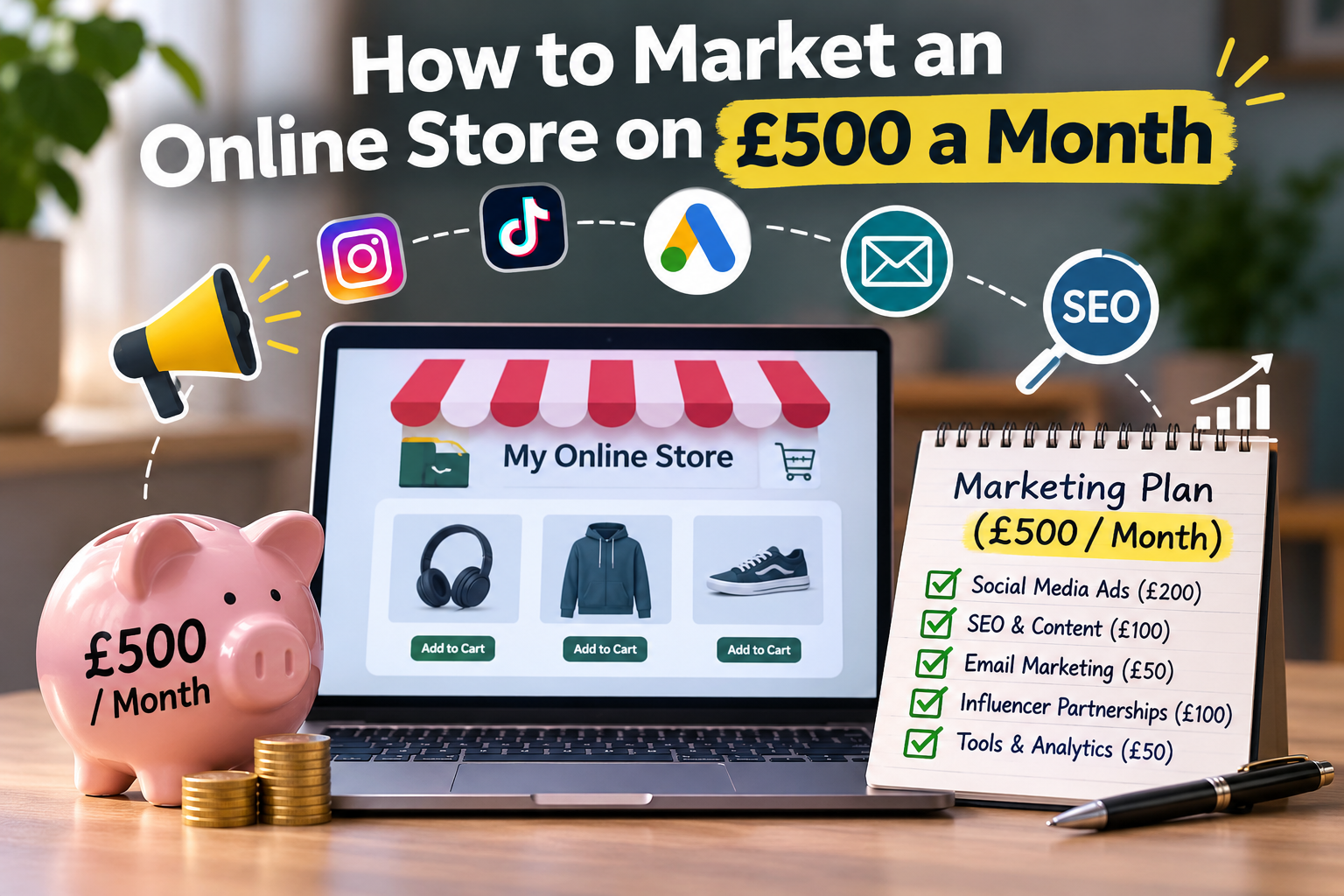
The Quick Answer: How to Market an Online Store on £500 a Month
You don't need a five-figure advertising budget to grow an online shop. You need a sensible plan, a clear understanding of your customers, and the discipline to spend money where it has the best chance of generating profitable sales.
If you've got £500 a month to invest in marketing your online store, here's a practical starting point:
| Marketing activity | Monthly budget | What you're trying to achieve |
|---|---|---|
| Search engine optimisation (SEO) and content | £150 | Attract customers through Google without paying for every click |
| Google Shopping or Meta advertising | £150 | Generate targeted traffic and test which products sell |
| Email marketing | £75 | Recover abandoned baskets and encourage repeat purchases |
| Organic social media and content creation | £75 | Build awareness, trust and engagement |
| Conversion rate optimisation (CRO) | £50 | Turn more website visitors into paying customers |
| Total | £500 | Build a sustainable, measurable marketing strategy |
Here's what matters most:
-
Start with your website. There's little point paying for visitors if your product pages, checkout or mobile experience are putting people off buying.
-
Focus on one or two advertising channels. A £500 monthly marketing budget won't stretch far if you scatter it across every platform.
-
Invest in organic visibility. E-commerce SEO and useful content can continue attracting potential customers long after you've published them.
-
Don't ignore existing customers. Email marketing, abandoned cart recovery and repeat purchases can generate revenue without constantly paying to acquire new shoppers.
-
Measure profit, not just traffic. A campaign that generates £1,000 in sales isn't necessarily successful if your products, advertising and fulfilment cost £1,100.
-
Give your strategy time. Use the first 90 days to establish a baseline, test your assumptions and improve what works.
The golden rule: Don't try to market your online store everywhere. Make a few carefully chosen channels work together, measure their contribution to sales, and invest more in the activities that produce profitable results.
This guide explains How to Market an Online Store on £500 a Month, from setting realistic marketing goals and understanding your ideal customer to allocating your budget, attracting traffic and improving conversions.
It's designed for independent e-commerce businesses, particularly single-brand online stores selling their own products, where every pound matters.
Is £500 a Month Enough to Market an Online Store?
Yes. £500 a month can be enough to start marketing an online store effectively.
But there's an important distinction between having enough money to start and having enough money to scale quickly.
If you're launching a new online shop with no existing audience, no customer reviews and very little organic traffic, £500 won't magically generate hundreds of orders overnight.
Equally, if you've already got a functioning website, a handful of proven products and some existing customers, that same £500 could help you build on what's working.
The difference comes down to how intelligently you use it.
What Can a £500 Monthly Marketing Budget Actually Achieve?
Think of your budget as £16.44 a day, averaged across a 365-day year.
That isn't much when you consider how quickly paid advertising costs can accumulate. However, not every marketing activity requires you to pay for each visitor.
With the right e-commerce marketing strategy, your budget can support several complementary activities:
-
Build organic search visibility by improving product pages, targeting relevant keywords and publishing helpful content.
-
Test paid advertising with a small number of products and carefully selected audiences.
-
Develop an email marketing system that follows up with interested shoppers and existing customers.
-
Create useful social media content that demonstrates your products and builds confidence in your brand.
-
Improve website conversions so more of the traffic you're already receiving turns into revenue.
The trick is understanding that these activities work on different timescales.
Paid advertising can bring visitors to your website relatively quickly, although sales are never guaranteed. SEO usually takes longer to develop, but successful optimisation can produce ongoing organic traffic. Email marketing may deliver faster results when you've already got a permission-based subscriber list.
A sensible small business digital marketing plan combines immediate opportunities with longer-term growth.
Why £500 Can Be More Effective Than a Poorly Spent £2,000
Imagine two online retailers.
Store A spends £2,000 a month advertising across Google, Facebook, Instagram and TikTok. It has no reliable conversion tracking, rarely reviews campaign performance and doesn't know which products are actually profitable.
Store B spends £500 a month. It concentrates on its best-selling products, improves its search visibility, collects email subscribers and tracks the cost of acquiring each customer.
Store A might generate more visitors and even more revenue.
But Store B could produce a better return on investment (ROI), particularly if it has healthier margins and encourages customers to purchase again.
That's not to suggest smaller budgets automatically outperform larger ones. They don't.
It simply illustrates why marketing efficiency matters more than marketing expenditure alone.
If you're unsure where your current website is losing potential customers, a free e-commerce marketing audit can be a useful starting point before committing money to additional advertising.
When £500 Might Not Be Enough
There are circumstances where £500 will be restrictive.
For example:
-
Your products have very low profit margins.
-
You're competing for expensive advertising keywords against established national retailers.
-
Your website needs substantial technical work before it can convert visitors.
-
You're trying to launch several unrelated product ranges simultaneously.
-
Your budget must also cover professional agency fees, photography, website development and advertising.
-
You need a large volume of sales immediately to keep the business operating.
None of these necessarily makes affordable e-commerce marketing impossible.
It does mean you'll need to prioritise ruthlessly.
For example, if your website has a poor mobile checkout experience, spending the entire £500 on online store advertising could simply expose that problem to more people.
Fixing the purchasing experience first might produce a better commercial outcome.
The bottom line? £500 is a realistic starting budget for a focused, owner-managed marketing plan. It isn't a guarantee of sales, and it works best when you're prepared to contribute your own time.
Step 1: Set Your Marketing Goals Before Spending a Penny
Here's where many small online businesses go wrong.
They decide they need more sales, open an advertising account, put £10 or £20 behind a campaign and hope for the best.
A few days later, they've received some clicks but no orders.
So they change the audience. Then the advert. Then the platform.
Before long, the budget has disappeared and they're no closer to understanding what went wrong.
Sound familiar?
The solution isn't necessarily better advertising. It's better planning.
Before deciding how to promote an online shop, establish exactly what you're trying to achieve.
Choose One Primary Marketing Goal
Your marketing goal should reflect the current stage of your business.
For example:
| Business situation | Primary goal | Useful KPI |
|---|---|---|
| Brand-new online store | Attract relevant visitors and validate demand | Qualified traffic and conversion rate |
| Store receiving traffic but few orders | Improve the purchasing experience | E-commerce conversion rate |
| Store with occasional sales | Acquire more profitable customers | Customer acquisition cost |
| Store with established customers | Increase repeat purchases | Repeat purchase rate |
| Store with proven profitable products | Scale customer acquisition | Contribution profit and return on ad spend |
You can monitor several marketing KPIs, but concentrating on one main objective makes it easier to decide where your limited budget should go.
For instance, a shop with 5,000 monthly visitors and a conversion rate of 0.5% may benefit more from conversion rate optimisation than immediately purchasing additional traffic.
A shop with a 3% conversion rate but only 200 monthly visitors faces a different challenge.
One needs to convert existing demand more effectively.
The other probably needs to attract more qualified visitors.
Same £500 budget. Completely different priorities.
Understand Your Numbers Before Setting Targets
Let's look at a simple example.
Suppose your online store has the following performance:
-
Average order value (AOV): £40
-
Gross profit margin before marketing: 50%
-
Monthly marketing budget: £500
-
Website conversion rate: 2%
At a £40 average order value, each order generates £20 in gross profit before marketing costs, assuming the 50% margin includes the relevant product costs but excludes marketing.
To recover £500 in marketing expenditure from that gross profit, you'd need:
£500 ÷ £20 = 25 additional orders
Those 25 orders would generate £1,000 in revenue.
However, that only covers the marketing spend at the stated margin. It doesn't necessarily cover payment processing, additional fulfilment costs, returns, overheads or tax.
Now consider the website traffic required.
At a 2% conversion rate:
25 orders ÷ 0.02 = 1,250 visitors
If those visitors were all purchased through advertising, you'd need an average cost per click of £0.40 to acquire them within £500.
And even then, you'd only be covering the marketing spend under our simplified assumptions.
This is why relying entirely on paid advertising can be challenging for smaller e-commerce businesses.
It's also why combining paid traffic with organic search, email marketing and customer retention can make commercial sense.
You can explore the relationship between advertising expenditure and sales performance using an e-commerce ROI calculator.
Focus on Customer Acquisition Cost, Not Vanity Metrics
It's easy to get excited when an Instagram Reel receives 10,000 views or a Google Ads campaign generates 500 clicks.
But views don't pay your suppliers.
And clicks don't automatically mean customers.
One of the most important metrics in e-commerce marketing is customer acquisition cost (CAC).
The basic formula is:
Customer acquisition cost = Total customer acquisition expenditure ÷ Number of new customers acquired
For example, if you spend £300 acquiring customers and generate 15 new customers:
£300 ÷ 15 = £20 CAC
Whether that's good or bad depends on your margins, average order value and customer lifetime value (CLV).
If you make £12 in contribution profit from a first order and customers rarely return, a £20 acquisition cost could be unsustainable.
But if your average customer buys repeatedly and generates £100 in lifetime contribution profit, the economics may be considerably more attractive.
Be careful, though. Future repeat purchases are not guaranteed, and cash flow matters.
For a small online store, it's generally safer to understand your first-order profitability before relying on projected lifetime value to justify advertising losses.
Practical tip: Set a maximum affordable customer acquisition cost before launching paid campaigns. Use your actual product margins and variable costs, not simply the amount of revenue each order generates.
Create Three Realistic 90-Day Targets
Instead of setting a vague goal such as "grow the business", choose measurable targets.
For example:
-
Traffic: Increase relevant organic website visits by 15% over your starting baseline.
-
Conversions: Improve your online store's conversion rate from 1.5% to 1.8%.
-
Customer acquisition: Establish a reliable acquisition cost for your best-selling product range and test whether paid advertising can meet your profitability target.
These are illustrative targets, not industry benchmarks or promised outcomes.
The purpose is to give your marketing activity direction.
Once you've established what success looks like, you can begin making informed decisions about where to spend your £500.
Step 2: Understand Your Target Audience Before Choosing Marketing Channels
You could have beautifully designed adverts, engaging social media posts and perfectly optimised product pages.
But if they're reaching the wrong people, you're wasting your time.
And potentially your entire marketing budget.
Understanding your target audience is one of the most effective ways to make low-cost online marketing work.
It's especially important when you're running a single-brand e-commerce store.
Unlike a large marketplace selling thousands of unrelated products, your brand has the opportunity to develop a clear identity around a specific customer need.
Use that advantage.
Stop Trying to Sell to Everyone
Let's imagine you sell premium reusable water bottles.
You could target anyone who drinks water.
Technically, that's an enormous market.
Commercially, it's a terrible starting point for a £500 marketing budget.
Instead, consider the different types of customers who might buy your products:
-
Fitness enthusiasts: Interested in hydration, portability and gym-friendly designs.
-
Commuters: Looking for leakproof bottles that fit comfortably inside a work bag.
-
Environmentally conscious shoppers: Interested in reusable alternatives to disposable plastic bottles.
-
Gift buyers: Searching for attractive, practical presents.
-
Outdoor enthusiasts: Looking for durability, insulation and convenience.
These customers might buy the same product, but their motivations are different.
That means their search queries, objections, preferred social platforms and reasons for purchasing could also differ.
A commuter might search for "best leakproof water bottle for work".
A gym-goer might search for "large insulated gym water bottle".
A gift buyer might respond to a short video showing the bottle's packaging and presentation.
One product. Several distinct marketing opportunities.
You don't need to target all of them immediately.
Choose the segment most likely to purchase profitably, then build your initial marketing strategy around that group.
Build a Simple Customer Persona
You don't need to commission expensive market research.
Start with what you already know.
Review previous orders, customer enquiries, product reviews, website search terms and social media conversations.
Then create a simple ideal customer profile.
| Customer characteristic | Example |
|---|---|
| Customer segment | Busy professionals who commute |
| Main problem | Drinks leaking inside their bags |
| Desired outcome | A reliable, attractive bottle for daily use |
| Purchase motivation | Convenience and product quality |
| Main objection | Concern about whether the bottle is genuinely leakproof |
| Likely search intent | Comparing leakproof water bottles |
| Useful content | Product demonstrations, customer reviews and comparison guides |
| Potential channels | Google Search, Google Shopping and Instagram |
Notice that this persona isn't just a list of demographic characteristics.
It focuses on why someone might buy.
That's far more useful when you're deciding what to say in an advert, which keywords to target or what information to include on a product page.
Research Your Competitors Without Copying Them
Competitor analysis can reveal opportunities that aren't immediately obvious.
Find three to five businesses selling similar products and examine:
-
Which product benefits do they emphasise?
-
What questions do customers ask in their reviews?
-
Which search terms appear in their product titles and category pages?
-
What types of content receive meaningful engagement?
-
What complaints or frustrations appear repeatedly?
-
Are they competing mainly on price, quality, convenience or brand identity?
You're not looking to imitate their marketing.
You're looking for gaps.
Perhaps competing stores have excellent product photography but very little information about sizing.
Maybe they promote premium quality without demonstrating why their products are worth the extra money.
Or perhaps they overlook specific long-tail keywords that describe problems your products solve.
Those gaps can become opportunities for your own content marketing, SEO and advertising.
Match Your Marketing Channel to Customer Intent
Not every customer is ready to buy.
Someone searching Google for "buy insulated water bottle UK" may be much closer to purchasing than someone casually scrolling through Instagram.
That doesn't mean Google is always the better platform.
It means the two channels often play different roles.
| Marketing channel | Typical role in the customer journey |
|---|---|
| Google Search | Capture existing demand from people actively searching |
| Google Shopping | Display products to shoppers comparing available options |
| Instagram and Facebook | Build awareness, demonstrate products and generate interest |
| Help shoppers discover products and ideas | |
| TikTok | Introduce products through entertaining or informative videos |
| Email marketing | Follow up with subscribers and encourage repeat purchases |
| Organic SEO content | Answer questions, build trust and attract relevant searches |
These are typical patterns, not fixed rules. Actual performance depends on your products, audience and execution.
With a limited budget, your objective is to identify the channels that match your customers' buying behaviour.
For example, if your products solve a problem people actively search for, Google-focused marketing may deserve priority.
If your products are highly visual, unusual or purchased on impulse, short-form social media content could be an effective way to introduce them.
And if customers frequently buy replacement products or complementary items, email marketing could become particularly valuable.
The important thing is to make your channel selection evidence-led rather than simply following whatever marketing trend happens to be popular this month.
Step 3: Allocate Your £500 Marketing Budget Where It Matters Most
Now we've reached the part that makes or breaks your plan.
Where should the money actually go?
There's no universal budget allocation that works for every online store.
A brand-new shop selling handmade jewellery has different needs from an established retailer selling replacement parts.
Likewise, a business with strong organic traffic but poor conversions should spend differently from one with an excellent website and virtually no visitors.
Nevertheless, a balanced £500 monthly marketing budget provides a useful starting framework.
A Practical £500 E-commerce Marketing Budget
| Channel | Monthly investment | Percentage |
|---|---|---|
| SEO and content marketing | £150 | 30% |
| Paid advertising | £150 | 30% |
| Email marketing | £75 | 15% |
| Organic social media content | £75 | 15% |
| Conversion rate optimisation | £50 | 10% |
| Total | £500 | 100% |
This allocation assumes your website is already operational and you're completing much of the work yourself.
It's a budget for marketing activities and supporting tools, not a realistic allowance for outsourcing every task to separate specialists.
Let's look at the reasoning behind each allocation.
£150 for SEO and Content Marketing
SEO is one of the most useful long-term investments for online stores operating on restricted budgets.
Instead of paying for every website visit, you're improving your chances of appearing in organic search results when potential customers look for relevant products or information.
Your £150 might support:
-
A keyword research or SEO tool subscription.
-
Product description improvements.
-
Content creation resources.
-
Technical SEO fixes you can implement yourself.
-
Image optimisation or other essential website improvements.
The most important distinction is between spending money on SEO and doing useful SEO work.
A subscription alone won't improve your rankings.
You'll need to research search intent, improve your product pages, address technical problems and publish genuinely helpful content.
For a small online store, I'd prioritise existing product and category pages before producing dozens of generic blog posts.
After all, attracting visitors who are actively searching for something you sell is often more commercially useful than generating unrelated traffic.
If you need a clearer understanding of the work involved, explore the e-commerce SEO services available to support organic search growth.
£150 for Paid Advertising
With £150 a month, you've got approximately £5 a day for advertising.
That's a testing budget, not a licence to compete aggressively across multiple platforms.
Start small.
Choose one advertising platform, one clearly defined objective and a limited selection of products.
For example, you might test:
-
Google Shopping ads for a proven best-selling product.
-
A tightly targeted Google Search campaign.
-
A Meta Ads campaign featuring a compelling product demonstration.
-
A retargeting campaign, provided you have sufficient eligible audience data and appropriate consent.
Avoid splitting £150 across Google Ads, Facebook Ads, Instagram Ads and TikTok Ads simultaneously.
You could end up with too little data from each campaign to make confident decisions.
And remember that the cost per click (CPC) will vary considerably depending on your industry, competition, targeting and advertising quality.
At £0.50 per click, £150 could purchase approximately 300 clicks.
At £2 per click, the same budget would purchase just 75.
Neither scenario guarantees a sale.
That's why paid advertising must be assessed alongside conversion rates, profit margins and customer acquisition costs.
£75 for Email Marketing
Email marketing deserves a place in your budget because it allows you to communicate with people who have already expressed an interest in your business.
Depending on your subscriber numbers and chosen platform, you may not even need to spend the full £75 on software.
Your initial priorities should include:
-
A compliant email signup form with a clear reason to subscribe.
-
An automated welcome email.
-
Abandoned checkout recovery where technically available and legally appropriate.
-
A post-purchase email sequence.
-
Occasional useful product updates or relevant offers.
You don't need an elaborate automation system to begin.
A well-written welcome sequence and a helpful post-purchase email can provide a solid foundation.
The objective isn't to bombard subscribers with discounts.
It's to build relationships that encourage customers to return.
£75 for Organic Social Media Content
Organic social media can be affordable, but it isn't genuinely free.
Your time has value.
Creating product photographs, filming demonstrations, editing videos and responding to comments all require effort.
The £75 allocation could support basic content creation tools, simple props, editing software or occasional production expenses.
For a single-brand online store, I'd focus on creating content that answers real customer questions.
Show your products being used.
Demonstrate their features.
Address common objections.
Share authentic customer feedback with permission.
Explain what makes your brand different.
You don't need to become a full-time influencer.
You need to help potential customers understand why your products are worth buying.
£50 for Conversion Rate Optimisation
This might be the smallest allocation in the plan, but don't underestimate it.
Conversion rate optimisation (CRO) focuses on improving the percentage of website visitors who complete a desired action, such as purchasing a product.
That could involve:
-
Improving product photography.
-
Making delivery information easier to find.
-
Clarifying your returns policy.
-
Adding genuine customer reviews.
-
Simplifying product descriptions.
-
Fixing mobile usability problems.
-
Improving the clarity of your add-to-basket buttons.
Many useful improvements cost little beyond your time.
And they can affect sales from every marketing channel, not just one campaign.
For example, if your website receives 1,000 visitors a month:
-
At a 1% conversion rate, you'd generate 10 orders.
-
At a 2% conversion rate, you'd generate 20 orders.
That's twice as many orders from the same number of visitors.
Of course, doubling a conversion rate isn't easy or guaranteed. The example simply illustrates why improving your website can be as important as attracting more traffic.
Before investing heavily in advertising, make sure your store provides a convincing, straightforward buying experience. Where larger improvements are necessary, professional e-commerce web design support may be worth considering.
Should You Follow This Budget Split Exactly?
Not necessarily.
Treat the allocation as a starting hypothesis.
If you've already got 5,000 monthly organic visitors but hardly any sales, you might temporarily redirect more of your budget towards conversion optimisation.
If you've got an excellent conversion rate but almost no traffic, you might prioritise SEO and a carefully controlled paid advertising test.
And if you have a substantial customer list but limited cash, email marketing and retention could deserve greater attention.
Your budget should follow your business's biggest constraint, not an arbitrary percentage.
The aim is to develop a cost-effective marketing strategy that makes each pound accountable.
Once you've established this foundation, the next challenge is putting those individual marketing channels to work, beginning with attracting qualified customers through search engines.
Step 4: Improve Your Online Store's SEO to Attract Customers Without Paying for Every Click
Imagine opening your online store tomorrow morning and discovering that potential customers have been finding your products through Google while you were asleep.
No advertising campaign running. No payment for every visitor. Just people searching for products you sell and discovering your website in the organic search results.
That's the attraction of e-commerce search engine optimisation (SEO).
And when you're working out How to Market an Online Store on £500 a Month, it's one of the most valuable long-term strategies to consider.
But there's a catch.
SEO isn't free, instant or guaranteed.
It takes research, consistent effort and an understanding of what your customers are actually searching for.
The good news? You don't need an enormous budget to start improving your website's organic visibility.
Start With Keywords That Show Buying Intent
Not all keywords are equally valuable.
Let's imagine you sell handmade leather wallets.
You could spend months trying to rank for the keyword "wallets".
It's broad, highly competitive and doesn't tell you much about what the searcher wants.
Now consider these alternatives:
-
Handmade leather wallets UK
-
Personalised leather wallet for men
-
Slim leather card holder
-
Brown leather bifold wallet
-
Handmade leather wallet gift
-
Genuine leather wallet with coin pocket
These are examples of long-tail keywords.
They tend to be more specific than broad product terms and can reveal much more about a potential customer's requirements.
Someone searching for "personalised leather wallet for men" may already know the type of product they want.
That's a very different prospect from someone searching for "what is leather?"
Both searches could have value, but they serve different purposes.
With a restricted small business marketing budget, prioritise keywords that closely match products you actually sell.
A simple keyword research process:
-
List your main products and product categories.
-
Write down the problems those products solve.
-
Search Google for relevant product terms and examine autocomplete suggestions.
-
Review related searches and common customer questions.
-
Look at the language competitors use in their product titles.
-
Use Google Search Console to identify searches already generating impressions for your website.
-
Group keywords by search intent and assign each group to the most appropriate page.
Don't create multiple pages targeting nearly identical keywords without a meaningful difference in purpose.
Instead, build clear, useful pages that satisfy the searcher's needs.
Optimise Your Product Pages Before Writing Dozens of Blog Posts
Here's a mistake I see in a lot of small online store marketing strategies.
The business owner spends hours publishing blog articles while their actual product pages contain little more than a photograph, a price and two sentences.
That's backwards.
Your product pages are where purchasing decisions happen.
They should be among the first pages you optimise.
A well-structured product page should include:
-
A descriptive product title containing the main product keyword naturally.
-
An original product description explaining features, benefits and practical uses.
-
High-quality photographs showing the product clearly from different angles.
-
Relevant image alt text describing meaningful visual information.
-
Clear pricing and availability information so customers know what to expect.
-
Delivery and returns information that addresses common purchasing concerns.
-
Genuine customer reviews where available.
-
Internal links to relevant categories, complementary products or useful buying guides.
For example, instead of naming a product simply:
"The Classic"
You could use:
"The Classic – Handmade Brown Leather Bifold Wallet"
You can still retain the product's brand identity while making its purpose clearer to shoppers and search engines.
The same principle applies to descriptions.
Avoid generic statements such as:
"Our premium-quality wallet is stylish, practical and perfect for everyday use."
That tells customers very little.
A more useful description might explain the number of card slots, dimensions, material, construction and whether the wallet fits comfortably in a trouser pocket.
Specific information helps customers decide whether the product meets their needs.
And that's ultimately what good product page optimisation is about.
Don't Overlook Your Category Pages
Product pages target individual items.
Category pages help shoppers browse related products.
Both are important.
Suppose your online store sells several styles of handmade leather accessories.
You might organise them into categories such as:
-
Men's leather wallets
-
Leather card holders
-
Personalised leather gifts
-
Leather travel accessories
Each category should have a clear purpose.
Use descriptive headings, helpful introductory text, sensible product filters and straightforward navigation.
Avoid stuffing category descriptions with repeated keywords.
Your objective is to make the page genuinely useful.
For a single-brand store, a well-organised collection structure can also strengthen internal linking and help search engines understand relationships between products.
Fix the Technical SEO Basics
You don't need to become a developer to identify some common technical SEO problems.
Start with the fundamentals.
Check these seven areas:
-
Mobile usability: Can customers comfortably browse and purchase using a smartphone?
-
Website speed: Do your pages load reasonably quickly, especially on mobile connections?
-
Indexing: Can Google discover and index the pages you want appearing in search results?
-
Broken links: Are important product and category links working correctly?
-
Duplicate content: Are unnecessary URL variations creating indexing confusion?
-
Structured data: Are relevant product details marked up correctly where supported?
-
Internal linking: Can visitors and search engines navigate naturally between related pages?
Google Search Console is particularly useful because it can reveal indexing issues, search impressions, clicks and other information about your site's organic search performance.
You can also use Google's PageSpeed Insights to investigate loading performance.
Don't become obsessed with achieving a perfect technical score.
A fast, usable website with helpful product information is generally more valuable than one that scores beautifully in a testing tool but fails to answer customers' questions.
Use Blog Content to Support Product Sales
Blogging can work extremely well for e-commerce SEO.
But only when the content connects to your products and audience.
Let's return to our leather wallet example.
Relevant blog topics might include:
-
How to choose the right leather wallet
-
Bifold vs trifold wallets: which is better?
-
How to care for a handmade leather wallet
-
Best personalised leather gifts for birthdays
-
What makes full-grain leather different?
These articles attract people researching products, comparing options or looking for advice.
They also create natural opportunities to link readers to relevant products.
This is where search intent becomes important.
Someone searching "how to clean a leather wallet" probably wants instructions, not an immediate sales pitch.
Answer their question thoroughly.
Then, where relevant, introduce your products as a logical next step rather than forcing them into every paragraph.
That's how content marketing can build trust while supporting future sales.
How Long Does E-commerce SEO Take to Work?
There isn't a fixed timetable.
Some technical improvements may affect how search engines process your pages relatively quickly.
Competitive keyword rankings and meaningful increases in organic traffic can take several months or longer.
Results depend on factors including:
-
Your website's existing authority and visibility.
-
Competition for your target keywords.
-
The quality and relevance of your content.
-
Technical accessibility.
-
Product demand.
-
The consistency of your SEO improvements.
With a £500 monthly marketing budget, treat SEO as an ongoing investment rather than a short-term advertising substitute.
Your first-month SEO priority: Identify your five most commercially important pages, improve their content and technical foundations, and establish a Search Console performance baseline.
That's a manageable starting point with the potential to benefit your store over time.
Step 5: Use Low-Cost Social Media Marketing to Build Trust and Demand
Social media can be a brilliant way to introduce people to your products.
It can also become an enormous waste of time.
The difference often comes down to whether you're using it with a clear commercial purpose.
If you're posting random product photographs, chasing followers and hoping something goes viral, you're not really following an e-commerce marketing strategy.
You're gambling with your time.
Instead, think of social media as an opportunity to show potential customers what your products do, why they matter and what makes your brand worth choosing.
Choose One Main Social Media Platform
When you're marketing an online store on £500 a month, you probably don't have the resources to produce unique content for every social platform.
So don't try.
Choose the platform that best matches your audience and product type.
| Platform | Potentially suitable for | Content ideas |
|---|---|---|
| Visual products, lifestyle brands and accessories | Reels, product demonstrations, customer photographs | |
| Community-focused brands and established customer audiences | Product updates, customer stories, useful advice | |
| TikTok | Products that benefit from entertaining demonstrations | Short videos, tutorials, behind-the-scenes content |
| Homeware, fashion, gifts, crafts and visually searchable products | Product images, inspiration boards, buying guides | |
| YouTube | Products requiring explanations or comparisons | Tutorials, detailed demonstrations, product comparisons |
These are starting points, not guarantees about where your customers spend their time.
Check your own analytics and customer feedback before committing substantial effort.
For example, a brand selling visually distinctive home accessories might find Pinterest worth testing.
A business selling a technical product could benefit from detailed YouTube demonstrations.
And a brand with an engaged Instagram audience may have little reason to immediately expand into three additional platforms.
Consistency on one relevant platform is usually a more manageable starting point than sporadic activity on five.
Create Content That Helps People Make Buying Decisions
Here's something worth remembering:
People rarely open Instagram thinking, "I hope a small business tries to sell me something today."
They're looking for entertainment, inspiration, information or connection.
Your content needs to offer at least one of those things.
For a single-brand online store, I recommend building content around four themes.
1. Show the Product in Action
Demonstrate what your product actually does.
If you sell kitchen accessories, show them being used to prepare a meal.
If you sell travel organisers, demonstrate how much they hold.
If you sell skincare accessories, explain their intended use without making unsupported medical claims.
Product demonstrations help customers imagine owning and using your products.
They're also an opportunity to answer questions that might otherwise prevent a purchase.
2. Address Customer Objections
Every product has potential objections.
Customers might wonder:
-
Is it worth the price?
-
How big is it?
-
Will it last?
-
Is it easy to use?
-
What happens if it doesn't suit me?
-
How does it compare with alternatives?
Turn these questions into content.
For example, a short video demonstrating the dimensions of a handbag beside everyday objects may be more useful than another carefully staged product photograph.
You're removing uncertainty.
And reducing uncertainty can make buying decisions easier.
3. Show the People and Process Behind Your Brand
One advantage of running an independent online store is that your business has a story.
You don't need to pretend you're a multinational retailer.
Show the design process.
Explain why you developed a particular product.
Share how orders are prepared.
Talk about materials, quality checks or packaging where those details are genuinely relevant.
This type of content can help customers connect with your brand rather than viewing your products as interchangeable commodities.
4. Share Genuine Customer Experiences
Customer reviews, photographs and user-generated content (UGC) can provide valuable social proof.
With permission, you could share:
-
Customer photographs featuring your products.
-
Video demonstrations from genuine buyers.
-
Reviews addressing common concerns.
-
Examples of products being used in everyday situations.
-
Customer questions and your responses.
Never invent reviews or present paid endorsements as independent customer opinions.
If you collaborate with influencers or provide free products in exchange for promotional content, make sure the commercial relationship is disclosed appropriately.
Trust is difficult to build and remarkably easy to damage.
A Simple Weekly Social Media Content Plan
You don't need to publish ten times a day.
Start with a realistic schedule.
| Day | Content | Purpose |
|---|---|---|
| Monday | Short product demonstration | Explain a useful feature |
| Wednesday | Customer question or practical tip | Build trust and address objections |
| Friday | Behind-the-scenes or customer story | Strengthen brand awareness |
| Sunday | Product-focused post or relevant offer | Encourage website visits |
This is an example, not a requirement to post four times every week.
If two excellent posts are all you can produce consistently, start there.
You can repurpose suitable content across channels rather than creating everything from scratch.
A product demonstration filmed for Instagram might also work on TikTok or YouTube Shorts after adapting the format.
A customer question could become a blog post, an email or a product page FAQ.
This is one of the most practical ways to make content marketing more affordable.
Should You Pay Micro-Influencers?
Micro-influencer marketing can be worth testing, particularly when your products appeal to a specific community.
However, don't assume an influencer with 20,000 followers will generate more sales than someone with 2,000.
Audience relevance and genuine engagement matter.
Before agreeing to a collaboration, consider:
-
Does their audience resemble your ideal customer?
-
Do their previous posts receive meaningful engagement?
-
Have they promoted similar products?
-
Is their content consistent with your brand?
-
Can you measure visits or purchases resulting from the collaboration?
You might offer a product for review or negotiate a modest paid collaboration.
But remember to account for the full cost, including product manufacturing, packaging, shipping and any fees.
Use an appropriate tracking link or discount code to help assess performance.
And ensure that advertising disclosures meet applicable UK requirements.
With a small budget, one carefully chosen collaboration is generally a more sensible test than distributing products to dozens of unrelated creators.
Step 6: Test Google Shopping and Paid Advertising Without Wasting Your Budget
Paid advertising is often the first thing online store owners think about when they want more sales.
And it's easy to understand why.
You create an advert, choose an audience, set a budget and potentially start attracting visitors much faster than you could through organic SEO alone.
But here's the problem.
Advertising platforms charge you for exposure or interactions, not guaranteed profit.
A campaign can generate hundreds of clicks and still lose money.
That's why affordable online advertising requires discipline, particularly when you've allocated just £150 of your £500 marketing budget to paid campaigns.
Google Shopping vs Meta Ads: Which Should You Choose?
The right platform depends largely on how customers discover your products.
Google Shopping can be particularly relevant when people are already searching for the types of products you sell.
Your products may appear with information such as images, prices and merchant details, depending on eligibility and placement.
For example, someone searching for "black leather laptop bag" could encounter Shopping results showing available products.
That shopper has expressed a specific interest.
Meta Ads, including advertising across Facebook and Instagram, can help introduce products to people who weren't necessarily searching for them.
A compelling video demonstration might generate interest in a product someone hadn't previously considered.
Both approaches can work.
But they solve slightly different problems.
| Consideration | Google Shopping | Meta Ads |
|---|---|---|
| Typical opportunity | Capture existing product demand | Generate interest and demand |
| Main creative asset | Product images and feed information | Images, videos and advertising copy |
| Customer behaviour | Often searching or comparing products | Often browsing social content |
| Important optimisation | Product feed quality and campaign structure | Creative quality and audience response |
| Potential challenge | Competitive clicks and product comparisons | Attracting attention without purchase intent |
| Useful performance metrics | CPC, conversions, ROAS | CPA, conversions, ROAS |
For a small online store, start by asking:
Are customers already searching for my products, or do I need to show them why they should want them?
That question can help guide your initial advertising strategy.
Start With Your Best-Selling Products
One of the easiest ways to waste a limited PPC budget is to advertise everything in your catalogue.
Suppose you sell 50 products.
Some have excellent margins.
Some have low margins.
Some are proven sellers.
Others have never generated an order.
Why give them all the same advertising priority?
Instead, identify two or three products with the strongest commercial potential.
Look for products that have:
-
Healthy contribution margins.
-
Consistent availability.
-
Clear customer demand.
-
Competitive selling propositions.
-
Strong product photography.
-
Positive customer feedback, where available.
-
A purchasing experience that works properly on mobile devices.
You can expand later if the results justify it.
For now, concentrate your budget where you have the clearest opportunity to learn.
Get Your Google Merchant Center Feed Right
If you're planning to use Google Shopping, your product data matters.
Google Merchant Center allows eligible retailers to submit product information for use in Shopping experiences and free product listings.
A product feed commonly includes information such as:
-
Product title.
-
Product description.
-
Price.
-
Availability.
-
Product image.
-
Product URL.
-
Brand.
-
Relevant product identifiers, where applicable.
-
Shipping and returns information.
Because you're selling your own brand, make sure your brand information is accurate and consistent.
Don't invent product identifiers where they don't exist.
For products without assigned GTINs, follow Google's applicable product identifier requirements rather than entering fabricated values.
Product titles should clearly describe what you're selling.
For example:
Weak title: "Signature Collection No. 4"
More descriptive title: "Signature Collection No. 4 – Black Leather Crossbody Bag"
The second version gives shoppers more context while preserving the product's identity.
Also check that the information in your feed matches the information displayed on your website.
Discrepancies involving price, availability or other required details can cause product disapprovals.
Don't Ignore Free Google Product Listings
Not every Google product placement requires paid advertising.
Eligible retailers can make products available through Google's free listings programme.
This can be particularly useful when you're exploring how to increase online store sales without spending heavily on advertising.
Free listings aren't a substitute for SEO or a guarantee of visibility.
However, they provide another potential route for customers to discover your products.
For a £500-a-month marketing plan, it's worth checking whether your store is eligible and whether your product data meets the relevant requirements.
How Much Should You Spend on Google Ads?
Let's assume you've allocated £150 a month to advertising.
That gives you approximately £5 per day over a 30-day month.
At that level, I would avoid launching several unrelated campaigns.
Instead, consider testing one focused campaign with a limited selection of products.
For example:
Illustrative Google Shopping test
-
Monthly advertising budget: £150
-
Average daily budget: Approximately £5
-
Advertised products: Two or three commercially promising items
-
Primary objective: Generate purchases at an acceptable acquisition cost
-
Measurement: Conversion tracking, cost per purchase and ROAS
You might begin by examining performance over several weeks, provided the campaign generates enough meaningful data.
But don't assume 30 days will always be sufficient to establish profitability.
At low spend levels, campaigns may generate too few conversions to support confident conclusions.
Avoid making major changes after every individual click.
Equally, don't continue spending indefinitely when the available evidence shows that a campaign is unlikely to meet your financial objectives.
Calculate Your Break-Even Return on Ad Spend
Return on ad spend (ROAS) is one of the most commonly used metrics in e-commerce advertising.
The basic formula is:
ROAS = Revenue attributed to advertising ÷ Advertising spend
Suppose you spend £150 on advertising and generate £600 in attributed revenue.
Your ROAS is:
£600 ÷ £150 = 4
That's a 4:1 ROAS, or £4 of attributed revenue for every £1 spent on advertising.
Sounds good, doesn't it?
Not necessarily.
If your products have low margins, that revenue might not leave enough money to cover advertising and other costs.
To estimate break-even ROAS, use your contribution margin before advertising.
Break-even ROAS = 1 ÷ Contribution margin
For example:
| Contribution margin before ads | Approximate break-even ROAS |
|---|---|
| 20% | 5.0 |
| 30% | 3.33 |
| 40% | 2.5 |
| 50% | 2.0 |
| 60% | 1.67 |
These calculations assume the margin already accounts for relevant variable costs other than advertising, and that revenue and cost figures are measured consistently.
At a 40% contribution margin, a 2.5 ROAS would approximately cover advertising costs before fixed overheads.
You'd generally need a higher ROAS to contribute towards those overheads and generate additional profit.
This is why a profitable advertising strategy isn't necessarily the one with the most clicks or even the highest sales revenue.
It's the one that generates an acceptable financial return.
What About Retargeting Ads?
Retargeting, sometimes called remarketing, involves advertising to eligible audiences who have previously interacted with your business.
For example, someone might view a product but leave without buying.
Where appropriate consent, tracking and platform eligibility requirements are met, you may be able to reach that person again with a relevant advert.
Retargeting can be useful because these audiences have already shown some interest.
However, there are two limitations for small online stores.
First, you need enough eligible audience activity to make the campaign viable.
Second, retargeting doesn't automatically create new demand.
If your website receives very little traffic, a dedicated retargeting campaign may have limited reach.
With only £150 available for paid advertising, don't automatically reserve money for retargeting.
Assess whether your audience size and campaign results justify it.
Five Paid Advertising Mistakes to Avoid
Before launching your first campaign, watch out for these common problems.
-
Advertising low-margin products: Revenue means little if every sale loses money.
-
Sending visitors to weak product pages: Advertising cannot reliably compensate for an unconvincing buying experience.
-
Using overly broad targeting: Your budget may disappear before you reach enough relevant shoppers.
-
Ignoring conversion tracking: Without reliable measurement, it's difficult to understand campaign performance.
-
Changing campaigns too frequently: Constant adjustments can make it harder to interpret results, especially with limited data.
Paid advertising should support your wider e-commerce marketing plan, not operate as an isolated experiment.
Your SEO, product content, customer reviews, pricing and checkout experience all influence what happens after someone clicks.
And that brings us to another important part of affordable e-commerce marketing: making more money from the customers and visitors you've already worked hard to attract.
Step 7: Use Email Marketing to Increase Sales Without Constantly Finding New Customers
Here's a question worth asking yourself.
What happens when someone visits your online store, looks at a product, considers buying it and then leaves?
If your only marketing strategy is attracting new visitors, the answer is probably nothing.
That potential customer disappears, and you're back to spending money trying to attract someone else.
This is where email marketing becomes one of the most cost-effective marketing strategies for small online stores.
Unlike paid advertising, where you're often paying to reach people through a third-party platform, email allows you to build an ongoing relationship with subscribers who have agreed to hear from your business.
And when you're learning How to Market an Online Store on £500 a Month, that relationship can be incredibly valuable.
Why Email Marketing Deserves a Place in Your £500 Budget
Imagine two customers visiting your online shop.
Customer A arrives through a Google advert, looks at a product and leaves.
Customer B arrives through the same advert, looks at the same product and subscribes to your newsletter because they're interested in receiving useful product advice and occasional offers.
Neither purchases immediately.
But you now have an opportunity to communicate with Customer B again, subject to their marketing preferences.
You could send them a helpful buying guide, introduce your brand or notify them about a relevant product launch.
Customer A may never return.
That's the difference between relying entirely on paid traffic and building an audience you can communicate with directly.
Email marketing can support several important e-commerce objectives:
-
Recovering potentially lost sales.
-
Encouraging first-time purchases.
-
Increasing repeat purchases.
-
Introducing complementary products.
-
Building customer loyalty.
-
Promoting relevant new products.
-
Increasing customer lifetime value.
However, email marketing isn't simply about collecting as many addresses as possible.
A smaller, engaged subscriber list can be more commercially useful than a large database of people who never open your messages.
Start by Building a Permission-Based Email List
Before you can send effective email campaigns, you need subscribers.
And you need to collect their information appropriately.
For UK businesses, that means understanding relevant UK GDPR and Privacy and Electronic Communications Regulations (PECR) requirements.
Don't assume that someone placing an order automatically gives you permission to send unrestricted promotional emails.
There are circumstances where the existing-customer 'soft opt-in' may apply, but it has specific conditions, including providing appropriate opportunities to opt out.
For new subscribers, a clear, voluntary signup process is a sensible starting point.
You might encourage signups by offering:
-
Useful product buying guides.
-
Early access to new collections.
-
Relevant product care advice.
-
Exclusive subscriber updates.
-
A modest first-order incentive, where commercially viable.
Be careful with discounts.
Offering 20% off every first order might attract subscribers, but it could also destroy your profit margin.
For a single-brand store, exclusive information or useful advice may be a better incentive than immediately reducing your prices.
Create a Simple Welcome Email Sequence
You don't need a complicated automation system.
Start with three emails.
Email 1: Welcome to the Brand
Send this shortly after someone subscribes.
Introduce your business, explain what makes your products different and deliver anything promised during signup.
Keep the tone welcoming rather than aggressively promotional.
Email 2: Help the Customer Choose
A few days later, share something genuinely useful.
This might be a product comparison, a buying guide, an explanation of your materials or answers to frequently asked questions.
The purpose is to remove uncertainty and build confidence.
Email 3: Introduce a Relevant Product
Follow up with a product recommendation or collection that matches the subscriber's interests, where you have enough information to make that recommendation appropriately.
Include clear product benefits, relevant customer feedback and a straightforward route back to your store.
The exact timing should depend on your products and customers.
Someone buying a low-cost everyday accessory may make decisions quickly.
Someone considering an expensive, specialised product may need considerably more time.
Recover Abandoned Baskets Without Annoying Customers
Cart abandonment is a familiar problem for e-commerce businesses.
A customer adds something to their basket but leaves before completing the purchase.
Sometimes they're comparing prices.
Sometimes delivery costs are higher than expected.
Sometimes they're distracted.
And sometimes they're simply not ready to buy.
Abandoned checkout recovery gives you an opportunity to follow up where you have the appropriate permission and technical setup.
A simple sequence might look like this:
| Timing | Message | Purpose |
|---|---|---|
| Around 1 hour after abandonment | A helpful reminder | Make it easy to return to the basket |
| Around 24 hours later | Product information or answers to common questions | Address potential objections |
| Around 48–72 hours later | A final relevant follow-up | Give the customer another opportunity to complete the order |
These timings are illustrative, not universal best practice.
You should also distinguish between service communications and direct marketing. An abandoned checkout message containing promotional content may be subject to electronic marketing rules.
Don't immediately offer a discount every time someone abandons their basket.
If customers learn that leaving without buying triggers a cheaper price, you may train them to delay purchasing.
Instead, start by making the buying process easier.
Remind customers what they were interested in, explain relevant delivery information and address common concerns.
Encourage Repeat Purchases With Post-Purchase Emails
Getting someone to buy from you once is a milestone.
Getting them to return is where a sustainable e-commerce business can begin to develop.
A useful post-purchase sequence could include:
-
Order confirmation: Clear transactional information about the purchase.
-
Product guidance: Instructions for getting the best results from the item.
-
Review request: An invitation to share genuine feedback.
-
Product care advice: Tips that help customers enjoy their purchase for longer.
-
Relevant follow-up: Information about complementary products or new releases, where marketing permission allows.
Not every product is suitable for frequent repeat purchases.
Someone buying a durable leather bag might not need another bag next month.
But they may be interested in a matching accessory, a gift or a future collection.
The key is relevance.
Good email marketing makes customers feel understood. Poor email marketing makes them feel chased.
How to Measure Email Marketing Performance
Don't judge your email marketing solely by open rates.
Email privacy features can make open-rate data less reliable than it once was.
Instead, examine:
-
Click-through rates.
-
Orders attributed to email campaigns.
-
Revenue generated.
-
Conversion rates.
-
Unsubscribe rates.
-
Customer repeat purchase rates.
-
Revenue per email recipient.
Remember to account for attribution limitations.
A customer might discover your brand through Instagram, return through Google and eventually purchase after receiving an email.
That doesn't mean the email was the only marketing activity responsible for the sale.
With £75 allocated to email marketing, start with a modest platform that supports the automation and compliance features you actually need.
Spend the rest of your effort improving the quality of your messages.
Step 8: Turn More Website Visitors Into Paying Customers
Let's imagine you've spent the last few weeks improving your SEO, creating social media content and testing paid advertising.
Your website traffic is increasing.
People are viewing your products.
But sales remain disappointing.
What's going wrong?
Possibly nothing with your marketing channels.
The problem might be your website.
Conversion rate optimisation (CRO) is the process of improving your website so a greater proportion of visitors complete a desired action.
For an online store, that usually means purchasing a product.
And with a £500 monthly marketing budget, improving conversions can be one of the smartest ways to make your existing traffic more valuable.
Understand Your E-commerce Conversion Rate
The basic formula is:
E-commerce conversion rate = Orders ÷ Website sessions × 100
For example, if your website receives 2,000 sessions and generates 30 orders:
30 ÷ 2,000 × 100 = 1.5%
Now imagine you improve your conversion rate to 2%.
The same 2,000 sessions would generate 40 orders.
That's ten additional orders without increasing traffic.
At an average order value of £50, those extra orders represent £500 in additional revenue.
Of course, revenue isn't profit, and conversion improvements aren't guaranteed.
Nevertheless, this illustrates why website optimisation deserves attention alongside traffic generation.
Make sure you're using a consistent measurement definition when comparing conversion rates. Different analytics platforms may report sessions, users and purchases differently.
Make Your Product Pages Easier to Buy From
A customer shouldn't need to work hard to understand what you're selling.
When someone lands on a product page, they should be able to answer several questions quickly.
What is it?
What does it do?
Why should I buy this particular product?
How much does it cost?
When will it arrive?
What happens if I want to return it?
If important information is missing, customers may leave to find answers elsewhere.
Review your product pages from the perspective of someone discovering your brand for the first time.
Pay particular attention to the following areas.
Product Photography
Your images need to do more than look attractive.
They should help customers understand the product.
Where relevant, include:
-
Clear photographs against a simple background.
-
Close-ups of important features.
-
Different angles.
-
Images showing scale.
-
Photographs of the product being used.
-
Accurate colour representations.
For example, if you sell jewellery, a photograph of a necklace on its own might not communicate its size.
Showing it being worn can provide valuable context.
Product Descriptions
Avoid filling your descriptions with vague adjectives.
Words such as "premium", "amazing" and "luxurious" mean little without supporting details.
Explain the benefits of specific features.
Instead of:
"This beautifully designed organiser offers exceptional convenience."
Try something more informative:
"Three separate compartments keep your charging cables, travel adapter and smaller accessories organised, so you can find them without emptying your bag."
The second version helps the customer picture a practical benefit.
That's what persuasive product copy should do.
Delivery and Returns
Unexpected costs can discourage purchases.
Make delivery charges, estimated delivery times and returns information easy to find.
Don't wait until the final checkout stage to reveal information customers reasonably need before making a decision.
If you offer free shipping above a certain order value, communicate the threshold clearly.
But make sure the threshold works financially.
Offering free delivery on unprofitable orders won't help your business grow sustainably.
Make Mobile Shopping Effortless
A website that looks excellent on a desktop computer can still be frustrating to use on a smartphone.
And your customers may be browsing while commuting, watching television or taking a short break.
Test your mobile experience personally.
Can you:
-
Find a product easily?
-
Read the description without excessive scrolling or zooming?
-
Select the correct size, colour or variation?
-
Add the item to your basket?
-
See the total cost?
-
Complete checkout without unnecessary complications?
Look for small frustrations.
Buttons that are difficult to tap.
Pop-ups that cover important information.
Product images that load slowly.
Forms that request unnecessary details.
These issues can create friction during the purchasing process.
With a limited marketing budget, fixing obvious usability problems may be more valuable than purchasing additional clicks.
Build Trust Without Making Unsupported Claims
Independent online stores often face a challenge that established retailers don't experience to the same degree.
Customers may not recognise the brand.
That doesn't mean they won't buy.
It means you need to give them reasons to feel confident.
Useful trust signals include:
-
Genuine customer reviews.
-
Clear business contact information.
-
Transparent delivery and returns policies.
-
Accurate product descriptions.
-
Secure checkout facilities.
-
Consistent branding.
-
Honest information about your products and business.
Avoid fake urgency messages, fabricated reviews and misleading claims about stock availability.
These tactics may create short-term pressure, but they can damage trust and potentially breach consumer protection rules.
For a single-brand business, reputation is an asset worth protecting.
Increase Average Order Value Without Excessive Discounting
Average order value (AOV) is another important e-commerce metric.
AOV = Total order revenue ÷ Number of orders
Suppose your store generates £2,000 from 50 orders.
Your average order value is £40.
If you can increase AOV to £45 while maintaining the same order volume, revenue would rise to £2,250.
That's an additional £250.
Possible approaches include:
-
Suggesting genuinely complementary products.
-
Offering relevant product bundles.
-
Introducing sensible quantity discounts.
-
Creating gift sets.
-
Using a financially viable free delivery threshold.
-
Highlighting useful accessories.
But don't confuse higher revenue with higher profit.
A bundle that increases order value while significantly reducing your margins may not improve your business.
Calculate the contribution profit of each offer before introducing it.
Run Small, Meaningful Conversion Tests
With only £50 allocated to conversion optimisation, you probably won't be paying for an advanced experimentation platform.
That's fine.
Start by reviewing your analytics, customer feedback and purchasing journey.
Identify the most obvious problems.
For example:
-
Customers frequently ask questions already answered somewhere on your website.
-
Important delivery information is difficult to find.
-
Product photographs don't show scale.
-
Mobile visitors struggle with a product selector.
-
Checkout abandonment increases after delivery charges appear.
Make targeted improvements and monitor what happens.
Where traffic is sufficient, controlled A/B testing can help you compare alternatives.
However, small online stores often lack the traffic required for statistically reliable results from short experiments.
Don't declare a winner because one version generated three orders and another generated two.
Look for consistent evidence, account for other changes and avoid drawing conclusions from tiny samples.
The goal isn't to redesign your entire website every month. It's to identify and remove the obstacles that make buying unnecessarily difficult.
Step 9: Track Your Marketing Results and Stop Spending on What Doesn't Work
There's a difference between being busy with marketing and knowing whether your marketing is profitable.
You could spend hours creating social media content, adjusting Google Ads campaigns and writing blog posts.
But if you can't explain what those activities are achieving, it's difficult to make good decisions about your next £500.
That's why measurement needs to be part of your e-commerce marketing plan from the beginning.
Not something you think about after three months of spending.
Set Up Google Analytics 4 and Search Console
Two useful starting points are:
Google Analytics 4 (GA4)
GA4 can help you understand how visitors interact with your website, where they come from and which actions they complete.
With appropriate e-commerce tracking configured, you can examine events such as:
-
Product views.
-
Add-to-cart actions.
-
Checkout activity.
-
Purchases.
-
Revenue.
-
Traffic acquisition.
Google Search Console
Search Console helps you understand how your website performs in Google's organic search results.
You can investigate:
-
Search queries generating impressions.
-
Organic clicks.
-
Click-through rates.
-
Pages receiving search visibility.
-
Indexing issues.
-
Certain technical search-related problems.
These tools answer different questions.
Search Console helps you understand how people discover your website through Google Search.
GA4 helps you examine what happens when people visit and interact with your website.
Used together, they can provide a clearer picture of your organic marketing performance.
Make sure your analytics and advertising tags are implemented in line with applicable privacy and consent requirements.
Use UTM Parameters to Understand Campaign Traffic
Suppose you share the same product link through Instagram, an email newsletter and a paid advertising campaign.
How do you know which activity generated the visitors?
UTM parameters can help identify campaign traffic in analytics reports.
For example, a tagged URL might include:
?utm_source=instagram&utm_medium=social&utm_campaign=summer_launch
This identifies the intended source, medium and campaign name.
You can use consistent naming conventions for different marketing activities.
For example:
| Channel | Source | Medium |
|---|---|---|
| Instagram organic post | social | |
| Email newsletter | newsletter | |
| Facebook paid campaign | paid_social | |
| Google paid campaign | cpc |
UTM parameters aren't a complete attribution solution.
They won't automatically resolve cross-device journeys, consent restrictions or every interaction that influences a purchase.
But consistent campaign tagging can make your reports easier to interpret.
Track the Numbers That Actually Matter
You don't need a dashboard containing 50 different metrics.
Start with a handful of meaningful indicators.
| Metric | What it tells you |
|---|---|
| Website sessions | How much traffic your store receives |
| E-commerce conversion rate | How effectively visits turn into orders |
| Average order value | Average revenue generated per order |
| Customer acquisition cost | How much you spend acquiring a new customer |
| Return on ad spend | Attributed revenue relative to advertising expenditure |
| Contribution profit | Revenue remaining after relevant variable costs |
| Repeat purchase rate | How frequently customers return |
| Organic search clicks | How much traffic Google Search generates |
Be particularly careful when comparing reported revenue across marketing platforms.
Google Ads, Meta Ads and GA4 may use different attribution rules.
A single purchase could be credited to more than one channel in separate reports.
Don't simply add all platform-attributed revenue together and assume you've calculated total sales.
Your store's actual order and revenue records should remain the financial reference point.
Review Your Marketing Performance Every Month
At the end of each month, ask five questions.
-
Which activities generated meaningful traffic?
-
Which activities contributed to sales?
-
How much did those sales cost to acquire?
-
Did the resulting orders produce sufficient contribution profit?
-
What should we continue, improve, reduce or stop next month?
You might discover that your SEO improvements are generating more relevant product page visits.
Perhaps your email welcome sequence is producing purchases.
Or maybe your paid advertising is generating clicks but failing to convert at an acceptable cost.
Don't automatically abandon a channel because one month's results are disappointing.
Consider the amount of data available, the time required for the activity to mature and whether tracking is reliable.
But don't continue spending money simply because you've already invested in a campaign.
Your £500 budget should evolve as you learn what works for your products and customers.
Step 10: Avoid These Common Small Business Marketing Budget Mistakes
When you're working with £500 a month, small mistakes can have a disproportionate impact.
Here are some of the most common problems to avoid.
Mistake 1: Trying to Use Every Marketing Channel
Google Ads. Facebook. Instagram. TikTok. Pinterest. SEO. Influencers. Email.
It's tempting to try everything.
But spreading a limited budget across too many channels can prevent you from gathering useful performance data.
Better approach: Start with one primary acquisition channel, one retention channel and essential website improvements.
Expand only when there's a clear reason.
Mistake 2: Paying for Traffic Before Fixing Your Website
Advertising can bring visitors to your store.
It cannot guarantee that they'll trust your brand or complete a purchase.
If your product pages are confusing, your mobile experience is frustrating or your delivery information is unclear, additional traffic may simply increase wasted expenditure.
Better approach: Review your website's purchasing journey before increasing advertising spend.
Mistake 3: Competing Entirely on Price
Discounting can attract attention.
But if your products have limited margins, constant price reductions may make customer acquisition unprofitable.
For a single-brand store, focus on communicating the genuine value of your products.
Explain their features, demonstrate their benefits and help customers understand what makes them different.
Better approach: Build a compelling product proposition rather than relying on discounts as your main marketing strategy.
Mistake 4: Ignoring Existing Customers
It's easy to become obsessed with finding new buyers.
But existing customers may already know your brand, understand your products and trust your business.
Neglecting them means missing opportunities for relevant repeat purchases and customer loyalty.
Better approach: Build useful post-purchase communication and appropriate email marketing into your strategy.
Mistake 5: Judging Success by Revenue Alone
A campaign that generates £2,000 in sales might look fantastic.
But if the products cost £1,200, advertising costs £600 and additional variable fulfilment expenses total £250, you've already spent £2,050.
That's a £50 loss before fixed overheads.
Better approach: Measure contribution profit and customer acquisition costs alongside revenue.
Mistake 6: Expecting Immediate SEO Results
SEO can take time.
Publishing three blog posts and waiting a fortnight isn't a meaningful test of a long-term organic search strategy.
Better approach: Track indexing, relevant impressions, organic clicks and eventual conversions over a suitable period.
Mistake 7: Changing Your Strategy Every Week
One week you're convinced Google Shopping is the answer.
The next you're concentrating on Instagram Reels.
Then you hear that email marketing delivers excellent returns, so you abandon everything else.
Constantly changing direction makes it difficult to understand what's working.
Better approach: Establish a focused 90-day plan with defined review points and measurable objectives.
Mistake 8: Forgetting to Account for Your Own Time
Doing your own marketing can save money.
But it isn't free.
If you're spending 20 hours a week creating content, editing videos and managing campaigns, that's time you aren't spending on product development, customer service or other business activities.
Better approach: Consider both financial expenditure and the time required to execute your marketing plan.
The most effective low-cost marketing strategy isn't necessarily the cheapest in pounds.
It's the one that produces the best sustainable return from the resources available.
Step 11: Your First 90-Day E-commerce Marketing Plan
So, how do you put everything together?
You've got £500 a month.
You understand your audience.
You know which products you want to promote.
And you've identified the marketing channels most likely to help you reach potential customers.
Now you need a practical plan.
Rather than trying to do everything immediately, break your first three months into manageable stages.
Month 1: Build the Foundations
Budget: £500
Your first month should focus on understanding your starting position and correcting obvious problems.
Week 1: Audit Your Website
-
Review your main product pages.
-
Check your mobile shopping experience.
-
Test the checkout process.
-
Review delivery and returns information.
-
Identify your most profitable products.
-
Confirm that your analytics are configured appropriately.
Week 2: Research Your Customers and Keywords
-
Identify your ideal customer segments.
-
Research relevant product keywords.
-
Review three to five competitors.
-
Choose your initial marketing channels.
-
Improve your most important product titles and descriptions.
Week 3: Set Up Your Marketing Systems
-
Configure your email signup process.
-
Create a basic welcome sequence.
-
Review Google Merchant Center eligibility.
-
Prepare your first paid advertising test.
-
Establish a simple social media content schedule.
Week 4: Launch and Measure
-
Begin your focused advertising test.
-
Publish useful product-focused content.
-
Monitor website traffic and conversions.
-
Review any technical issues.
-
Record your baseline marketing performance.
Month 1 objective: Build a functioning, measurable marketing system rather than chasing immediate growth at any cost.
Month 2: Test, Learn and Improve
Budget: £500
By the second month, you should have some initial information about your website and marketing activity.
You may not have enough data to make confident profitability decisions, particularly if sales volumes are low.
But you can begin identifying patterns.
Focus on:
-
Improving product pages that receive traffic but generate limited sales.
-
Reviewing advertising search terms, audiences and product performance.
-
Publishing another useful piece of search-focused content.
-
Improving your email signup and welcome experience.
-
Creating social media content around common customer questions.
-
Checking whether your marketing activity is attracting the right audience.
Don't make changes simply for the sake of appearing productive.
Use the evidence available.
For example, if your Google Shopping campaign attracts visitors but produces no purchases, investigate whether the issue is product targeting, pricing, the landing page or the buying experience.
If your Instagram content receives engagement but few website visits, consider whether the content clearly communicates the product's value and provides an appropriate next step.
Month 2 objective: Identify promising activities, correct weaknesses and improve the quality of your marketing data.
Month 3: Concentrate on What Shows Promise
Budget: £500
By the third month, you should have a better understanding of how your chosen channels are performing.
Now it's time to make more deliberate budget decisions.
Suppose your initial allocation was:
| Activity | Original budget |
|---|---|
| SEO and content | £150 |
| Paid advertising | £150 |
| Email marketing | £75 |
| Social media | £75 |
| Conversion optimisation | £50 |
| Total | £500 |
You might discover that paid advertising is generating purchases at an acceptable acquisition cost, while your existing social content is consuming considerable time without producing much meaningful engagement.
In that situation, a revised allocation could look like this:
| Activity | Revised budget |
|---|---|
| SEO and content | £150 |
| Paid advertising | £200 |
| Email marketing | £75 |
| Social media | £25 |
| Conversion optimisation | £50 |
| Total | £500 |
This is only an illustration.
You shouldn't increase advertising expenditure unless the available evidence supports doing so.
For another store, the opposite decision might make more sense.
Perhaps paid campaigns are unprofitable, but organic search visibility is improving and email marketing is encouraging repeat purchases.
In that case, redirecting some advertising expenditure towards content and customer retention could be more appropriate.
Month 3 objective: Refine your marketing budget allocation based on evidence, commercial performance and the opportunities available.
What Should You Have Achieved After 90 Days?
Don't measure success solely by whether you've doubled your revenue.
A more useful assessment is whether you've established a stronger marketing foundation.
By the end of 90 days, aim to have:
-
A clear understanding of your ideal customers.
-
Better-optimised product and category pages.
-
Reliable baseline analytics.
-
A manageable content marketing process.
-
A functioning email marketing system.
-
Initial evidence about paid advertising performance.
-
A clearer understanding of customer acquisition costs.
-
A prioritised list of improvements for the next quarter.
Some businesses may achieve profitable growth within this period.
Others may still be validating their products, channels or conversion performance.
Both situations can provide useful information.
The important thing is to avoid spending three months repeating the same mistakes without learning anything.
Frequently Asked Questions About Marketing an Online Store on £500 a Month
Is £500 a Month Enough to Market an Online Store?
Yes, £500 a month can be enough to begin marketing a small online store, particularly if you handle much of the work yourself.
Focus on a limited number of channels, improve your website before purchasing substantial traffic, and measure profitability carefully.
The budget is less suitable for businesses that need to outsource every marketing activity or compete aggressively in expensive advertising markets.
What Is the Best Way to Spend £500 on E-commerce Marketing?
A practical starting allocation is £150 for SEO and content, £150 for paid advertising, £75 for email marketing, £75 for social media content and £50 for conversion optimisation.
However, the best allocation depends on your website's current performance, product margins, audience and business goals.
Prioritise the activity most likely to address your biggest commercial constraint.
Should a Small Online Shop Invest in SEO or Paid Advertising?
Ideally, the two should complement each other.
SEO can help build long-term organic visibility, while paid advertising provides opportunities to test products and attract targeted visitors more quickly.
With a limited budget, prioritise the channel that best matches your customers' buying behaviour and your business's immediate needs.
How Much Should I Spend on Google Ads for My Online Store?
If you're following the example budget in this guide, £150 a month provides a modest starting test.
That's approximately £5 a day over a 30-day month.
However, some product categories have advertising costs that make such a small budget difficult to test effectively.
Don't spend money simply because you've allocated it. Consider your margins, expected cost per click and likely conversion rate before launching.
What Are the Cheapest Ways to Attract Customers to an Online Shop?
Some of the most accessible low-cost marketing methods include product page SEO, useful blog content, organic social media, email marketing, free Google product listings and customer referrals.
These methods may involve little direct advertising expenditure, but they still require time and effort.
Focus on activities that attract relevant customers rather than simply generating attention.
Can I Market an Online Store Without Paid Advertising?
Absolutely.
You can use SEO, organic social media, email marketing, content creation, customer referrals and relevant partnerships.
However, organic marketing isn't guaranteed to produce immediate results.
You'll need consistency, useful content and a clear understanding of your target audience.
How Long Does E-commerce SEO Take to Generate Results?
There is no guaranteed timeframe.
Some improvements may become visible relatively quickly, while meaningful organic traffic growth for competitive keywords can take several months or longer.
Your website's existing visibility, technical condition, competition and content quality all influence results.
Track progress through Google Search Console and your e-commerce analytics rather than expecting instant rankings.
How Can Email Marketing Increase Repeat Purchases?
Email marketing helps you maintain relationships with customers after their first purchase.
Useful approaches include product care advice, relevant recommendations, new product announcements, replenishment reminders where appropriate and personalised offers.
Focus on providing value and respecting customer communication preferences rather than sending constant promotional messages.
What Is a Good Customer Acquisition Cost for an Online Store?
There isn't a universal good customer acquisition cost.
It depends on your average order value, contribution margins, repeat purchase behaviour and customer lifetime value.
For example, a £15 acquisition cost might be sustainable for a business earning £30 in first-order contribution profit, but unsustainable for one earning just £8.
Calculate your maximum affordable acquisition cost using your actual business figures.
How Do I Measure the ROI of a £500 Marketing Budget?
Start by identifying the incremental contribution profit generated by your marketing activity.
A simplified formula is:
Marketing ROI = (Incremental contribution profit before marketing − Marketing expenditure) ÷ Marketing expenditure × 100
For example, if your marketing generates £800 in incremental contribution profit before marketing costs and you spend £500:
(£800 − £500) ÷ £500 × 100 = 60% ROI
That represents a simplified 60% return on marketing expenditure before any additional costs not already included in the calculation.
In practice, accurately determining which sales were incremental and attributable to marketing can be difficult.
Use your store's financial records alongside analytics and campaign reports to build a more reliable picture.
Final Thoughts: You Don't Need a Huge Budget. You Need a Better Plan.
Learning How to Market an Online Store on £500 a Month isn't about finding a secret advertising trick or discovering a platform that guarantees cheap customers.
It's about making deliberate choices.
You have a limited amount of money.
You have a limited amount of time.
And you need both to contribute towards a business that can grow sustainably.
That means understanding your customers before choosing marketing channels.
It means improving your product pages before paying to send thousands of people to them.
It means treating SEO as a long-term investment, using paid advertising carefully and building relationships with customers who have already shown an interest in your brand.
Most importantly, it means understanding the difference between generating sales and generating profitable sales.
A £500 monthly marketing budget won't solve every problem.
But it can give you the structure to test ideas, build useful marketing assets, understand your numbers and gradually improve performance.
Start small. Measure what matters. Improve what works.
And don't feel pressured to copy the marketing strategy of a business spending £50,000 a month.
Your business has different resources, different products and different opportunities.
The best e-commerce marketing strategy is the one that works for your customers, your margins and your stage of growth.
Because ultimately, successful online store marketing isn't about how much you can afford to spend.
It's about how effectively you turn that investment into sustainable business growth.