What is Search Engine Optimization?

In today’s digital world, Search Engine Optimization (SEO) is the cornerstone for increasing website visibility on platforms like Google. This article explains the role of SEO, key strategies for optimization, and how to build authority. With a focus on both on-page and off-page SEO techniques, it guides on leveraging tools like Google Analytics and utilizing best practices to improve rankings. We also touch on the impact of content quality, mobile optimization, and the importance of technical elements to maximize reach and engagement.
Search Engine Optimization, or SEO, is a method of enhancing a website to rank higher in search engines, drawing in organic traffic without paying for ads. SEO involves various elements, from the use of targeted keywords to technical enhancements that make a site easier to navigate and faster to load. Mastering SEO requires a blend of creativity, strategic planning, and understanding how search engines work.
Below, we delve into the essentials of SEO, why it matters, and how you can start applying SEO techniques to improve your site’s presence.
The Foundation of SEO: What It Is and Why It Matters
Organic Search and How It Works
Organic search is a search engine's unpaid listings, generated based on the relevance of the content to the search query. Websites that are well-optimized have a better chance of ranking higher on the Search Engine Results Page (SERP), resulting in greater visibility and, consequently, more traffic. Unlike paid advertising, which disappears when budgets run out, organic SEO efforts can offer long-term benefits.
“SEO is a journey of continuous improvement, as both user behavior and search engine algorithms evolve.”
Types of SEO: On-Page, Off-Page, and Technical SEO
A well-rounded SEO strategy includes three core types of optimization: On-Page SEO, Off-Page SEO, and Technical SEO. Each of these plays a unique role in improving your website's performance on search engines.
On-Page SEO focuses on the content and HTML source code on each page. It includes elements like:
- Meta Tags (Title Tags, Meta Descriptions) for better visibility on the SERP.
- Image Optimization, with proper use of Alt Text and compression to enhance load times.
- Internal Linking, which aids in guiding users through the site and increases engagement.
For further insights into optimizing your site content, consider our services.
Off-Page SEO revolves around building credibility and authority beyond your website:
- Backlinks from reputable sites are crucial, as they act as endorsements of your content’s value.
- Social Signals like shares and mentions on social platforms can enhance your website's credibility.
- Brand Mentions on other websites can indirectly help build your Domain Authority, making your website more trustworthy in the eyes of search engines.
Technical SEO tackles the backend of your website. This includes:
- Improving Page Speed to keep users engaged.
- Making the site Mobile-Friendly to cater to users on various devices.
- Ensuring proper Indexing and Crawlability to help search engines effectively navigate and understand your site content.
Technical SEO adjustments might seem complex, but they’re necessary for a site that performs well on both desktop and mobile devices. You can check your site’s technical SEO status by using tools like our free audit.
Understanding Keywords: The Backbone of SEO
What is Keyword Research?
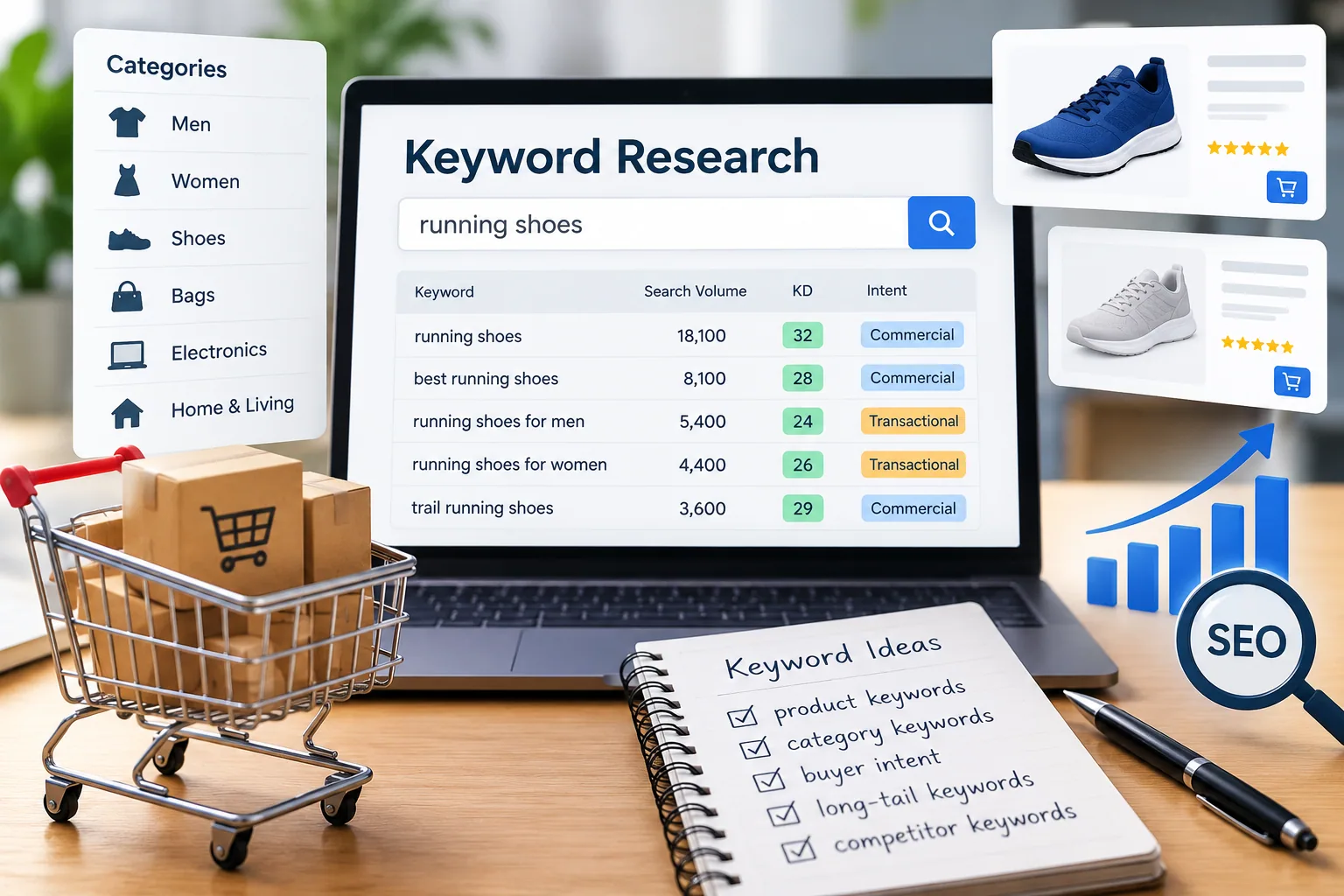
Keyword research is the process of identifying terms that potential visitors are searching for. Using tools like Google Keyword Planner or Ahrefs can help you pinpoint Long-Tail Keywords that have lower competition but still attract relevant traffic. This tactic not only boosts the likelihood of ranking but also drives more targeted traffic to your site.
When performing keyword research, consider these key aspects:
- Keyword Difficulty: It helps determine how challenging it will be to rank for a specific term.
- Search Intent: Understanding the purpose behind a user’s query ensures that your content meets their needs, increasing the chances of engagement.
At Easy E-commerce Marketing, we help clients identify and integrate keywords seamlessly into their content. Learn more about how our SEO services can support your growth.
Implementing Keywords: From Meta Tags to Content
Once you've identified relevant keywords, it’s essential to use them strategically. Here are effective ways to incorporate keywords:
- Title Tag: Incorporate primary keywords here as it’s one of the first elements users see.
- Meta Description: Though it doesn’t directly impact ranking, it influences click-through rates (CTR) by providing a preview of your page’s content.
- Content Body: Use keywords naturally within the content to enhance relevance without compromising readability.
Well-placed keywords, in combination with quality content, signal search engines that your page provides value, thus improving Page Rank over time.
Boosting Content Quality and Relevance
Search engines prioritize pages that provide quality, valuable content. Content Optimization involves enhancing the readability, engagement, and relevance of each page. Incorporating LSI (Latent Semantic Indexing) keywords and ensuring your content aligns with Search Intent are vital for better rankings.
In addition, regular updates and Content Freshness keep your site relevant, especially if you operate in a dynamic industry. Google values recent information, which can also boost your standing on the SERP. For guidance on keeping your content fresh, visit our home page.
Leveraging Technical SEO for Enhanced Site Performance
Technical SEO is the backbone of a well-functioning website, focusing on optimizing elements that impact the way search engines crawl, index, and display your content. A technically optimized site is fast, accessible, and easy for search engines to understand, which can lead to higher rankings and improved user satisfaction.
Enhancing Site Speed and Core Web Vitals
Site speed is a significant ranking factor, as users tend to abandon slow-loading websites. Google’s Core Web Vitals—a set of metrics related to speed, responsiveness, and visual stability—offer a baseline for measuring and improving user experience. The three key metrics are:
- Largest Contentful Paint (LCP): Measures loading performance.
- First Input Delay (FID): Assesses interactivity.
- Cumulative Layout Shift (CLS): Tracks visual stability of the site as it loads.
Improving these metrics can reduce bounce rates and keep users engaged. Compressing images, minimizing JavaScript, and leveraging browser caching are just a few ways to boost site speed.
Mobile-Friendly Design: Meeting Google’s Mobile-First Index
With the rise in mobile searches, Google has adopted a mobile-first indexing approach, meaning it primarily uses the mobile version of a site for indexing and ranking. A Mobile-Friendly design ensures that your site is accessible and easy to navigate on any device, which is critical for both SEO and user experience.
Responsive web design, larger clickable elements, and mobile-optimized images contribute to a seamless mobile experience. To assess your site’s mobile performance, consider using Google Search Console, which provides valuable insights into your mobile usability and highlights areas for improvement.
Site Structure: Sitemaps, URLs, and Canonical Tags
A logical URL Structure and clear Sitemap make it easier for search engines to crawl and index your content effectively. An XML sitemap lists all your website's URLs, helping search engines discover and index each page. Submit your sitemap to Google via Search Console to ensure comprehensive indexing.
Canonical tags also play an essential role in helping search engines understand your content. These tags inform Google of the preferred URL when duplicate content exists, reducing the risk of content dilution and helping consolidate your site’s ranking signals.
<link rel="canonical" href="https://easyecommercemarketing.com/"/>
Setting up Robots.txt is another crucial step for technical SEO. This file guides search engines on which parts of the site to crawl or avoid, ensuring that only valuable pages are indexed.
For more information on optimizing your site structure, explore our SEO services that cover technical auditing and enhancements.
Building Authority with Off-Page SEO
While on-page and technical SEO make your site appealing to search engines, Off-Page SEO helps build its reputation and authority across the web. The stronger your site’s authority, the more likely it is to rank highly for competitive keywords.
Backlinks: Quality Over Quantity
Backlinks, or links from other websites pointing to yours, act as endorsements of your content’s credibility. When a reputable website links to your page, it signals to search engines that your content is valuable, helping increase your Domain Authority. However, quality is more important than quantity when it comes to backlinks—links from trusted, relevant sites hold far more value than numerous links from low-quality sources.
Strategies for Building Backlinks:
- Guest Posting: Write articles for other reputable websites and include a link back to your site.
- Content Syndication: Share your high-quality content on platforms that accept syndication, helping reach a broader audience.
- Competitor Analysis: Use tools like Ahrefs or Moz to identify where competitors earn backlinks, then target those sites with your unique content.
Our free audit can help identify opportunities for improving your backlink profile, contributing to better search rankings and online visibility.
Social Media Signals and Brand Mentions
Though social signals aren’t direct ranking factors, they indirectly influence SEO by driving traffic and encouraging brand mentions. High engagement rates on social media can boost a page’s visibility, leading to more backlinks and brand exposure. Brand Mentions—even unlinked references—indicate to search engines that your brand is active and trusted, contributing to E-E-A-T (Experience, Expertise, Authority, and Trust).
Regularly sharing content on social media platforms helps keep your brand top-of-mind for audiences, encouraging shares and engagement that amplify your SEO efforts.
Local SEO: Reaching Nearby Audiences
For businesses targeting a specific geographical area, Local SEO is essential for connecting with nearby customers. Creating and optimizing a Google Business Profile can help your business appear in local search results, Google Maps, and the "Local Pack" at the top of search results for location-based queries.
Tips for local SEO success include:
- Ensuring accurate NAP (Name, Address, Phone Number) details on your website and Google Business Profile.
- Encouraging customer reviews and responding to them promptly.
- Adding relevant local keywords to your content.
For a deeper understanding of how to reach local customers effectively, visit our homepage.
Content Optimization: A Key to SEO Success
Content is at the heart of SEO. Without valuable, engaging content, it’s challenging to attract or retain visitors, much less rank on search engines. Content Optimization involves crafting content that is not only informative and high-quality but also aligned with user intent.
User Intent and Content Relevance
Understanding Search Intent is fundamental to creating content that meets users' needs. By addressing the questions and challenges that users are looking to solve, your content can attract more relevant traffic and boost User Engagement. Content that answers a specific need has a better chance of ranking well and retaining visitors.
Using Meta Tags and Snippet Optimization
Meta Tags, including the title tag and meta description, play an essential role in how users perceive your content on the SERP. A well-optimized title tag includes the target keyword and clearly conveys the content’s purpose, encouraging users to click through to your site.
The meta description, although not a direct ranking factor, impacts CTR (Click-Through Rate) by providing a concise summary of the page. Snippet Optimization—enhancing the meta title and description—helps your listing stand out in search results.
Analytics and Tracking: Measuring Your SEO Performance
No SEO strategy is complete without ongoing analysis and tracking. Monitoring your SEO performance enables you to understand what’s working, identify areas for improvement, and adapt to ever-evolving search engine algorithms. Analytics tools provide data on user behavior, engagement, and technical issues, empowering you to make data-driven decisions to enhance your SEO strategy.
Using Google Analytics and Google Search Console
Google Analytics and Google Search Console are essential tools for tracking website performance:
- Google Analytics provides insights into user behavior, including traffic sources, session duration, bounce rate, and engagement metrics. By analyzing these data points, you can determine how users interact with your site and identify popular content.
- Google Search Console helps monitor your site’s visibility on Google’s SERPs. It offers data on keyword rankings, click-through rates, and indexing status. It also highlights any crawl errors or mobile usability issues that might be impacting your rankings.
For instance, if you notice a high bounce rate on a key landing page, this could indicate that the content isn’t meeting user expectations or that the page load time is too slow. Our free audit provides an in-depth look at these metrics, helping you pinpoint issues and optimize for better results.
Core Metrics to Watch
Several metrics can give you a clear picture of your SEO performance:
- Organic Traffic: The number of visitors who find your site through organic search results. A steady increase in organic traffic is often a good indicator of SEO success.
- Click-Through Rate (CTR): The percentage of users who click on your link when it appears on the SERP. High CTRs can boost rankings, so it’s worth testing different title tags and meta descriptions to improve CTR.
- Bounce Rate: A high bounce rate suggests that visitors are leaving the page without interacting, often due to slow load times, irrelevant content, or a poor user experience.
Tracking these core metrics provides valuable feedback on your SEO efforts, allowing you to adjust your strategy and improve performance over time.
Enhancing User Experience (UX) for Better Rankings
User experience (UX) is closely tied to SEO. A positive UX encourages visitors to stay longer on your site, engage with your content, and even return in the future—all actions that can indirectly improve your search rankings. Google prioritizes sites that offer a smooth, enjoyable experience, making UX optimization a crucial aspect of SEO.
Page Structure and Content-Length
A clear and logical Title Hierarchy (H1, H2, H3 tags) helps users and search engines alike understand the structure and main points of each page. Breaking down content with headers, bullet points, and numbered lists also enhances readability, improving user engagement.
Content-Length is another factor; while quality always trumps quantity, longer content often performs better in search engines. Aim for comprehensive, well-organized content that thoroughly covers the topic at hand, ensuring it remains accessible and scannable for users.
Mobile Optimization and Site Security
As previously mentioned, Mobile-Friendly design is now a necessity for SEO. Ensuring that your site is fully responsive on mobile devices and provides a seamless experience is critical. Factors like larger buttons, optimized image sizes, and easy-to-read text contribute to a mobile-friendly experience.
Additionally, HTTPS/Site Security is a direct ranking factor. An SSL certificate not only secures user data but also builds trust. Users are more likely to engage with and trust a site that prioritizes their security, which can contribute positively to your SEO.
For more on creating a user-friendly and secure website, see our services page.
Content Maintenance: Keeping Your Site Relevant and Fresh
Maintaining content relevance is key to a successful SEO strategy. Search engines favor Content Freshness, especially for topics that evolve over time. Regular updates keep your content accurate and aligned with current user expectations.
Updating Evergreen Content
Evergreen content refers to high-value content that remains relevant over time. By updating statistics, adding new insights, and refreshing keywords, you can keep these pages performing well. Google often revisits well-maintained pages, and regular updates signal that your content is still valuable and accurate.
Additionally, refreshing content allows you to adjust your LSI (Latent Semantic Indexing) Keywords to reflect any changes in how users are searching for related topics. Adding internal links to newer content also keeps users engaged and can improve the crawlability of your site.
Leveraging SEO Tools and Software
SEO tools play an integral role in effective optimization, helping you conduct keyword research, analyze backlinks, and monitor rankings. While there are many options on the market, choosing the right tools can simplify and enhance your SEO strategy.
Popular SEO Tools for Keyword Research and Competitor Analysis
- Ahrefs and SEMrush are widely used for keyword research, competitive analysis, and backlink tracking. They help you identify content gaps, analyze your competitors’ strategies, and refine your own approach.
- Moz offers keyword and site analytics tools, as well as valuable insights into your domain authority and link-building opportunities.
These tools can reveal important insights that shape your SEO plan, offering ways to monitor progress, adjust tactics, and stay ahead of competitors. To explore how to use these tools for your brand, check out our home page.
SEO as a Continuous Process
SEO is an ongoing journey rather than a one-time task. Search engines continuously update their algorithms to improve user experiences and deliver more relevant results. Therefore, staying informed on the latest SEO trends and algorithm changes is crucial to maintaining and improving your rankings.
Regularly Reviewing and Adapting Your Strategy
Your SEO strategy should evolve as your business grows and as SEO practices change. Regularly reviewing your keyword strategy, optimizing existing content, and auditing your technical setup are necessary steps for continuous improvement.
Content Calendar planning can help ensure a steady flow of fresh, relevant content, which search engines appreciate. By consistently delivering quality information that aligns with user needs, you not only improve rankings but also build long-term credibility and trust with your audience.
Staying Ahead with SEO Best Practices
Embracing SEO best practices—such as optimizing for search intent, using structured data, and creating high-quality backlinks—keeps your site competitive. Remember that SEO is about providing value to your audience and ensuring they can find your content when they need it.
As you continue to refine your SEO, don’t hesitate to reach out for a professional consultation or further assistance. Visit Easy E-commerce Marketing for guidance tailored to your specific business needs.
FAQ: Common Questions About SEO
1. What is the difference between SEO and SEM?
SEO (Search Engine Optimization) focuses on improving a website’s organic visibility by optimizing content and technical aspects for search engines. SEM (Search Engine Marketing), on the other hand, includes paid advertising efforts, like PPC (Pay-Per-Click), alongside organic SEO. Both aim to drive traffic, but SEM has an immediate impact through paid ads, while SEO focuses on long-term organic growth.
2. How long does it take to see results from SEO?
SEO is a long-term strategy. Depending on factors like keyword competition, the quality of your SEO practices, and the age of your website, it typically takes 3-6 months to see noticeable changes in rankings and traffic. However, SEO efforts build over time, and consistent optimization can yield increasing results over the long term.
3. What are backlinks, and why are they important?
Backlinks are links from other websites that point to your website. They act as “votes of confidence” for search engines, signaling that your content is valuable and credible. High-quality backlinks from reputable sources can improve your Domain Authority and boost your rankings in search results.
4. Does social media activity affect SEO?
While social signals like shares and likes aren’t direct ranking factors, social media activity can indirectly benefit SEO. Content that performs well on social media can drive more traffic, build brand awareness, and even attract backlinks, all of which can positively impact SEO.
5. What are rich snippets, and how can they help my SEO?
Rich snippets are enhanced search results that display additional information like reviews, prices, or images. Using structured data (schema markup) helps search engines better understand your content, increasing the chances of your pages appearing with rich snippets, which can improve visibility and click-through rates (CTR).
6. How does SEO benefit e-commerce websites specifically?
For e-commerce websites, SEO drives targeted organic traffic, which can result in more product sales. Techniques like product page optimization, image SEO, and local SEO (for brick-and-mortar stores) are especially useful. A well-optimized e-commerce site ranks higher for product-related searches, making it easier for potential customers to find and buy products.
7. What role does user experience (UX) play in SEO?
User experience (UX) has become increasingly important in SEO. Google considers factors like page speed, mobile-friendliness, and Core Web Vitals when ranking pages. Websites that provide a positive UX are more likely to keep visitors engaged, reduce bounce rates, and rank higher in search results.
8. What is the purpose of a robots.txt file?
The robots.txt file instructs search engine crawlers on which pages or sections of your site should or shouldn’t be crawled. It’s useful for blocking certain non-essential pages (e.g., login pages, admin areas) from search engines, allowing them to focus on crawling the most important pages that you want indexed.
9. How can I avoid penalties from Google?
Google penalizes websites for practices that violate its guidelines, such as using keyword stuffing, duplicate content, or spammy backlinks. To avoid penalties, focus on creating high-quality, user-centered content, avoid “black-hat” SEO tactics, and monitor your backlink profile to ensure you’re only associated with reputable websites.
10. What are LSI keywords, and how do they support SEO?
LSI (Latent Semantic Indexing) keywords are terms related to your main keyword that help search engines understand the context of your content. Including relevant LSI keywords in your content makes it more comprehensive and can improve its relevance, increasing the chances of ranking well for multiple related search queries.
For a customized SEO strategy, contact Easy E-commerce Marketing or get a free audit.