Keyword Research for Ecommerce Product and Category Pages
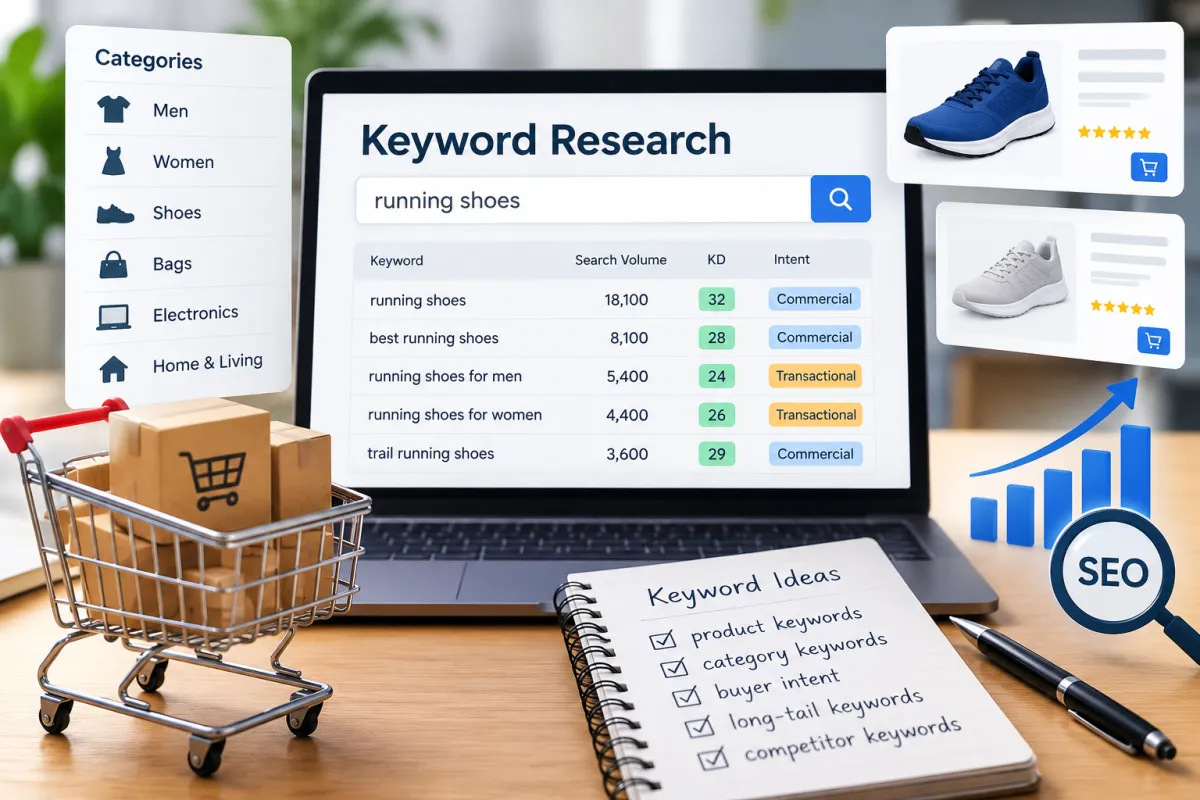
Keyword Research for Ecommerce Product and Category Pages is about more than finding popular search terms. It's about understanding what your customers want, how they search for it, and which pages on your website should appear when they're ready to buy.
Get this right, and your ecommerce store can attract more relevant visitors, improve organic rankings and turn search traffic into revenue. Get it wrong, and you could spend months optimising pages for keywords that attract browsers rather than buyers.
The essentials: What you need to know
Start with customer intent, not search volume. A keyword searched 100 times a month by purchase-ready customers can be more valuable than one searched 10,000 times by people looking for general information.
Product and category pages need different keywords. Category pages generally target broader product groups, while individual product pages focus on specific products, features, benefits and variations.
Find keywords using multiple sources. Google Search Console, Google Keyword Planner, competitor websites, autocomplete suggestions and specialist SEO tools can reveal opportunities.
Prioritise commercial relevance. Consider search volume, keyword difficulty, competition, buying intent and potential revenue before selecting your target keywords.
Map keywords to the right URLs. Every important search intent should have a suitable destination, helping prevent keyword cannibalisation and unnecessary competition between your own pages.
Think beyond exact-match keywords. Related search terms, product attributes, long-tail keywords and semantic variations help create more useful, contextually relevant content.
Measure what matters. Rankings and organic traffic are useful, but qualified visitors, conversions and organic revenue reveal whether your ecommerce keyword strategy is working.
The bottom line: Successful ecommerce keyword research connects what people search for with what your store actually sells. The goal isn't simply to rank for more keywords. It's to rank for the right ones.
What Is Ecommerce Keyword Research?
Imagine walking into a shop and asking for a waterproof hiking jacket.
The salesperson could point you towards every jacket in the building. Or they could ask what conditions you'll be hiking in, what size you need and how much you're willing to spend.
The second approach is more useful because it understands what you're trying to achieve.
Ecommerce keyword research works in much the same way.
It's the process of identifying, analysing and selecting the words and phrases potential customers use when searching for products online. Those search queries then inform your website structure, product descriptions, collection pages, category content and wider ecommerce SEO strategy.
But there's an important distinction.
Keyword research for ecommerce isn't simply about discovering what people type into Google. It's about understanding why they type it.
Someone searching for "running shoes" might be browsing different styles. Someone searching for "men's waterproof trail running shoes size 10" has a much clearer idea of what they want.
Both searches have potential value, but they shouldn't necessarily lead to the same page.
Effective keyword research for online stores helps you determine:
Which products and categories customers are searching for.
How customers describe those products in their own words.
Whether a search indicates research, comparison or purchase intent.
Which keywords your website has a realistic opportunity to rank for.
Whether a product page, category page or informational article best satisfies the search.
How much commercial value a keyword could generate for your business.
For a single-brand ecommerce store, this becomes particularly important.
Unlike a marketplace selling thousands of competing brands, your website needs to build visibility around your own products, their defining features and the problems they solve.
That means balancing branded searches with non-branded keywords that introduce potential customers to your products for the first time.
The Difference Between Keywords, Search Queries and Search Intent
These three terms are closely connected, but they describe different things.
Term | Meaning | Example |
|---|---|---|
Keyword | A phrase you choose to target through SEO | Waterproof running shoes |
Search query | The actual words someone enters into a search engine | Best waterproof running shoes for winter trails |
Search intent | The reason behind the search | Finding suitable shoes before purchasing |
A single target keyword can match numerous relevant search queries.
For example, a category page targeting "waterproof running shoes" might also attract visitors searching for "waterproof trail shoes", "running shoes for wet weather" and other closely related phrases.
This is where semantic SEO becomes useful.
Rather than creating a separate page for every minor keyword variation, you can build comprehensive, relevant content around a clearly defined topic and user intent.
Key takeaway: Search engines don't need every keyword variation repeated word for word. Your pages should clearly describe what you sell, demonstrate relevance and satisfy the searcher's needs.
Why Keyword Research Matters for Ecommerce Product and Category Pages
Here's a mistake that's surprisingly easy to make.
You create a beautiful ecommerce website. Your product photography looks professional. Your descriptions explain every feature. Your checkout works perfectly.
But hardly anyone discovers your products through Google.
The problem might not be your products or your website design.
It could be that your pages aren't targeting the language customers actually use when searching.
Keyword research bridges that gap.
It gives your product and category page optimisation a clear direction, helping you build visibility around genuine customer demand instead of assumptions.
1. Attract Customers Who Are More Likely to Buy
Not all website traffic is equally valuable.
Consider these two searches:
"How are running shoes made?"
"Buy lightweight waterproof running shoes"
The first suggests informational intent. The second indicates a stronger likelihood of purchase.
Both searches can contribute to an ecommerce content strategy, but the second is usually more appropriate for a commercial landing page.
By identifying high-intent keywords, you can focus your ecommerce keyword targeting on people actively looking for products like yours.
That doesn't mean ignoring informational keywords. They can introduce your brand earlier in the buying journey.
It means giving each type of search the right destination.
2. Improve Visibility Across More Relevant Searches
A product can be described in several different ways.
A customer might search by:
Product type or category.
Brand or product name.
Size, colour or material.
Specific features or specifications.
Intended use or desired benefit.
Problem the product solves.
Price range or product quality.
For example, a reusable water bottle might be described as an "insulated water bottle", "stainless steel drinks bottle", "leakproof water bottle" or "water bottle that keeps drinks cold".
These phrases aren't necessarily interchangeable in every search result, but they reveal different ways customers discover similar products.
Good ecommerce SEO keyword research helps you identify which variations deserve priority and where they belong.
The result is a more complete picture of your product's search opportunities.
3. Build a More Logical Ecommerce Website Structure
Keyword research can influence more than page copy.
It can help determine how your products should be organised.
Suppose your store sells several types of skincare products.
Research might reveal distinct demand for:
Facial cleansers.
Moisturisers.
Vitamin C serums.
Skincare for dry skin.
Fragrance-free skincare.
Some searches describe product categories. Others describe ingredients, benefits or customer needs.
Understanding these differences can help you decide whether to create dedicated collection pages, product filters, educational content or a combination of these.
However, not every keyword deserves its own page.
Creating too many similar categories can produce thin content, confusing navigation and keyword cannibalisation.
The objective is a logical ecommerce site architecture that makes sense to customers and search engines.
4. Make Better Commercial Decisions
Search demand can reveal valuable information about your market.
You might discover that customers frequently search for a particular material, feature or product variation that isn't prominently displayed on your website.
Alternatively, you might find that an existing category attracts substantial search interest but faces intense competition.
These insights can inform product positioning, collection naming, content development and marketing priorities.
Keyword research can also support investment decisions.
Before spending heavily on content or SEO improvements, it's worth understanding the potential commercial return. Our ecommerce ROI calculator can help you explore the relationship between marketing investment and financial performance.
Ultimately, keyword research should support profitable growth, not simply higher rankings.
Understanding Search Intent for Ecommerce
Search intent is one of the most important concepts in Keyword Research for Ecommerce Product and Category Pages.
Why?
Because Google isn't just trying to match words.
It's trying to return results that satisfy what someone wants to accomplish.
If a person searches for "best running shoes for beginners", they may expect comparisons, recommendations and buying advice.
If they search for "buy men's black running shoes", they're more likely to expect ecommerce category pages or individual product listings.
Targeting the right keyword with the wrong page type can make ranking considerably harder.
The Four Main Types of Search Intent
Search intent | Example search | Most suitable content |
|---|---|---|
Informational | How to choose running shoes | Buying guide or blog article |
Navigational | Nike official website | Brand homepage or relevant brand page |
Commercial investigation | Best waterproof running shoes | Comparison guide, buying guide or relevant collection |
Transactional | Buy waterproof trail running shoes | Product or category page |
These categories are useful starting points, although real searches can contain mixed intent.
For example, "best waterproof trail running shoes" might return editorial reviews alongside ecommerce listings.
That's why checking the actual search results is essential before deciding which page to optimise.
Informational Keywords: Reaching Customers Earlier
Informational keywords appear when someone wants to learn something.
Examples include:
How to choose the right running shoes.
What makes a water bottle leakproof?
Which skincare ingredients help dry skin?
How to measure your feet for shoes.
These searches don't always lead to immediate purchases.
However, they can attract potential customers who are researching a problem your products solve.
For a single-brand store, useful buying guides and educational articles can introduce your expertise while creating opportunities for contextual internal links to relevant collections and products.
The key is to provide genuinely helpful information rather than turning every educational article into a sales pitch.
Commercial Keywords: Helping Customers Compare Their Options
Commercial investigation keywords suggest that someone is considering a purchase but hasn't necessarily made their final decision.
Common modifiers include:
Best.
Top-rated.
Reviews.
Comparison.
Alternatives.
Affordable.
Premium.
For beginners.
For example, "best insulated water bottle for hiking" indicates a more specific requirement than simply "water bottle".
Depending on the search results, this keyword might be best served by a buying guide, a comparison article or a carefully curated collection page.
For a single-brand store, comparisons should remain useful and transparent. If you're discussing your own products, explain their differences and limitations rather than pretending to offer an independent marketplace comparison.
Transactional Keywords: Reaching Purchase-Ready Customers
Transactional keywords often have the strongest direct commercial relevance.
They commonly include modifiers such as:
Buy.
Shop.
Order.
For sale.
Price.
Discount.
Delivery.
Specific sizes, colours or product models.
But don't assume every transactional search contains the word "buy".
A search for "stainless steel insulated water bottle 750ml" may show strong purchase intent even without an obvious transactional modifier.
The combination of product type, material and capacity suggests that the customer knows what they're looking for.
These product-specific keywords can be particularly valuable for ecommerce product page SEO.
Navigational Keywords: Capturing Existing Brand Demand
Navigational searches usually involve people looking for a particular website, company or product brand.
For a single-brand ecommerce business, examples might include:
Your brand name.
Your brand name followed by a product category.
A specific product name.
Your brand name followed by "reviews" or "delivery".
Branded keywords are important because they help existing customers and people who have already discovered your business find the right destination.
However, relying exclusively on branded search demand limits your ability to reach new customers.
A balanced ecommerce keyword strategy targets both branded and non-branded searches.
How to Identify Search Intent Before Targeting a Keyword
You don't need to guess what Google considers relevant.
The search results provide useful evidence.
For each important keyword:
Search the keyword in Google. Use the country and market you're targeting.
Examine the leading organic results. Are they product pages, category pages, guides or comparison articles?
Look for SERP features. Shopping results, images, videos and People Also Ask questions can reveal how the query is being interpreted.
Assess the dominant intent. Determine whether users appear to want information, comparisons or products.
Choose the appropriate destination. Match the keyword to an existing page or plan a suitable new one.
Record your findings. Include the keyword, intent, preferred page type and target URL in your keyword research spreadsheet.
This process is known as search intent analysis.
It should happen before you invest significant time in writing product descriptions, building category pages or producing supporting content.
Remember: The best keyword isn't necessarily the one with the highest monthly search volume. It's the one that combines relevant demand, achievable competition, suitable search intent and meaningful commercial value for your store.
How to Find Ecommerce Keywords: A Step-by-Step Guide
Now that you understand the importance of search intent, it's time to find the keywords your potential customers are actually using.
And here's where things get interesting.
You don't need to start with expensive software, an enormous spreadsheet or thousands of keyword suggestions.
You need a structured approach.
Effective ecommerce keyword research begins with understanding your products, expands into discovering customer search behaviour, and finishes with selecting keywords that have genuine commercial potential.
Let's work through the process.
Step 1: Start With Seed Keywords and Product Attributes
Every successful ecommerce keyword strategy begins with seed keywords.
These are the basic words and phrases that describe your products, collections and the problems they solve.
Think of them as the starting points from which you'll discover more specific keyword opportunities.
Suppose you operate a single-brand ecommerce store selling reusable water bottles.
Your initial seed keywords might include:
Reusable water bottles
Insulated water bottles
Stainless steel water bottles
Sports water bottles
Leakproof drinks bottles
Thermal water bottles
These are broad product-related terms. They're useful for keyword discovery, but they don't yet reveal the full range of customer searches.
To expand your list, consider the different ways someone might describe your products.
Product attributes
What physical characteristics distinguish your products?
Consider:
Materials, such as stainless steel, cotton or leather.
Colours and finishes.
Sizes, dimensions and capacities.
Product features and specifications.
Designs and styles.
Product variations and compatibility.
Product benefits
What does the product help customers achieve?
For example, an insulated water bottle might help keep drinks cold, prevent leaks or reduce reliance on disposable plastic bottles.
Those benefits can inspire relevant search terms such as "water bottle that keeps drinks cold" or "leakproof bottle for travelling".
Product use cases
Where, when and why would someone use the product?
An insulated water bottle could be relevant to hiking, commuting, gym sessions, school or everyday travel.
Each use case introduces potential long-tail keywords.
Customer terminology
Finally, consider whether customers describe your products differently from your internal product names.
You might call something a "vacuum-insulated hydration vessel", while customers simply search for "insulated water bottle".
Search engines need to understand your products, but customers need to recognise them.
Always prioritise clear, familiar product terminology.
Create a Seed Keyword Matrix
A simple matrix helps organise your initial keyword ideas.
Keyword dimension | Example |
|---|---|
Product type | Water bottle |
Material | Stainless steel |
Feature | Leakproof |
Benefit | Keeps drinks cold |
Capacity | 750ml |
Audience | Adults |
Use case | Hiking |
Brand | Your brand name |
You can then combine relevant attributes into natural keyword variations.
For example:
Stainless steel water bottle.
Leakproof stainless steel water bottle.
Insulated water bottle for hiking.
750ml stainless steel water bottle.
Water bottle that keeps drinks cold.
Don't automatically target every possible combination.
Some phrases may have little demand, some may sound unnatural, and others may describe products you don't sell.
The purpose of this exercise is to generate relevant keyword candidates, not to manufacture hundreds of pages.
Step 2: Expand Your Keyword List Using Google Search
Google itself is one of the most useful starting points for keyword discovery.
Its search features can reveal how people phrase questions, compare products and explore different purchasing options.
Use Google Autocomplete
Begin typing one of your seed keywords into Google.
For example:
"insulated water bottle..."
Google may suggest searches relating to size, material, intended use, features or particular customer needs.
These suggestions can reveal valuable long-tail keyword opportunities that you might otherwise overlook.
Try expanding your research with different modifiers:
Best insulated water bottle...
Insulated water bottle for...
Insulated water bottle with...
Insulated water bottle without...
Large insulated water bottle...
Lightweight insulated water bottle...
Record relevant suggestions and group them by topic.
Remember that autocomplete predictions vary according to location, language, timing and other factors. They indicate possible search interests, not verified monthly search volumes.
Explore People Also Ask
Google's People Also Ask feature can help identify questions customers have about your products.
For example:
Are insulated water bottles worth buying?
What size water bottle is best for hiking?
How long do insulated bottles keep water cold?
Are stainless steel water bottles safe?
These questions can support product FAQs, buying guides and educational content.
They can also help you understand the concerns customers may have before purchasing.
However, not every question belongs on a product page.
A detailed comparison or educational topic may deserve its own supporting article, while a concise product-specific question might fit naturally within an FAQ section.
Check Related Searches
Related searches can reveal additional terminology, product attributes and adjacent topics.
Pay attention to phrases that introduce a different customer requirement.
For example, a search relating to insulated water bottles might lead you towards searches for lightweight bottles, wide-mouth designs or bottles with built-in straws.
These variations can help you discover relevant keyword clusters.
But there's an important distinction.
A keyword variation should only become a target if it accurately reflects the products available in your store.
Ranking for something you don't sell rarely creates a good customer experience.
Step 3: Use Keyword Research Tools to Validate Demand
Once you've gathered a substantial list of seed keywords and related search terms, you need to evaluate them.
This is where keyword research tools become valuable.
Platforms such as Google Keyword Planner, Google Search Console, Ahrefs and Semrush can help you understand search demand, competition and existing performance.
Different tools provide different datasets and estimates, so avoid treating any single metric as absolute truth.
Google Keyword Planner
Google Keyword Planner is primarily designed for advertising research, but it can also support organic keyword discovery.
You can use it to:
Find keyword ideas related to your products.
Explore average monthly search estimates.
Identify related keyword variations.
Compare search demand across locations.
Investigate seasonal search patterns.
One important limitation: the competition metric in Google Keyword Planner reflects advertiser competition, not organic SEO ranking difficulty.
Don't confuse the two.
Google Search Console
If your ecommerce store already receives organic impressions or clicks, Google Search Console is particularly useful.
It shows which search queries have generated impressions and clicks for your website.
You can investigate:
Queries receiving impressions but few clicks.
Product pages appearing for unexpected search terms.
Category pages attracting relevant non-branded searches.
Queries with improving or declining performance.
Pages receiving visibility for overlapping keywords.
For example, imagine a product page receives impressions for "750ml insulated water bottle" but has a low click-through rate.
That could indicate an opportunity to improve the page title, description or relevance to the query.
It doesn't automatically mean the keyword is suitable, though.
Always check whether the page satisfies the underlying search intent.
Ahrefs and Semrush
Specialist SEO platforms can help expand your research further.
Depending on the tool and available data, you can investigate:
Estimated keyword search volume.
Keyword difficulty.
Competitor rankings.
Related keyword suggestions.
SERP features.
Keyword gaps.
Organic traffic estimates.
Search intent classifications.
These metrics can help with keyword prioritisation, particularly when you have hundreds of potential targets.
But remember:
A keyword difficulty score is an estimate, not a prediction of whether your website will rank. Search intent, content quality, website authority, competition and the usefulness of your page all influence the outcome.
Step 4: Analyse Search Volume, Keyword Difficulty and Commercial Value
This is where keyword research becomes a decision-making process rather than simply collecting search terms.
A large keyword list isn't particularly useful until you know which opportunities deserve attention.
Start by evaluating three fundamental factors.
1. Search volume
Monthly search volume estimates how often a keyword is searched within a particular market.
Higher search volume may indicate greater demand, but it can also attract stronger competition and broader search intent.
2. Keyword difficulty
Keyword difficulty attempts to estimate how challenging it may be to achieve strong organic rankings.
Different SEO tools calculate difficulty differently.
Use the metric as a comparative guide rather than an absolute measure.
3. Commercial value
Commercial value considers how relevant a keyword is to your products and how likely the resulting visitors are to become customers.
This is especially important for ecommerce.
A keyword might have relatively modest search demand but strong purchase intent and an excellent match with a profitable product.
That could make it more valuable than a broad, high-volume keyword.
Example: Comparing Ecommerce Keyword Opportunities
The following figures are hypothetical and illustrate how you might evaluate different keywords.
Keyword | Monthly searches | Difficulty | Commercial intent |
|---|---|---|---|
Water bottles | 50,000 | High | Mixed |
Insulated water bottles | 8,000 | Medium | Commercial |
Leakproof insulated water bottle | 1,200 | Medium | Transactional |
750ml stainless steel insulated bottle | 250 | Low | Transactional |
How do insulated bottles work | 900 | Low | Informational |
The broadest keyword attracts the largest estimated audience.
But the more specific phrases may attract people with clearer purchasing requirements.
For a single-brand store, those targeted opportunities can be particularly attractive.
You may have a better chance of competing for relevant long-tail keywords while building authority around your wider product categories.
Don't Ignore Zero-Volume Keywords
Some keyword research tools report little or no search demand for highly specific phrases.
That doesn't necessarily mean nobody searches for them.
Keyword databases have limitations, especially for niche products, emerging trends and uncommon long-tail queries.
A phrase describing an exact product variation might still be useful if it closely matches customer needs.
Instead of dismissing every zero-volume keyword, consider:
Whether the phrase describes a real customer requirement.
Whether the product is available in your store.
Whether related phrases have measurable demand.
Whether Search Console reveals relevant impressions.
Whether the phrase naturally belongs in existing page content.
The aim isn't to create individual pages for every obscure search.
It's to ensure your product information reflects the language customers use.
Step 5: Research Competitor Keywords and Identify Gaps
Competitor keyword analysis can reveal opportunities that aren't immediately obvious from your own product catalogue.
Start by identifying websites that appear prominently for your most important non-branded keywords.
These are your organic search competitors.
They won't always be the same businesses you consider your direct commercial competitors.
A single-brand ecommerce store might compete in search results against marketplaces, specialist retailers, established manufacturers and informational websites.
Study which types of pages appear for your target keywords.
Ask yourself:
Which category keywords do competitors target?
How do they organise product collections?
Which product attributes appear in their page titles?
What questions do their buying guides answer?
Which search intents appear underserved?
Are there relevant long-tail keywords they haven't addressed effectively?
Tools such as Ahrefs and Semrush can help identify keyword gaps between your domain and competing websites.
However, copying competitor keywords without evaluating relevance is a mistake.
A large marketplace might rank for thousands of products, brands and variations that have nothing to do with your catalogue.
Your objective is to find commercially relevant gaps, not imitate every keyword a competitor ranks for.
For a single-brand business, look particularly closely at opportunities connected to your products' distinctive features, benefits and intended uses.
Step 6: Group Related Keywords Into Search Intent Clusters
By this stage, your spreadsheet might contain hundreds of keywords.
Some will describe essentially the same customer requirement.
Others will look similar but represent different search intents.
Keyword clustering helps you distinguish between them.
Consider these examples:
Keyword cluster | Example keywords | Potential page type |
|---|---|---|
Broad product category | Insulated water bottles, thermal water bottles | Category page |
Product feature | Leakproof insulated bottles, spillproof water bottles | Category or filtered landing page |
Specific product | 750ml stainless steel insulated bottle | Product page |
Product education | How insulated water bottles work | Blog article |
Buying advice | Best water bottle for hiking | Buying guide |
The key principle is simple:
Group keywords by the needs they represent, not just by the words they share.
Two keywords may look different but produce similar search results, suggesting that one strong page could satisfy both.
Conversely, two closely related phrases may deserve separate pages if they represent genuinely different products or customer requirements.
Search intent clustering can reduce unnecessary content duplication and make keyword mapping considerably easier.
How to Choose Keywords for Ecommerce Category Pages
Category page keyword research deserves special attention because category pages often represent some of the most commercially important URLs on an ecommerce website.
A well-optimised category page allows customers to browse a relevant group of products, compare options and move towards a purchase.
Unlike an individual product page, a category page usually targets broader product searches.
For example:
Women's running shoes.
Stainless steel water bottles.
Natural skincare products.
Organic cotton bedding.
Wireless headphones.
These searches describe groups of products rather than one specific item.
That's why ecommerce category page SEO should focus on matching broader product demand with useful, clearly organised collections.
Identify Your Primary Category Keywords
Every important category page should have a clearly defined primary keyword.
This is generally the most relevant search term representing the products within that collection.
Suppose your store sells several insulated water bottles.
Your category page might target:
Primary keyword: Insulated water bottles
Relevant secondary keywords could include:
Thermal water bottles.
Stainless steel insulated bottles.
Reusable insulated bottles.
Insulated drinks bottles.
The exact selection depends on your products, search demand and the similarity of the search results.
You don't need to force every variation into your content.
Instead, use relevant terminology naturally in the page title, headings, introductory copy, product descriptions and supporting information.
Use Category Hierarchy to Match Different Search Needs
A logical category hierarchy helps customers navigate your store while giving search engines a clearer understanding of how your products relate to one another.
For example:
Parent category: Water Bottles
Potential subcategories:
Insulated Water Bottles
Sports Water Bottles
Stainless Steel Water Bottles
These categories may be appropriate if your store has enough relevant products and genuine search demand to justify them.
But what if you only sell three water bottles, all made from stainless steel?
Creating separate collections for every overlapping attribute might add unnecessary complexity.
Instead, a single well-optimised category page with useful product information could be the better option.
When deciding whether a subcategory deserves its own indexable URL, consider:
Does the keyword represent a distinct search intent?
Do you have enough relevant products to make the page useful?
Is there evidence of meaningful search demand?
Would the page offer something different from an existing collection?
Can customers easily discover the category through navigation?
If the answers are mostly no, avoid creating a separate page simply because a keyword exists.
Research Product Attributes for Category Pages
Attribute-based keyword research is particularly useful for ecommerce category optimisation.
Customers frequently narrow their searches using characteristics such as:
Material.
Size.
Colour.
Capacity.
Style.
Intended use.
Compatibility.
Specific features.
For example, a broad search for "water bottles" may evolve into "large insulated water bottles" or "stainless steel water bottles with straw".
These searches can reveal valuable subcategory or filtering opportunities.
However, there's an important technical consideration.
Not every filtered product combination should become an indexable landing page.
Automatically allowing search engines to index every colour, size and feature combination can create thousands of low-value URLs.
This is where faceted navigation SEO becomes important.
A dedicated landing page may be worthwhile when a filtered combination has distinct search demand, sufficient products and a genuinely useful customer experience.
Otherwise, the filter may be better treated as a browsing feature rather than an independent SEO destination.
Optimise Category Pages for Both Search Engines and Shoppers
Once you've selected the right category keywords, you need to use them in ways that improve the page.
Important areas include:
SEO title tag: Clearly describe the product category and its main value.
H1 heading: Use a natural, recognisable category name.
Category introduction: Explain what customers will find and who the products are suitable for.
Product listings: Display relevant products with descriptive names and useful information.
Internal links: Help customers navigate between related categories and products.
Supporting content: Address common questions or purchasing considerations where useful.
Image alt text: Describe meaningful product imagery accurately.
Breadcrumbs: Reinforce the category's position within the site hierarchy.
Avoid filling category pages with lengthy, repetitive SEO copy that pushes the products far down the page.
Customers generally visit category pages to explore products.
Your content should support that task, not interrupt it.
A concise introduction, helpful filters, clear product information and relevant supporting content often provide a better experience than several paragraphs of forced keyword repetition.
Category page SEO principle: Target the language customers use to find a group of products, then make it easy for them to browse and choose from that group.
How to Choose Keywords for Ecommerce Product Pages
Product page keyword research follows a different approach.
While category pages target product groups, individual product pages should focus on the specific items customers want to find.
That might include the product name, material, size, model, features, intended use or other distinguishing attributes.
For a single-brand ecommerce store, this is particularly important.
You want customers to discover your products even when they haven't heard of your brand.
That means your product pages should communicate both what the product is and what makes it relevant to the search.
Start With the Product's Core Identity
Begin with the most accurate description of the product.
For example:
"750ml Stainless Steel Insulated Water Bottle"
This description immediately communicates three important attributes:
Capacity: 750ml.
Material: Stainless steel.
Product type: Insulated water bottle.
Now consider a product named only "The Explorer".
That might be a memorable branded name, but it doesn't tell an unfamiliar customer what the product actually is.
A more descriptive product title could be:
"The Explorer 750ml Insulated Water Bottle"
This preserves the product's identity while making its purpose clearer.
The best wording depends on your brand, product and search intent, but descriptive product terminology is generally valuable.
Identify Primary and Secondary Product Keywords
A product page should usually have one primary keyword theme supported by closely related secondary terms.
For example:
Keyword role | Example |
|---|---|
Primary keyword | 750ml insulated water bottle |
Secondary keyword | Stainless steel insulated bottle |
Feature keyword | Leakproof water bottle |
Benefit keyword | Keeps drinks cold |
Use-case keyword | Insulated bottle for hiking |
Branded keyword | Explorer insulated bottle |
These phrases should only be used if they accurately describe the product.
If the bottle isn't leakproof, don't target "leakproof water bottle".
If it hasn't been designed or tested for a particular use, avoid making unsupported claims.
Search visibility should never come at the expense of accurate product information.
Use Product Specifications to Discover Long-Tail Keywords
Long-tail keywords often emerge naturally from detailed product specifications.
Think about the information customers need before purchasing.
For clothing, that might include:
Fabric.
Fit.
Size.
Colour.
Style.
Intended activity.
For electronics, it might include:
Model.
Compatibility.
Battery life.
Dimensions.
Connectivity.
Technical specifications.
For skincare, it might include:
Product type.
Ingredients.
Skin type.
Texture.
Fragrance.
Intended benefit.
These attributes can reveal highly relevant product-specific search queries.
They also help customers evaluate whether the product meets their requirements.
This is why product page optimisation shouldn't be separated from product information quality.
Detailed, accurate specifications can support both organic search relevance and purchase decisions.
Write Product Titles for Clarity and Relevance
A strong product title should balance three objectives:
Help customers immediately recognise the product.
Include relevant descriptive terminology.
Remain natural and readable.
Compare these examples.
Weak product title:
"Explorer Bottle"
Over-optimised product title:
"Best Insulated Water Bottle 750ml Stainless Steel Bottle Leakproof Thermal Water Bottle"
Better product title:
"Explorer 750ml Stainless Steel Insulated Water Bottle"
The improved version communicates the product name, capacity, material and product type without awkward repetition.
The same principle applies to product page metadata.
SEO title tags should be descriptive and compelling rather than overloaded with keyword variations.
Optimise Product Descriptions Around Customer Needs
Your product description shouldn't read like a list of search terms.
It should help customers understand what they're buying.
Start with the most important product benefit, then support it with accurate features and specifications.
For example, a description might explain that a bottle is designed for everyday hydration, describe its insulation technology, outline its capacity and clarify how the lid works.
Relevant semantic keywords can appear naturally as part of that explanation.
You might also include:
Product dimensions.
Materials.
Care instructions.
Compatibility information.
Available variations.
What's included.
Answers to common product questions.
Avoid copying identical descriptions across multiple products.
Where products share characteristics, retain consistent technical information but clearly explain what distinguishes each variation.
This is particularly important when several products compete for similar long-tail keywords.
Consider Product Variants Before Creating Separate URLs
Suppose you sell the same insulated bottle in five colours.
Should every colour have its own SEO-optimised product page?
Not necessarily.
The answer depends on the product structure, search demand, user experience and technical implementation.
Separate URLs may be useful when variations have distinct search demand or meaningful differences.
However, creating nearly identical indexable pages for minor variations can increase duplication and keyword cannibalisation risks.
For many stores, allowing customers to select colours or sizes on one product page is simpler.
Where variants have separate URLs, use an appropriate indexing and canonicalisation strategy based on how those pages function.
The objective is to help search engines identify the most useful destination while keeping the shopping experience straightforward.
Match Product Keywords to Purchase Intent
Before finalising your product keyword targeting, inspect the search results.
If Google primarily displays individual product pages, that may indicate the keyword is suitable for your product URL.
If the results are dominated by category pages, the keyword may be too broad for one individual product.
And if the results mainly contain reviews or buying guides, the dominant intent may be informational or commercial investigation.
This simple check can prevent a common ecommerce SEO mistake:
Trying to make a product page rank for a keyword that searchers expect a different type of page to satisfy.
Product page SEO works best when the keyword, product and customer expectation are closely aligned.
How to Map Keywords to Product and Category URLs
Finding good keywords is only half the job.
You also need to decide where they belong.
This process is called keyword mapping, and it's one of the most valuable steps in building an organised ecommerce SEO strategy.
Without it, different pages can end up targeting the same search intent.
You might have a category page, two product pages and a blog article all competing for variations of one broad keyword.
That doesn't automatically mean Google will penalise your website, but it can make your targeting unclear and reduce the effectiveness of your content strategy.
Keyword-to-URL mapping helps establish which page should serve each important search intent.
Build a Keyword Mapping Spreadsheet
Start with a simple spreadsheet containing the following columns:
Column | Purpose |
|---|---|
Primary keyword | Main search theme |
Secondary keywords | Closely related terms |
Search intent | Informational, commercial, transactional or navigational |
Target URL | Page assigned to the keyword cluster |
Page type | Product, category or blog |
Search volume | Estimated monthly demand |
Keyword difficulty | Estimated organic competition |
Commercial priority | Business value of the opportunity |
Current performance | Existing impressions, clicks and rankings |
Action required | Optimise, create, consolidate or monitor |
This provides a clear overview of your keyword strategy.
It also helps prevent teams from producing new pages without checking whether a suitable URL already exists.
Example: Mapping Keywords Across an Ecommerce Store
Imagine you're planning the SEO structure for a single-brand water bottle store.
Your keyword map might look like this:
Keyword cluster | Intended page |
|---|---|
Water bottles, reusable water bottles | Main water bottle collection |
Insulated water bottles, thermal bottles | Insulated bottle collection |
750ml insulated water bottle | Relevant individual product |
How to clean a stainless steel water bottle | Educational blog article |
Best water bottle size for hiking | Buying guide |
Each page has a distinct purpose.
The main collection introduces the broader product range.
The insulated bottle collection targets a more specific product group.
The individual product page focuses on a particular item.
The educational content answers questions that customers may ask before or after purchasing.
These pages can support one another through relevant internal links without needing to target identical primary keywords.
Follow the One Primary Intent, One Preferred Destination Principle
A useful rule for ecommerce keyword mapping is:
Assign each distinct primary search intent to one preferred URL wherever practical.
This doesn't mean a page can only rank for one keyword.
A strong category page may rank for many related phrases.
Likewise, an individual product page can attract searches involving its name, features, specifications and relevant variations.
The objective is to avoid creating multiple competing pages that provide essentially the same answer to the same search.
When two keyword clusters share similar search results and customer expectations, consider whether they should be consolidated.
When they represent genuinely different requirements, separate pages may be appropriate.
A good keyword map creates clarity for customers, content creators and search engines alike.
Frequently Asked Questions About Keyword Research for Ecommerce Product and Category Pages
1. How many keywords should you target on an ecommerce product or category page?
Each ecommerce product or category page should generally focus on one primary keyword theme, supported by several closely related secondary keywords and semantic variations.
There isn't a fixed number of keywords you should include. A category page might naturally rank for dozens of related search queries, while a highly specific product page may target a smaller group of product-specific keywords.
Focus on relevance rather than quantity. Include keywords naturally in your SEO title, headings, product descriptions and supporting content without repeating phrases unnecessarily.
2. How often should you update your ecommerce keyword research?
Review your ecommerce keyword strategy at least every three to six months, with more frequent checks for competitive categories, seasonal products and rapidly changing markets.
Keyword research isn't a one-time exercise. Customer search behaviour, product demand, competitors and search engine results can change over time.
You should also revisit your keyword targeting whenever you launch new products, introduce collections, change your product range or notice significant changes in organic traffic.
Regular keyword analysis helps you identify emerging opportunities before your competitors do.
3. Should small ecommerce stores target low-competition keywords first?
Yes, targeting relevant low-competition keywords can be an effective starting point for smaller ecommerce stores, particularly those competing against established retailers and large marketplaces.
Long-tail keywords often describe specific products, features or customer requirements. Although they typically attract fewer searches individually, they can offer strong commercial relevance.
However, low competition shouldn't be your only consideration.
Prioritise keywords that accurately describe your products, match customer search intent and have realistic revenue potential. A low-difficulty keyword with no connection to your products offers little value.
4. Can ecommerce product pages rank for keywords without backlinks?
Yes. Ecommerce product pages can achieve organic rankings without having backlinks pointing directly to them, particularly for specific, less competitive search queries.
Search engines consider multiple signals, including content relevance, product information, internal linking, website structure and overall site quality.
A product page with a descriptive title, unique content, accurate specifications and clear internal links may perform well for relevant long-tail searches.
However, competitive keywords can be considerably harder to rank for without a strong website reputation and relevant links.
Backlinks can help, but they're not the only factor influencing ecommerce product page rankings.
5. Should discontinued or out-of-stock products keep their keyword rankings?
Where possible, ecommerce stores should preserve the SEO value of useful product URLs rather than automatically deleting pages when products become unavailable.
For temporarily out-of-stock products, keeping the page accessible can allow customers to view specifications, check availability and explore suitable alternatives.
For permanently discontinued products, the best approach depends on whether the page still serves a useful purpose.
If there's a genuinely equivalent replacement, a relevant redirect may be appropriate. Otherwise, retaining an informative page or returning the correct removal status may be more suitable.
Avoid redirecting every discontinued product to your homepage, as this often provides a poor match for the original search intent.
6. Does keyword research for ecommerce change between countries?
Yes. Keyword research should account for differences in language, spelling, terminology, search demand and purchasing behaviour across countries.
For example, UK shoppers might search for "trainers", while US shoppers are more likely to use "sneakers" for certain footwear.
Even English-speaking markets can have significant differences in product terminology.
Search volume, keyword difficulty and competitors can also vary by location.
If your ecommerce store targets multiple countries, research keywords separately for each important market rather than assuming the same keyword strategy will work everywhere.
7. Are question-based keywords suitable for ecommerce product pages?
Yes, question-based keywords can support ecommerce product page SEO when they address genuine customer concerns about a specific product.
Questions about sizing, materials, compatibility, care instructions, durability and product features can be particularly useful.
For example, a customer considering an insulated bottle might want to know whether it is dishwasher-safe or compatible with a particular lid.
Answering relevant questions directly on the product page can improve its usefulness and help customers make informed purchasing decisions.
However, broader educational questions may be better suited to dedicated buying guides or blog articles.
8. Should you target keywords containing competitor brand names?
Competitor brand keywords can reveal useful information about customer preferences and market demand, but targeting them requires careful consideration.
For a single-brand ecommerce store, non-branded product keywords are often a more sustainable way to attract customers who haven't discovered your business.
Competitor-related searches may be appropriate for genuine, accurate comparison content, provided the information is fair and doesn't mislead customers about brand relationships.
Avoid using competitor trademarks in ways that could create confusion or imply affiliation.
Instead, prioritise the product features, benefits and customer needs that make your own brand relevant.
9. How long does it take for ecommerce keyword optimisation to improve rankings?
Ecommerce keyword optimisation can take several weeks to several months to produce measurable organic search improvements.
The timeline depends on factors such as website authority, keyword competition, existing rankings, crawl frequency, content quality and the extent of the changes.
Updating an established product page that already receives impressions may produce results sooner than launching a completely new category page.
Some improvements may also take longer, especially in competitive markets.
Monitor impressions, clicks, keyword visibility and organic conversions over time rather than expecting immediate ranking increases after publishing changes.
10. Can AI-generated keyword suggestions replace traditional ecommerce keyword research?
AI tools can help generate seed keywords, identify semantic variations, organise keyword clusters and suggest potential customer questions.
However, AI-generated keyword suggestions shouldn't replace research using real search data.
An AI tool may suggest phrases that sound commercially relevant but have limited demand, different search intent or little connection to your actual products.
For reliable ecommerce SEO keyword research, validate promising suggestions using Google Search Console, keyword research platforms and manual search engine results analysis.
The most effective approach combines AI-assisted keyword discovery with search data, commercial judgement and an understanding of your customers.
Final takeaway: Keyword Research for Ecommerce Product and Category Pages is an ongoing process of understanding customer demand, choosing commercially relevant search terms and matching them to useful product and category experiences. By regularly reviewing your keyword targeting, maintaining accurate product information and focusing on customer intent, you can build a stronger foundation for sustainable ecommerce organic search growth.
