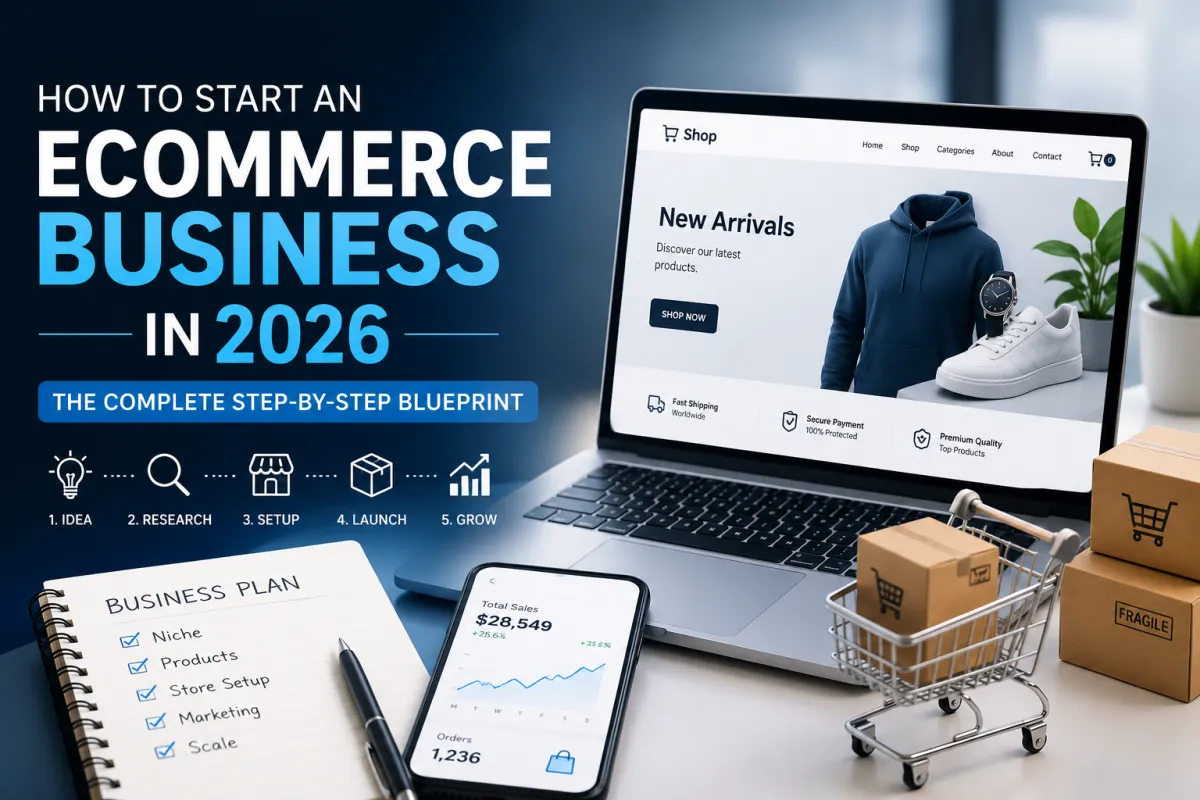
How to Start an Ecommerce Business in 2026: The Complete Step-by-Step Blueprint
Here's an SEO-optimised, long-form blog article designed to drive readers toward downloading your checklist. It's built around a high-intent keyword cluster ("how to start an ecommerce business"), uses scannable structure for SEO, and weaves the lead magnet CTA in at three strategic points: early hook, mid-article value reinforcement, and a strong closing conversion push.
How to Start an Ecommerce Business in 2026: The Complete Step-by-Step Blueprint
Starting an ecommerce business has never been more accessible — or more competitive. With global ecommerce sales projected to exceed $8 trillion by 2027, the opportunity is enormous. But here's the uncomfortable truth most "start your store today" guides won't tell you: roughly 80–90% of new ecommerce businesses fail within the first two years.
The reason isn't bad products. It isn't bad luck. It's a lack of systems.
The founders who build profitable, long-term ecommerce brands aren't the ones with the flashiest ads or the trendiest products. They're the ones who launch with a structured plan covering everything from legal setup to email automation to post-launch retention. They treat their business like a business — not a side hustle they hope catches fire.
This guide walks you through every phase of building a sustainable ecommerce brand, from the foundational strategy nobody talks about to the post-launch growth levers that turn a one-time buyer into a repeat customer. By the end, you'll have a clear roadmap — and a free downloadable checklist — to launch with confidence.
Grab the free companion resource: The Complete Ecommerce Business Startup Checklist — a 14-section operational framework covering every task you need to complete before, during, and after launch. [Download it free here →]
Why Most Ecommerce Businesses Fail Before They Start
Before we get into the how, it's worth understanding the why behind failure. In my experience reviewing dozens of struggling stores, the same patterns appear again and again:
No clear customer avatar. The founder is "selling to everyone," which means they're really selling to no one.
Underestimated cash requirements. Inventory, ads, tools, returns, and software eat capital faster than first-time founders expect.
No retention strategy. They obsess over acquisition and ignore the fact that repeat customers drive 65%+ of revenue for established brands.
Skipping the boring stuff. Legal structure, accounting, GDPR, refund policies — the foundational pieces that prevent existential headaches later.
Launching without a system. No checklist. No process. Just vibes.
That last one is the most common — and the most fixable. Let's get into the framework that prevents it.
Phase 1: Build Your Business Foundation Before You Build Your Store
The single biggest mistake new founders make is jumping straight to "what platform should I use?" before they've answered the questions that actually determine success.
Choose the Right Ecommerce Model
Not every model suits every founder. The four most common are:
Dropshipping — low capital, low margin, high competition. Good for testing demand, hard to scale into a real brand.
Private label — you brand someone else's manufactured product. Higher margins, requires upfront inventory investment.
Wholesale — buying in bulk and reselling. Strong for established niches with proven demand.
Print-on-demand — zero inventory, creative-led. Great for designers, slim margins.
Pick based on your capital, time, and risk tolerance — not on which TikTok guru hyped it last week.
Define Your Customer Avatar (Properly)
"Women aged 25–45 who like fitness" is not a customer avatar. It's a demographic. A real avatar includes:
Their specific frustration with current solutions
Where they spend time online
What they've already tried and abandoned
The emotional outcome they're actually buying
The clearer this picture, the easier every downstream decision becomes — copy, ads, product design, packaging, email tone.
Validate Demand Before You Spend a Penny on Inventory
Use free tools to pressure-test your idea: Google Trends, Amazon best-seller lists, keyword research tools, and TikTok and Instagram search to gauge organic interest. If you can't find evidence that people are already searching for, buying, or talking about something in your category, that's a red flag — not a green-field opportunity.
Phase 2: Branding That Actually Sells
Branding isn't your logo. Branding is the feeling a customer gets when they encounter your business — from the domain name to the unboxing experience.
The strongest ecommerce brands nail four things:
A memorable, easy-to-spell name with the .com available and clean social handles.
A consistent visual identity — colour palette, typography, and photography style that look intentional across every touchpoint.
A defined brand voice — playful, premium, no-nonsense, irreverent. Pick one and commit.
A clear unique selling proposition (USP) — the one-sentence answer to "why should I buy from you instead of Amazon?"
If your USP is "high quality at a good price," you don't have a USP. You have a wish.
Phase 3: Legal and Financial Setup (Don't Skip This)
This is the section new founders most love to skip — and the one that bites hardest later. At minimum, before you take a single order:
Register your business structure (sole trader, LLC, Ltd company — country dependent)
Open a dedicated business bank account
Set up accounting software from day one (Xero, QuickBooks, FreeAgent)
Draft and publish your privacy policy, terms and conditions, and refund policy
Confirm GDPR compliance if you sell to UK or EU customers
Build a 12-month cashflow forecast so you know your runway
A boring afternoon spent on this saves you a panicked weekend with a lawyer six months from now.
Phase 4: Product Research, Sourcing, and Margins
This is where most ecommerce businesses are won or lost — long before the website is built or the first ad runs. Get the product wrong and no amount of marketing fixes it. Get it right and even average execution makes money.
The challenge is that "pick a product" is too broad a task to act on. So we'll break it into the two decisions that actually matter:
What category should you operate in? (Your niche and business model)
Is this specific product worth pursuing? (Qualification against the criteria that predict success)
Step 1: Find the right niche for you
Most "find your niche" advice ignores the most important variable — you. Your capital, time, risk tolerance, and skills should drive this decision as much as market data. A profitable niche for a full-time founder with £20K to invest looks nothing like a profitable niche for someone with £500 and ten hours a week.
The quiz below scores your situation across six dimensions — capital, time, risk appetite, work style, brand ambition, and existing expertise — and recommends the business model most likely to suit you.
[Take the niche-finder quiz →]
It takes around two minutes. The result isn't a magic answer — it's a starting point that filters out the models that will fight you and points you toward the ones that will work with your reality.
Step 2: Qualify the specific product
Once you have a model and category, the next failure point is picking a specific product that seems exciting but doesn't survive contact with the unit economics.
Every viable ecommerce product passes the same eight tests:
Margin — can you sell at 3x landed cost minimum? Below that, ads eat the business.
Demand — is there evidence people are already searching for or buying this?
Differentiation — why would someone buy from you instead of Amazon?
Price point — is it high enough (typically £30+) to absorb customer acquisition cost?
Logistics — is it small, light, and durable enough to ship profitably?
Repeat potential — will customers come back, or is every sale one-and-done?
Seasonality — does demand hold up year-round, or is it concentrated in one quarter?
Regulation — how heavy is the compliance burden (supplements, electronics, cosmetics, kids' products)?
Founders who skip this checklist learn it the hard way — usually six months in, after committing inventory budget to a product that can't carry the ad spend needed to sell it.
The scorecard above lets you stress-test any product idea in under a minute. Score below 55 and you should seriously reconsider. Score 75+ and you have something worth ordering samples for.
[Use the product qualification scorecard →]
Sourcing and supplier vetting
Once a product passes the scorecard, the final pre-launch step is sourcing. Before placing your first order:
Order samples from at least three suppliers and physically test them side by side
Calculate landed cost including freight, duties, and packaging — not just unit price
Confirm minimum order quantities (MOQs) you can actually afford to commit to
Verify lead times against the launch date you've promised yourself
A boring afternoon of supplier diligence saves you the expensive lesson of receiving 500 units of something that doesn't match the sample.
The full Phase 4 workflow — niche selection, product qualification, sourcing, and supplier vetting — is broken down step by step inside The Complete Ecommerce Business Startup Checklist. [Download your free copy →]
Phase 5: Build a Website That Converts, Not Just Looks Good
Most new founders agonise over their homepage and neglect the pages that actually drive revenue: product pages.
A high-converting product page includes:
An SEO-optimised title that matches search intent
5–7 high-quality images including lifestyle, scale, and detail shots
A short video showing the product in use
Benefit-led copy (not feature-led specs)
Visible reviews and trust badges above the fold
Clear shipping, returns, and sizing information
Strategic upsells and bundle offers
And it must load fast on mobile. Over 70% of ecommerce traffic is now mobile-first — if your site takes more than three seconds to load, you're haemorrhaging sales before customers even see your product.
Phase 6: Marketing Systems That Compound Over Time
The founders who win long-term don't rely on a single channel. They build systems that compound:
SEO and content marketing is the slowest-burning, highest-ROI channel. Optimised category pages, blog content targeting buyer-intent keywords, and proper schema markup take six to twelve months to mature — but become free, perpetual traffic.
Email marketing is the highest-ROI channel in ecommerce, full stop. Welcome flows, abandoned cart sequences, post-purchase nurtures, and win-back campaigns can drive 25–40% of total revenue for mature stores.
Paid social (Meta, TikTok) accelerates everything else but should never be your only channel. If your ad account gets restricted tomorrow, do you still have a business?
Organic social and influencer partnerships build the brand equity that makes paid ads cheaper over time.
The mistake is treating these as separate. They're not. A customer might discover you via TikTok, sign up for your email list from a popup, see a retargeting ad three days later, and finally convert after reading a blog post. That's one customer journey across four channels — and only systems thinking captures it.
Phase 7: Pre-Launch Quality Assurance
The 48 hours before launch are where most stores break — and most founders are too excited to notice. Before going live:
Place a real test order on desktop and mobile
Verify every payment method works (including Apple Pay and Google Pay)
Test the checkout on the slowest device you can find
Trigger every email automation manually to confirm it fires
Check shipping rules against five different addresses
Have someone outside your business try to break the site
Launch day is not the day to discover your checkout is broken in Safari.
Phase 8: Post-Launch Growth (Where the Real Business Begins)
Launch is the starting line, not the finish line. The first 90 days post-launch are about learning, not scaling. Watch the metrics that matter:
Conversion rate — anything below 1% means your product page or traffic quality needs work
Customer acquisition cost (CAC) vs average order value (AOV) — the ratio that determines whether you have a business or a money pit
Repeat purchase rate — the single best predictor of long-term profitability
Email revenue as a percentage of total — if it's below 20%, your flows need attention
Once you've validated unit economics, then you scale ad spend, expand product lines, and invest in operational systems for fulfilment, customer service, and inventory management.
The Pattern Behind Every Successful Ecommerce Brand
Strip away the niches, the products, the brand aesthetics — and every successful ecommerce business runs on the same underlying pattern: systems, preparation, consistency, and customer experience. Not luck. Not virality. Not a magic product.
Founders who launch with a checklist and a process build stores that survive their first year. Founders who launch on vibes build stores that don't.
You don't need to memorise every step in this article. You just need a structured operational framework you can work through, tick off, and refer back to as you grow.
Your Next Step: Get the Free Startup Checklist
Everything covered in this article — and 14 full sections of granular, actionable launch tasks — is laid out in a free, printable resource I've built specifically for founders launching their first (or next) ecommerce brand.
Inside The Complete Ecommerce Business Startup Checklist you'll get:
A complete 14-section operational roadmap from idea validation to post-launch scaling
Every legal, financial, and compliance task you need to handle before launch
The exact product page, checkout, and email flow setup high-converting stores use
A pre-launch QA checklist to bulletproof your store before going live
A post-launch growth framework to turn first-time buyers into repeat customers
It's the same framework I'd hand a friend launching their first store tomorrow — completely free, no fluff, instantly downloadable.
👉 [Download The Complete Ecommerce Business Startup Checklist — Free]
Build it right the first time. Your future self will thank you.
