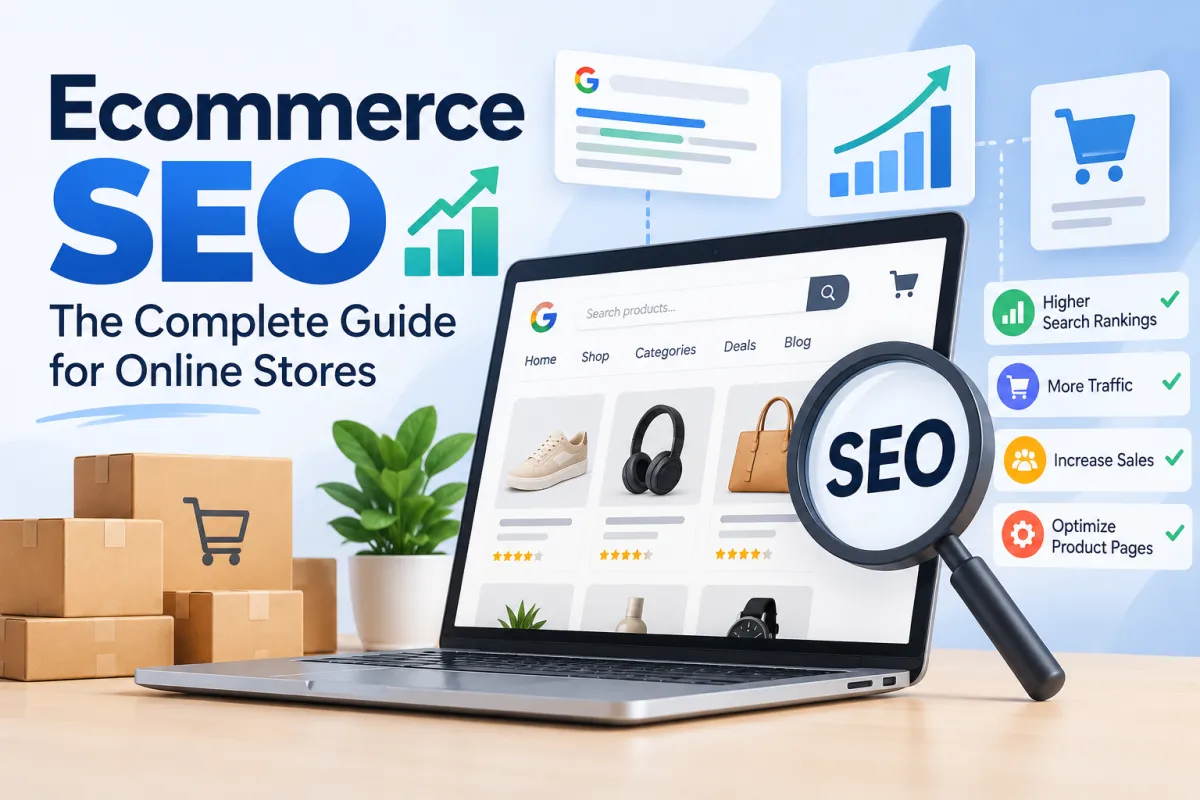
Ecommerce SEO: The Complete Guide for Online Stores
In a hurry? Here’s what matters: Ecommerce SEO is the process of making an online store easier for search engines to discover, understand and rank — and easier for shoppers to navigate and buy from. A strong ecommerce SEO strategy starts with understanding search intent, finding commercially valuable keywords, creating a logical site architecture, and optimising category and product pages around what customers actually search for. Technical SEO, internal linking, structured data, content, authority and measurement then strengthen that foundation. The objective isn't simply more traffic. It is attracting relevant shoppers who can turn organic visibility into sales and revenue.
What Is Ecommerce SEO?
Ecommerce SEO is search engine optimisation specifically adapted to the challenges and opportunities of an online store.
Sounds simple enough.
In practice, an ecommerce website behaves very differently from a conventional brochure website.
A store may have dozens, hundreds or thousands of URLs. Products can appear within several categories. Filters generate additional URL combinations. Products go out of stock. Collections change. Similar products can have remarkably similar descriptions.
Then there is the customer.
Someone searching for "how to choose a coffee grinder" is at a very different stage of the purchase journey from somebody searching for "buy stainless steel burr coffee grinder."
Good SEO for ecommerce understands the difference.
It connects:
what people search for;
why they are searching;
which page should satisfy that search;
how search engines discover and interpret the page;
how easily shoppers can move through the store;
and whether that traffic ultimately produces conversions and revenue.
That last point deserves emphasis.
Ecommerce SEO isn't really about rankings. Rankings are the route. Relevant traffic, customers and profitable organic revenue are the destination.
A #1 organic ranking for a keyword that attracts the wrong audience may be worth considerably less than a #4 position for a transactional keyword that consistently produces customers.
That distinction should influence almost every SEO decision an online retailer makes.
How Ecommerce SEO Works
Search engines need to perform several jobs before a product can appear prominently in Google search results.
At a simplified level, Google needs to:
Discover the URL through links, sitemaps or other signals.
Crawl the page and access its important content.
Understand what the page, product or category represents.
Index the URL where appropriate.
Evaluate its relevance and quality against competing pages.
Rank it for applicable search queries.
Your ecommerce SEO strategy consequently has to operate at several levels simultaneously.
Technical SEO helps search engines access and process the store.
Site architecture and internal linking establish relationships between pages.
On-page SEO communicates what individual URLs are about.
Keyword research identifies the language customers use.
Content helps the store answer questions beyond immediate product searches.
Structured data gives machines additional information about products and other entities.
Authority signals and backlinks can strengthen confidence in the website.
And user experience matters throughout, because attracting a shopper is only useful if the website gives them somewhere sensible to go next.
This is why ecommerce search engine optimization cannot be reduced to adding keywords to product descriptions.
It is a system.
Ecommerce SEO vs Traditional SEO
The underlying principles of search optimisation remain broadly similar, but ecommerce introduces additional complexity.
A service business might have a homepage, ten service pages and a collection of articles. An online store could have:
a homepage;
category or collection pages;
subcategory pages;
hundreds of product pages;
product variants;
informational articles;
buying guides;
filtered URLs;
pagination;
account and checkout pages;
discontinued product URLs;
and dynamically generated pages.
Every additional URL creates decisions about crawlability, indexing, canonical URLs, internal links and search intent.
That scale is one reason online store SEO can go wrong surprisingly quickly.
A technically small issue replicated across 2,000 product URLs is no longer a small issue.
Why SEO Matters for an Online Store
Paid advertising can generate traffic almost immediately. Turn the campaigns off, however, and that traffic can disappear just as quickly.
Organic search works differently.
An optimised category page can continue attracting prospective customers long after it was originally improved. A genuinely useful buying guide can acquire backlinks, build topical authority and direct shoppers towards relevant products for years. A strong product page can capture long-tail keywords that would otherwise require paid clicks.
This doesn't make organic traffic free. SEO requires time, content, technical work and ongoing maintenance.
What it can create is a compounding acquisition channel.
Consider a simplified customer journey:
Google search → useful category page → product page → purchase
Now compare that with:
Google search → buying guide → internal link → category page → product comparison → purchase
Both journeys began with organic search. Their search intent, however, was completely different.
This is where a mature ecommerce SEO strategy becomes valuable: it creates entry points for customers at multiple stages of the buying journey rather than fighting exclusively for a handful of obvious product keywords.
SEO Can Capture Existing Demand
Search traffic is unusually valuable because the customer initiates the interaction.
They already want something.
Their query might reveal:
a problem they need to solve;
a product they are researching;
alternatives they are comparing;
a category they want to browse;
or an item they are ready to purchase.
The job of ecommerce keyword research is to identify those patterns and match them with the right pages.
SEO Can Reduce Dependence on Paid Acquisition
Most ecommerce businesses don't need an artificial battle between SEO and PPC. They can complement each other.
Paid search can generate immediate visibility and provide useful information about queries that convert. SEO can build longer-term organic visibility around valuable categories, products and informational topics.
The commercial question is ultimately about return.
Traffic without revenue isn't a particularly useful ecommerce KPI.
Businesses evaluating marketing investment can use an ecommerce ROI calculator to put acquisition costs, conversion performance and potential returns into a clearer commercial context.
Start With Search Intent, Not Search Volume
One of the easiest mistakes in keyword research is becoming hypnotised by search volume.
A keyword gets 20,000 searches a month.
Great.
But who is making those searches, and what do they want?
Search intent describes the underlying purpose behind a query.
For ecommerce, it can broadly be divided into several groups.
Search intent | Example query | Likely destination |
|---|---|---|
Informational | "how to clean leather trainers" | Guide/blog article |
Commercial investigation | "best running shoes for flat feet" | Buying/comparison guide |
Category-focused | "men's waterproof running shoes" | Category page |
Transactional | "buy black waterproof running shoes size 10" | Category/product page |
Navigational | "Brand X running shoes" | Brand/store page |
The exact boundaries aren't always neat. Human beings don't search according to SEO textbooks.
Still, the principle is enormously useful:
Match the page to the intent.
Trying to rank a blog post for a query where Google overwhelmingly rewards ecommerce category pages can be an uphill battle.
Likewise, trying to force a product page to rank for a broad informational question may make little sense.
Transactional Keywords
Transactional keywords indicate that somebody may be close to acting.
They often contain modifiers such as:
buy;
order;
shop;
price;
sale;
discount;
online;
delivery;
specific sizes, colours or models.
These searches may have lower search volume than enormous generic phrases, but their purchase intent can make them commercially important.
For a single-brand ecommerce store, they can become particularly interesting when customers search for a combination of product type + feature + problem + attribute.
For example:
waterproof + trail running shoe + wide fit + men's
That is a much more revealing query than simply:
shoes
The former tells you something about the customer. The latter barely tells you anything.
Commercial-Intent Keywords
Commercial investigation usually happens slightly earlier.
The shopper knows broadly what they need but hasn't decided exactly what to purchase.
Searches can contain terms such as:
best, top, review, vs, comparison, alternative, recommended, for [use case]
These keywords create opportunities for buying guides, comparisons and educational content that naturally introduce relevant collections or products.
Informational Keywords
Informational keywords are sometimes dismissed because the person isn't necessarily ready to buy.
That is shortsighted.
Imagine that your store sells premium kitchen knives. Someone searching:
"What is the difference between a chef's knife and a santoku?"
may not purchase today.
But your store is perfectly positioned to answer that question.
A strong article can satisfy the query, establish expertise, link naturally to the appropriate categories and products, and introduce the brand before the shopper reaches the transactional stage.
That is content marketing supporting SEO rather than content existing simply because somebody decided the website "needs a blog."
How to Do Ecommerce Keyword Research
Keyword research for an online store shouldn't produce one enormous spreadsheet of phrases with no relationship to the website.
It should produce a map of demand.
You want to understand what customers search for and determine which existing — or future — URL should satisfy each meaningful group of queries.
Step 1: Start With Your Products and Categories
Begin with what you actually sell.
List your:
primary product categories;
subcategories;
individual product types;
important product features;
materials;
colours and sizes where relevant;
problems the products solve;
intended audiences;
common use cases;
and terminology customers use to describe them.
Don't start with SEO tools.
Start with the customer.
If your internal team calls something a "multi-purpose hydration vessel" but customers overwhelmingly search for "water bottle," you can probably guess which language belongs on the website.
Once you have seed topics, tools such as Google Keyword Planner, Google Search Console, Ahrefs and Semrush can expand them into actual search queries.
Google autocomplete can reveal useful patterns too.
Type the beginning of a product-related search and examine how people extend it. You'll often uncover attributes, questions, comparisons and long-tail keywords that wouldn't have appeared in the initial brainstorm.
Step 2: Examine Search Volume — But Don't Worship It
Search volume estimates how frequently people search for a phrase.
It is useful.
It is not a business strategy.
Imagine these two hypothetical keywords:
Keyword | Monthly searches | Intent |
|---|---|---|
coffee | 100,000 | Extremely broad |
1kg single origin espresso beans | 700 | Highly specific |
If your store sells speciality coffee, which searcher sounds closer to becoming a customer?
Exactly.
A lower-volume keyword can have much greater commercial value when it closely matches the product.
This is why long-tail keywords matter.
They tend to be longer and more specific, often reflecting clearer intent. Individually they may look unimpressive. Collectively, however, a well-optimised ecommerce catalogue can rank for enormous numbers of these specific searches.
Step 3: Consider Keyword Difficulty
Keyword difficulty attempts to estimate how challenging it may be to rank organically for a query.
Different SEO platforms calculate it differently, so treat the metric as a guide rather than a law.
More importantly, look at the actual search engine results page.
Ask:
Who currently ranks?
Are the results product pages, category pages or articles?
Are enormous marketplaces dominating?
Are specialist independent retailers visible?
How closely do the ranking pages satisfy the query?
Is the content genuinely strong?
Does your store have a credible page that could compete?
Sometimes the SERP tells you more than the difficulty score.
Step 4: Map Keywords to Pages
Now keyword research becomes architecture.
Instead of giving every keyword its own page, group closely related searches by shared intent.
Suppose research reveals:
men's waterproof jackets;
waterproof jackets for men;
men's rain jackets;
men's waterproof outdoor jackets.
These phrases may belong to one strong category page rather than four near-identical pages.
Keyword mapping helps establish:
keyword cluster → search intent → target URL
This can prevent keyword cannibalisation, where several pages on your own store compete for essentially the same search intent.
The objective isn't to create the maximum possible number of pages.
It is to create the right pages.
Ecommerce Site Architecture: Build the Store for People and Search Engines
Imagine walking into a physical shop where every department has been randomly rearranged.
Shoes are beside coffee machines. Women's jackets are hidden behind televisions. To reach men's shirts, you have to walk through seven unrelated departments and ask somebody for directions.
You'd leave.
Yet plenty of ecommerce websites are structured this way digitally.
Ecommerce site architecture describes how pages are organised and connected throughout the store.
A clean hierarchy might look something like:
Homepage
└── Main Category ├── Subcategory │ ├── Product │ └── Product └── Subcategory ├── Product └── Product
Simple beats clever.
A logical website hierarchy helps customers understand where they are, helps search engines discover pages, supports internal linking and distributes link equity through the site.
Keep Important Pages Within Reasonable Reach
Important commercial pages shouldn't be buried unnecessarily deep in the website.
As a general architectural principle, aim for a relatively shallow structure where valuable categories and products can be reached through intuitive navigation without excessive click depth.
This doesn't mean every product needs a homepage link.
It means the route should make sense.
Homepage → category → subcategory → product
is understandable.
Homepage → menu → department → collection → subcollection → filter → another filter → product
may create unnecessary crawl depth and a frustrating customer journey.
Use Clear, Descriptive URLs
Good SEO-friendly URLs tell humans and search engines something about the destination.
Compare:
/store/p?id=98472&cat=36with:
/mens-shoes/waterproof-running-shoes/The second communicates context immediately.
Useful URL structure tends to be:
readable;
descriptive;
relatively concise;
consistent;
stable over time.
Avoid changing established URLs merely because you discover a prettier naming convention. URL migrations introduce their own SEO considerations and need to be handled carefully with appropriate 301 redirects.
Breadcrumb Navigation
Breadcrumbs show the relationship between the current page and the wider website hierarchy.
For example:
Home > Men's Shoes > Running Shoes > Waterproof Running Shoes
They can improve navigation while reinforcing relationships between products, subcategories and categories.
Breadcrumb structured data can also help search engines interpret this hierarchy.
That brings us to an important point: good ecommerce SEO often improves the website for both crawlers and customers at exactly the same time.
Clear architecture is one example.
Fast pages are another.
Useful product information is another.
SEO and user experience don't have to be competing priorities.
Category Pages: Your Organic Search Workhorses
If product pages capture highly specific demand, category pages often target broader commercial searches.
They can be among the most valuable organic landing pages on an ecommerce website.
Think:
women's running shoes;
organic coffee beans;
standing desks;
men's winter coats;
wireless headphones.
These searches don't necessarily indicate that someone has selected a particular product. They indicate an interest in a group of products.
That's precisely what a category page provides.
Category Page SEO Starts With Intent
The first question isn't:
"How many words should we put on this page?"
It is:
"What does somebody searching this phrase expect to find?"
If the query is strongly commercial, they probably want products.
Don't make shoppers scroll through an 1,800-word history of waterproof jackets before they can see a jacket.
A strong category page can combine:
a clear H1;
a concise, useful introduction;
relevant products;
practical filtering and sorting;
supporting category descriptions where genuinely useful;
internal links to relevant subcategories;
FAQs where they answer real customer questions;
appropriate title tags and meta descriptions.
SEO copy should support the shopping experience, not obstruct it.
Don't Turn Category Copy Into Keyword Soup
You've seen this before:
"Shop our men's running shoes. Our men's running shoes are the best men's running shoes for shoppers looking for men's running shoes online..."
Nobody wants to read that.
Search engines don't need it either.
Use primary keywords, secondary keywords and semantically related terminology naturally. Describe the products. Explain meaningful differences. Answer purchasing questions. Help somebody make a decision.
If a paragraph exists solely to repeat a category keyword, delete it.
Useful specificity beats keyword density.
Product Page SEO: Optimising the Pages That Make the Sale
A product page has a difficult job.
It needs to communicate relevance to search engines while convincing a human being to purchase.
Those goals are more compatible than they might initially appear.
Good product page SEO begins with complete, distinctive and useful product information.
That includes:
a descriptive product title;
unique product descriptions;
specifications;
features and benefits;
high-quality images;
descriptive image alt text;
price and availability;
delivery information;
customer reviews where available;
FAQs when appropriate;
related products;
and clear calls to action.
The exact mix depends on the product, but the principle remains the same:
Answer the questions a customer needs answered before buying.
Write Unique Product Descriptions
Manufacturer descriptions create an obvious problem for multi-brand retailers: dozens of stores can end up publishing essentially identical copy.
A single-brand store has an advantage.
You own the product.
You know why it exists, how it is made, who it is for and what differentiates it. That first-party knowledge can produce product copy competitors simply cannot replicate.
Don't waste that advantage with three generic sentences.
Good product descriptions can naturally incorporate product keywords while explaining:
what the product does;
who it is designed for;
important materials or specifications;
meaningful benefits;
dimensions or compatibility;
care instructions;
use cases;
and answers to common objections.
That is useful for search visibility.
More importantly, it is useful for customers.
And those two ideas will continue to converge as we move into technical SEO, structured data, product schema, Core Web Vitals, content strategy, link building and measuring organic revenue in the next sections of this guide.
Technical SEO for Ecommerce: Make Your Store Easy to Crawl, Understand and Index
You can have excellent products, persuasive product descriptions and carefully researched keywords, but none of that helps organic search if search engines struggle to access the store.
That is where technical SEO enters the picture.
For ecommerce websites, technical problems have a habit of multiplying.
One incorrect setting on a five-page website affects five pages. The same mistake in a product template, filter system or canonical implementation could affect hundreds or thousands of URLs.
The objective is straightforward:
Search engines should be able to discover, crawl, understand and index the URLs you want customers to find — without wasting resources on endless combinations of URLs that offer little or no additional search value.
That sounds simple.
Ecommerce platforms can make it anything but.
Crawlability and Indexing Are Different Things
These two concepts are often bundled together, but they describe different stages of search.
Crawlability concerns whether search engine crawlers can access and follow your pages.
Indexing concerns whether those pages become eligible for inclusion in a search engine's index.
A page can therefore be:
crawlable and indexed;
crawlable but not indexed;
blocked from crawling;
discovered but rarely crawled;
or inaccessible because nothing meaningful links to it.
This distinction matters when diagnosing SEO problems.
If an important category page isn't appearing in Google search results, simply asking "Why isn't Google ranking it?" jumps ahead several steps.
First ask:
Can Google discover the URL?
Can Google crawl it?
Is the page indexable?
Has Google indexed it?
Does Google consider another URL to be canonical?
Does the page actually satisfy a worthwhile search intent?
Only then: why isn't it ranking competitively?
That sequence can save hours of guesswork.
Control Your Crawl Budget
Search engines don't crawl every URL on every website continuously.
Crawl budget broadly describes the resources a search engine is willing and able to devote to crawling a site.
For a small single-brand store with a relatively compact catalogue, crawl budget may not be a major concern.
For a large ecommerce website, it can become much more significant.
The problem is rarely that the store has "too many products."
It is often that one useful product catalogue creates enormous numbers of technically accessible URL variations.
Consider a category with filters for:
size;
colour;
material;
price;
availability;
rating;
style;
and sort order.
Allow every possible combination to generate a unique crawlable URL and one category can suddenly produce hundreds or thousands of URLs.
Now repeat that across the store.
This is why faceted navigation deserves particular attention.
Faceted Navigation and Product Filters
Product filters are brilliant for shoppers.
Someone browsing 400 products probably doesn't want to inspect every item manually. They may want:
Black → Medium → Under £100 → In Stock
That improves usability.
The SEO question is whether every filter combination deserves to become an indexable landing page.
Usually, it doesn't.
For example:
/category/shoes?colour=black
/category/shoes?colour=black&size=10
/category/shoes?colour=black&size=10&sort=price
/category/shoes?colour=black&size=10&sort=price&availability=1
Those URLs might be useful states for a customer without being useful standalone pages in organic search.
Poorly controlled URL parameters can contribute to:
duplicate content;
near-duplicate pages;
index bloat;
wasted crawling;
diluted ranking signals;
confusing canonicalisation;
and thousands of low-value URLs appearing in search systems.
The solution isn't automatically to block every filtered page.
Some facets may represent genuine search demand.
If customers actively search for black leather handbags, for example, a dedicated indexable collection may make perfect sense.
The important distinction is intent.
If a filtered combination satisfies meaningful, distinct search demand, consider whether it deserves a permanent optimised landing page. If it exists purely as a temporary browsing state, don't automatically treat it like an SEO destination.
This is another example of keyword research influencing technical architecture.
Canonical Tags and Duplicate URLs
Ecommerce stores are particularly vulnerable to duplicate and near-duplicate URLs.
A single product might be accessible through:
/products/example-product
/category/products/example-product
/products/example-product?colour=black
/products/example-product?utm_source=email
Depending on the platform and configuration, search engines may encounter multiple URLs displaying substantially the same primary content.
A canonical tag helps indicate the preferred version.
Conceptually, it says:
"Several URLs may lead to similar content, but this is the URL we consider the main version."
Canonical URLs are especially relevant around:
URL parameters;
product variants;
tracking parameters;
sorting;
filtered navigation;
duplicate category paths;
and other technically generated URL variations.
But canonical tags aren't magical correction fluid.
If your site architecture continually sends contradictory signals — canonicalising to one URL while internally linking heavily to another, for example — you're making interpretation unnecessarily difficult.
Consistency is better.
Your preferred URL should ideally align across:
internal links;
canonical tags;
XML sitemaps;
redirects;
structured data where applicable;
and the URLs presented to users.
XML Sitemaps
An XML sitemap provides search engines with a structured list of URLs you want them to know about.
For ecommerce stores, sitemaps can be particularly helpful because inventories change.
Products launch.
Categories appear.
Pages disappear.
Collections evolve.
A good ecommerce XML sitemap should focus on canonical, indexable URLs rather than becoming a dumping ground for everything the website can technically generate.
That means you generally don't want to fill it with:
redirected URLs;
broken pages;
duplicate parameter URLs;
URLs deliberately marked
noindex;or pages canonicalised elsewhere.
Think of your sitemap as a curated list of meaningful destinations.
Not the website's attic.
Robots.txt and Noindex: Don't Confuse Them
Two technical controls regularly cause confusion: robots.txt and noindex.
They aren't interchangeable.
A robots.txt rule controls crawler access to particular areas or URL patterns.
A noindex directive tells compliant search engines that a page should not be included in their search index.
The distinction matters.
Carelessly blocking a URL in robots.txt while expecting a crawler to access its noindex instruction can create unintended results.
Technical directives should therefore be implemented deliberately rather than copied from somebody else's ecommerce SEO checklist.
A rule that makes sense for a marketplace with 500,000 URLs may be completely inappropriate for a single-brand store with 120 products.
Find and Fix Orphan Pages
An orphan page has no meaningful internal links pointing towards it.
Even if the URL appears in an XML sitemap, a lack of internal links can make the page harder for users and crawlers to discover naturally while communicating very little about its relationship to the rest of the website.
Products and categories should exist within a coherent internal structure.
Relevant links might come from:
category pages;
subcategories;
related-product modules;
buying guides;
blog content;
navigation;
breadcrumbs;
and other relevant products.
Internal linking shouldn't be random.
Links create context.
A guide about choosing a product can link to the category where customers can browse those products. A category can link to important subcategories. Product pages can surface complementary products.
Done well, the store becomes a connected network rather than a pile of URLs.
Page Speed and Core Web Vitals
Customers are impatient.
Search engines know this.
A beautiful ecommerce experience that takes an eternity to load isn't particularly beautiful in practice.
Page speed affects usability, conversion behaviour and the overall page experience. Ecommerce stores can be especially vulnerable because product and collection pages often contain large images, third-party scripts, tracking systems, review widgets, recommendation engines and other functionality.
Google's Core Web Vitals focus on measurable aspects of real-world user experience.
Three important metrics are:
Metric | What it broadly measures |
|---|---|
LCP — Largest Contentful Paint | Loading performance |
INP — Interaction to Next Paint | Responsiveness to user interaction |
CLS — Cumulative Layout Shift | Visual stability |
You don't need to turn every store owner into a performance engineer.
You do need to recognise what poor performance feels like.
Have you ever opened a product page, tried to tap a button, and watched it jump down the screen because another element suddenly loaded above it?
That's the sort of frustrating experience CLS attempts to quantify.
Or tapped a product filter and waited while the website apparently contemplated the meaning of existence before responding?
Responsiveness matters too.
Common Causes of Slow Ecommerce Pages
Images are an obvious starting point.
Product photography is essential, but uploading enormous original image files directly to product pages can create unnecessary weight.
Useful image optimisation practices include:
resizing images appropriately;
compressing files;
using modern formats such as WebP or AVIF where appropriate;
avoiding unnecessarily oversized assets;
implementing lazy loading sensibly;
and providing descriptive image alt text.
Then look beyond images.
Third-party applications and scripts can quietly accumulate.
One app handles reviews.
Another handles pop-ups.
Another powers chat.
Another provides recommendations.
Another tracks behaviour.
Another adds social proof.
Individually, each seems harmless. Collectively, the browser may be doing an extraordinary amount of work before somebody can comfortably interact with the product page.
Periodically audit what is actually necessary.
Every app should earn its place.
Mobile-First Ecommerce SEO
For many stores, a substantial proportion of browsing happens on mobile devices.
Google also operates with mobile-first indexing, making the mobile version of your experience fundamental to search.
But "mobile-friendly" shouldn't mean merely "the page technically fits on a phone."
Use the store yourself.
Can you:
open the navigation comfortably;
find a category;
apply product filters;
view product images;
read the product description;
select a variant;
add the item to the basket;
understand delivery information;
and proceed towards checkout without fighting the interface?
SEO audits can become obsessed with bots and forget that the ultimate destination is a human being holding a phone.
Technical correctness and usability should reinforce one another.
HTTPS and Ecommerce Security
Every modern ecommerce store should operate securely over HTTPS.
Customers may provide names, addresses, login information and payment-related data during the purchase journey. Security is therefore not an optional SEO embellishment.
Make sure the website consistently resolves to its secure HTTPS version and avoid unnecessary mixtures of HTTP and HTTPS resources.
Security also contributes to something SEO tools can't neatly summarise in a single metric:
trust.
If a shopper doesn't trust the store, rankings won't rescue the sale.
JavaScript SEO and Modern Ecommerce Platforms
Modern ecommerce websites can rely heavily on JavaScript.
That isn't inherently bad.
The difficulty appears when important content, links or functionality depend on JavaScript in ways that make discovery or rendering unnecessarily difficult.
Things worth checking include whether search engines can reliably access:
product names;
product descriptions;
prices;
availability;
category links;
pagination;
primary navigation;
canonical information;
and other important page content.
This becomes particularly relevant with highly customised or headless ecommerce implementations.
Server-side rendering or other rendering approaches can help in suitable architectures, but the technical solution depends on the platform.
The SEO principle remains much simpler:
Don't make search engines solve a puzzle merely to discover what your customers can buy.
Structured Data and Ecommerce Schema Markup
A product page makes sense visually to a human.
We can look at it and understand:
"That's the product name. That's the price. Those stars represent reviews. It's currently in stock."
Machines benefit from more explicit information.
Structured data provides a standardised way of describing entities and their properties.
For ecommerce, schema markup can help communicate information such as:
product name;
brand;
SKU;
image;
description;
price;
currency;
availability;
ratings;
reviews;
offers;
and breadcrumb relationships.
This can improve a search engine's understanding of the page and may make eligible pages suitable for enhanced search appearances.
It does not guarantee a rich result.
That's an important distinction.
Product Schema
Product schema is particularly important for ecommerce product pages.
Depending on the implementation and the information genuinely present on the page, properties may describe the product and associated offer information.
For example:
Product
├── name
├── image
├── description
├── SKU
├── brand
└── Offer ├── price ├── priceCurrency └── availability
The structured data should correspond with the visible product information.
If the page says the product costs £79, your schema shouldn't tell search engines it costs £59.
Accuracy matters.
This becomes particularly important as product information is consumed by an expanding range of search experiences, shopping surfaces and AI-driven systems.
Review and AggregateRating Schema
If your product genuinely has customer reviews displayed on the page, appropriate review-related structured data may help search systems understand that information.
Relevant schema types and properties can include Review and AggregateRating.
Again, structured data should describe reality.
Don't fabricate ratings.
Don't mark up reviews that don't exist.
Don't use schema as an attempt to manufacture search features.
Think of schema markup as a translation layer between the information customers can already see and the structured information machines can process.
Offer Schema
Offer information can describe commercial attributes including:
price;
currency;
availability;
and applicable offer details.
For ecommerce, this matters because price and stock status are fundamental product attributes.
Keeping product data accurate across the website should therefore be considered part of search optimisation rather than something that belongs exclusively to merchandising.
BreadcrumbList
Earlier, we discussed breadcrumb navigation from the perspective of site architecture.
BreadcrumbList structured data gives search engines explicit information about that hierarchy.
For example:
Home
→ Clothing
→ Men's Clothing
→ Jackets
→ Waterproof Jacket
That relationship provides useful context.
The product isn't an isolated URL floating around the internet.
It exists within an organised catalogue.
Rich Results, Rich Snippets and SERP Visibility
Standard organic listings have traditionally consisted of familiar elements such as a title, URL and description.
Search results can now contain considerably more information.
Depending on query, eligibility, implementation and Google's own systems, ecommerce-related search appearances may incorporate information such as:
price;
availability;
ratings;
product imagery;
shipping information;
and other product attributes.
These enhanced appearances can make listings more informative before the shopper even reaches your website.
That can influence click-through rate (CTR) because users have additional information when deciding which result deserves their attention.
But avoid thinking:
schema markup = guaranteed rich snippets = instant rankings.
It doesn't work like that.
Structured data helps search engines understand explicit information and can establish eligibility for certain experiences. Search engines ultimately determine what appears.
Google Merchant Center and Product Feeds
Organic ecommerce visibility increasingly extends beyond traditional blue-link search results.
Product information can appear across shopping-related surfaces, making accurate product feeds an important part of a broader ecommerce search strategy.
Google Merchant Center allows retailers to provide structured product information such as:
product titles;
descriptions;
prices;
images;
availability;
brand;
identifiers;
condition;
and landing-page URLs.
A product feed shouldn't be treated as a boring administrative export.
The quality of product data matters.
Vague titles, inconsistent attributes, outdated availability and poor imagery can weaken how effectively products are represented.
This introduces a useful broader principle:
Modern ecommerce SEO isn't confined to optimising webpages. It increasingly involves optimising the underlying product information that search and discovery systems consume.
Product data accuracy deserves ongoing attention.
Product Variants: One Product or Several Pages?
Variants create an interesting SEO problem.
Imagine one shirt available in:
six colours;
five sizes;
and several fits.
Should every combination have its own indexable URL?
Probably not.
But there is no universal answer.
The deciding question is whether individual variants represent meaningful, independently searchable products.
Colour can sometimes carry significant search demand.
Size usually behaves differently.
Customers might regularly search for "red leather handbag", making colour commercially meaningful. Far fewer businesses would benefit from indexable URLs for every minor variation generated by a selector.
Variant strategy should consider:
search demand;
product differences;
user experience;
duplicate content;
canonicalisation;
internal linking;
and platform behaviour.
Don't generate hundreds of indexable pages simply because the ecommerce system makes it possible.
Out-of-Stock and Discontinued Products
Products don't live forever.
Some sell out temporarily.
Others disappear permanently.
That creates an SEO decision.
Temporarily Out of Stock
If a product is expected to return, deleting the page immediately may waste an established URL and create a poor experience for users arriving through old links.
Instead, consider keeping the page live while clearly communicating:
that the product is currently unavailable;
whether it is expected back;
alternative products;
related categories;
or a stock notification option where appropriate.
Don't pretend an unavailable product is available.
Accuracy comes first.
Permanently Discontinued
When a product is permanently gone, ask whether there is a genuine replacement.
If a close successor exists, a 301 redirect may sometimes be appropriate.
If there isn't an equivalent replacement, blindly redirecting every discontinued product to the homepage can create a confusing experience.
Sometimes allowing a genuinely removed URL to return the appropriate HTTP status is cleaner.
Other times, keeping an informative discontinued-product page can make sense if it continues to satisfy useful search demand.
Context matters.
Thin Content and Duplicate Content
Ecommerce sites naturally create pages with similar structures.
That isn't automatically a problem.
Twenty products in the same collection will naturally share navigation, shipping information, template elements and perhaps some specifications.
The problem appears when the main value of each page becomes almost indistinguishable.
If every product description says:
"Our premium product is made from high-quality materials and is perfect for anyone looking for quality and style."
then technically the words may be "unique."
Practically, they say nothing.
Unique content isn't about passing a plagiarism detector.
It's about adding distinctive information.
For a single-brand store, this is a substantial opportunity.
You know things about your own products that a marketplace, affiliate website or generic reseller may not know:
why you designed them;
how materials were selected;
what changed between versions;
what customers frequently ask;
which use cases they suit;
what they don't suit;
how to care for them;
and how they compare with other products in your range.
Use that knowledge.
That's how product copy becomes genuinely difficult to replicate.
Internal Linking: Build Paths, Not Just Links
Internal linking is one of the most controllable elements of ecommerce SEO.
Every internal link can serve several purposes:
Discovery: helping crawlers and users find another page.
Context: helping indicate what the destination is about.
Hierarchy: showing relationships between pages.
Authority distribution: helping link equity move throughout the website.
Navigation: moving customers towards useful next steps.
This means internal links should appear where they make contextual sense rather than being injected mechanically.
For example:
Buying guide → relevant category
Category → subcategory
Subcategory → product
Product → complementary product
Blog article → related buying guide
Discontinued product → genuine replacement
This creates pathways.
And pathways are valuable for both shoppers and search engines.
Content Marketing for Ecommerce SEO
Ecommerce content shouldn't exist just to satisfy a publishing calendar.
Nobody benefits from:
"We need four blog posts this month because the SEO spreadsheet says so."
Start with customer demand instead.
What questions appear before purchase?
What causes hesitation?
What do customers compare?
What terminology confuses them?
What problem are they actually trying to solve?
Those questions can produce useful content.
Buying Guides
Buying guides can bridge informational and commercial search intent.
Someone might know they need a product without knowing which variation suits them.
A good buying guide helps them understand:
important features;
terminology;
sizes or specifications;
different use cases;
what to prioritise;
common mistakes;
and which products suit different requirements.
That gives you a natural opportunity to introduce relevant categories and products without forcing the sale.
Comparison Content
Customers compare things.
If you don't help them do it, somebody else will.
Useful comparisons might include:
Product A vs Product B
Material A vs Material B
Entry-level vs premium
Small vs large
Option A for use case X vs Option B for use case Y
Comparison content works when it helps somebody make a decision.
It fails when the predetermined conclusion is simply:
"Our product is obviously amazing. Buy it."
Customers can smell that a mile away.
Credibility comes from acknowledging genuine differences and helping the reader determine which option fits their needs.
Topic Clusters and Topical Authority
A strong ecommerce content strategy can develop groups of interconnected resources around subjects closely related to the products you sell.
Suppose a brand sells specialist coffee equipment.
Its content hub might cover:
Coffee Grinders
├── How to choose a coffee grinder
├── Burr vs blade grinders
├── Espresso grinder settings
├── How to clean a coffee grinder
├── Why grind size matters
└── Best grinder for different brewing methods
Those resources can link naturally to each other and to the appropriate commercial pages.
This creates a topic cluster.
Instead of publishing unrelated articles based on whichever keyword looked interesting that morning, the website develops depth around subjects relevant to its products and customers.
That can strengthen topical relevance while creating useful entry points across the customer journey.
And importantly, the content has somewhere to lead.
Information → consideration → category → product
That's a far healthier ecommerce content model than publishing informational traffic with no relationship to the store.
E-E-A-T and First-Party Experience
E-E-A-T refers to Experience, Expertise, Authoritativeness and Trustworthiness.
It shouldn't be treated as another box where somebody writes "E-E-A-T optimised" in a spreadsheet and considers the job complete.
For an ecommerce brand, genuine first-party knowledge can be an advantage.
You make or sell the product.
Show what you know.
That might involve:
original product photography;
detailed specifications;
transparent company information;
clear policies;
genuine customer reviews;
expert buying advice;
testing information;
care instructions;
demonstrations;
original research;
or explanations from the people involved in designing and developing the products.
The internet has no shortage of generic product content.
First-hand information is harder to imitate.
User-Generated Content and Customer Reviews
Customers can contribute useful information too.
Product reviews frequently contain details that traditional product descriptions overlook:
"I'm 6'2" and the large fits perfectly."
"I use this outdoors five days a week."
"The compartment fits my 15-inch laptop."
Those observations can answer questions prospective buyers genuinely have.
User-generated content, or UGC, can therefore strengthen a product page by adding authentic experience and additional context.
But don't treat reviews as a keyword-generation machine.
Their real value is trust.
Encourage genuine feedback.
Make reviews useful.
Allow customers to discuss meaningful attributes.
And never manufacture testimonials simply for SEO.
Content Hubs Should Connect to Commercial Pages
One of the strangest ecommerce SEO mistakes is creating a successful blog that seems to exist on a different planet from the store.
An article ranks.
It receives thousands of visits.
Then the reader reaches the bottom and...
nothing.
No relevant category.
No related product.
No sensible next step.
Traffic becomes a vanity metric.
Every informational page doesn't need to sell aggressively, but relevant internal pathways should exist.
If someone reads a detailed guide to choosing the correct product size, giving them a natural route to browse those products is helpful, not pushy.
The relationship should make sense.
That's the standard.
Link Building for Ecommerce Websites
Backlinks remain an important part of organic search because links from other websites can help establish discovery, context and authority.
The difficult part is earning links worth having.
Buying enormous batches of irrelevant links isn't a sustainable substitute for building something people genuinely want to reference.
For ecommerce brands, legitimate opportunities can include:
digital PR;
original research;
useful industry data;
genuinely exceptional guides;
supplier or partner relationships;
product collaborations;
expert commentary;
interactive tools;
original visual resources;
and noteworthy brand stories.
The exact approach depends on the market.
A fashion brand will have different opportunities from a specialist industrial supplier.
What matters is relevance and legitimacy.
Digital PR
Digital PR can earn coverage and backlinks by giving publishers something genuinely newsworthy or useful.
That could include:
proprietary data;
customer trend analysis;
surveys;
product innovation;
unusual experiments;
expert insights;
seasonal data;
or stories with clear relevance to the industry.
The emphasis is on having something worth covering.
Sending 500 journalists an email titled "Please link to our category page" isn't digital PR.
It's inbox decoration.
SEO Is Becoming Broader Than Ten Blue Links
Traditional search engine rankings still matter enormously.
But product discovery is becoming more fragmented.
Customers can encounter products through conventional organic listings, shopping experiences, images, merchant listings, video, AI-generated search experiences and other discovery systems.
That changes how we should think about ecommerce website optimization.
The future isn't simply:
"Put keyword in title tag."
It increasingly involves providing clear, consistent information about:
who your brand is;
what each product is;
what category it belongs to;
what it costs;
whether it is available;
what attributes it has;
who it is for;
how it differs from alternatives;
and what real customers think about it.
In other words, entity SEO and semantic SEO matter.
Search systems are trying to understand things and relationships, not merely count strings of words.
Ecommerce SEO and AI Search
AI search experiences add another layer to product discovery.
AI Overviews, answer engines and generative search systems can synthesise information rather than simply displaying a conventional list of pages.
This has led to terms such as answer engine optimization and generative engine optimisation (GEO).
The terminology may evolve.
The underlying lesson is more durable.
Create information that machines can understand and people can trust.
That means:
clear product data;
strong site architecture;
accurate structured data;
distinctive first-party information;
descriptive product copy;
genuine expertise;
useful comparisons;
accessible content;
consistent brand information;
and technically crawlable pages.
There's no need to abandon conventional SEO in pursuit of every new acronym.
Many of the foundations overlap.
A technically sound store with excellent product information, authoritative content and clear entities is better positioned for both traditional organic search and emerging discovery experiences.
Don't Optimise for Search Engines at the Expense of Customers
Technical ecommerce SEO can become remarkably abstract.
Crawl budget.
Canonicalisation.
JavaScript rendering.
Schema.
Index bloat.
Link equity.
All important.
But ultimately, someone has to buy something.
That person doesn't care whether your canonical implementation is elegant.
They care whether:
they found the right product;
the page loaded quickly;
the photographs answered their questions;
the description made sense;
the price was clear;
the product was actually available;
they trusted the brand;
and purchasing felt straightforward.
The strongest SEO strategy connects those two worlds.
Make the website easier for search systems to understand while making it better for customers to use.
When those objectives align, ecommerce SEO stops being a collection of isolated optimisation tricks.
It becomes part of how the store works.
International Ecommerce SEO: Selling Beyond One Market
Expanding an ecommerce store internationally creates opportunity.
It also creates complexity.
A website serving customers in multiple countries may need to account for:
different languages;
currencies;
product availability;
delivery options;
regional terminology;
pricing;
legal requirements;
and different search behaviour.
Simply translating an English product page word-for-word doesn't necessarily create an effective international ecommerce SEO strategy.
People in different markets can search differently even when they want exactly the same product.
That's why international keyword research matters.
Hreflang and International Targeting
If you operate multiple versions of substantially similar pages for different languages or regions, hreflang annotations can help search engines understand which version is intended for which audience.
For example, you might have separate pages targeting:
English speakers in the UK;
English speakers in the US;
French speakers in France;
German speakers in Germany.
The language may change.
The currency might change.
Products and delivery information may change.
Even English-language terminology can vary significantly between countries.
Think:
trainers vs sneakers
jumper vs sweater
trousers vs pants
International SEO therefore involves more than translation.
It requires localisation.
That means understanding how customers in the target market actually describe products, what they search for, which questions they ask and what information they expect before buying.
A technically perfect translation that ignores local search behaviour can still miss the market.
Ecommerce Site Migrations: When SEO Can Go Very Wrong
Few moments in the life of an ecommerce website deserve more SEO attention than a site migration.
Perhaps you're:
changing ecommerce platforms;
moving domains;
redesigning the website;
restructuring categories;
changing URL formats;
consolidating products;
moving to headless ecommerce;
or rebuilding the entire store.
A migration can improve a website enormously.
It can also destroy years of accumulated organic visibility if handled carelessly.
Why?
Because search engines know your existing site through its URLs and the signals attached to them.
Change those URLs without creating a clear path from old to new and search engines — not to mention customers following old links — can encounter dead ends.
Create a URL Migration Map
Before changing established URLs, create a map showing where important old URLs should go.
Conceptually:
Old URL | New URL | Action |
|---|---|---|
|
| 301 redirect |
|
| 301 redirect |
|
| 301 redirect |
| No equivalent | Review individually |
A 301 redirect tells browsers and search engines that a resource has permanently moved.
But don't automatically redirect every deleted URL to the homepage.
A redirect should lead somewhere relevant.
If Product A has been replaced by Product B, that may be a logical destination.
If an old page about garden furniture is redirected to a homepage selling kitchen equipment, the relationship is considerably harder to justify.
Don't Forget Internal Links
Redirects are useful during migrations, but they shouldn't become permanent substitutes for maintaining clean internal links.
If an internal link points to:
Old URL → 301 → New URL
update it to point directly to the new URL where practical.
The cleaner path is:
Internal link → New URL
The same principle applies to XML sitemaps, canonical tags and other technical references.
After a migration, check that all these signals agree about which URLs now matter.
Monitor the Migration After Launch
Launching isn't the end of the migration.
It's when monitoring becomes particularly important.
Watch for:
unexpected 404 errors;
redirect chains;
redirect loops;
indexing changes;
crawl errors;
canonical problems;
lost internal links;
missing structured data;
robots.txt mistakes;
accidental
noindexdirectives;organic traffic changes;
ranking changes;
and changes in organic revenue.
Compare like with like where possible.
Seasonality matters.
If Christmas products naturally decline in January, don't automatically blame a December migration for every traffic decrease.
SEO data needs context.
Google Search Console: Your View From Google
SEO platforms can estimate plenty of things.
Google Search Console gives you information directly related to how Google encounters and displays your website.
For ecommerce SEO, it is one of the most useful diagnostic tools available.
You can use it to investigate:
search queries;
clicks;
impressions;
average positions;
click-through rate;
indexed pages;
excluded URLs;
sitemap processing;
Core Web Vitals;
page experience signals;
and individual URL indexing information.
But data is only valuable when you ask useful questions.
Instead of opening Search Console and admiring a graph, investigate.
Which category pages are gaining impressions but not clicks?
Which product-related queries rank just outside the strongest positions?
Which pages have lost visibility?
Are valuable URLs actually indexed?
Which queries produce unexpected landing pages?
Are two URLs competing for similar searches?
Those questions turn Search Console from a reporting dashboard into an SEO tool.
Impressions, Clicks and CTR
These three metrics tell different parts of the story.
An impression indicates that a result from your site was displayed in search.
A click indicates that somebody selected it.
CTR, or click-through rate, describes clicks relative to impressions.
Suppose a product category generates:
50,000 impressions;
750 clicks;
strong average positions.
That should prompt investigation.
Perhaps the title tag doesn't communicate the offer clearly.
Perhaps competitors have stronger search appearances.
Maybe your result doesn't align closely enough with search intent.
Perhaps the query mix contains searches where the page is only marginally relevant.
Don't immediately rewrite every meta description because CTR appears low.
Investigate the queries first.
Aggregated metrics can hide wildly different search intents.
Search Engine Rankings Are Not the Final KPI
Rankings are useful.
They're also seductive.
Moving from position 11 to position 4 for an important transactional keyword is meaningful.
Moving from position 43 to position 8 for a completely irrelevant phrase is less exciting than an SEO report might make it appear.
The commercial chain looks more like:
Visibility → clicks → relevant sessions → engagement → conversions → revenue → profit
Rankings sit near the beginning.
For ecommerce businesses, success ultimately needs to connect with commercial outcomes.
Measure Organic Revenue, Not Just Organic Traffic
Imagine two SEO campaigns.
Campaign A
Organic traffic increases 80%.
Revenue increases 5%.
Campaign B
Organic traffic increases 25%.
Revenue increases 40%.
Which one changed the business more?
Traffic growth can be excellent, but ecommerce SEO needs to look further down the funnel.
Useful metrics may include:
organic sessions;
new organic users;
non-brand organic traffic;
category-page traffic;
product-page traffic;
organic conversion rate;
transactions;
average order value;
organic revenue;
assisted conversions;
customer acquisition cost;
and return on investment.
No single metric tells the whole story.
Together, they can show whether improved search visibility is attracting people who actually matter to the business.
Conversion Rate Optimisation and SEO Belong Together
Suppose SEO doubles your organic traffic.
Excellent.
Now suppose almost nobody buys.
You have discovered the limits of traffic acquisition.
Conversion rate optimisation (CRO) looks at what happens after visitors arrive and attempts to improve the proportion who complete meaningful actions.
For an ecommerce store, that might mean purchasing, adding to basket, signing up for stock notifications or taking another commercially useful step.
SEO and CRO should communicate with each other.
If an important category attracts thousands of relevant organic visitors but converts poorly, investigate.
Potential causes could include:
mismatched search intent;
confusing navigation;
weak product imagery;
insufficient product information;
unclear delivery costs;
poor mobile UX;
lack of trust signals;
stock problems;
slow page speed;
confusing filters;
weak calls to action;
or simply the wrong products for the audience.
More traffic won't automatically solve those problems.
Sometimes improving the page you already rank with creates more value than chasing another hundred keywords.
Ecommerce SEO ROI
SEO is often described as a long-term investment, which is true but incomplete.
It should still be accountable.
Calculating SEO ROI can become complicated because organic performance may be influenced by brand demand, seasonality, merchandising, pricing, promotions, website changes and other marketing channels.
Still, you should attempt to connect investment with commercial outcomes.
Consider:
SEO costs
against:
incremental organic revenue and resulting profit
Costs may include:
SEO specialists;
developers;
writers;
digital PR;
tools;
design;
technical implementation;
and internal staff time.
Returns should be interpreted in the context of margin rather than assuming that £1 of revenue equals £1 of profit.
That distinction matters enormously in ecommerce.
Brand vs Non-Brand Organic Search
Another useful distinction is brand versus non-brand organic search.
Branded searches might include:
Your Brand
Your Brand + product
Your Brand reviews
Non-brand searches might include:
waterproof hiking backpack
best backpack for weekend travel
40 litre carry on backpack
Both are valuable, but they tell you different things.
Strong branded search traffic may demonstrate existing brand demand.
Non-brand visibility can reveal how effectively you're reaching people who haven't necessarily decided to find you specifically.
For SEO growth, that distinction is useful.
Otherwise, an increase in branded searches caused by a successful television campaign, influencer partnership or PPC campaign might accidentally be credited entirely to SEO.
Marketing channels interact.
Measurement should acknowledge that.
Keyword Cannibalisation: When Your Own Pages Compete
Keyword cannibalisation occurs when multiple pages compete around the same or substantially similar search intent.
This doesn't mean a website can only mention a keyword on one page.
That's a myth.
The problem occurs when search engines struggle to determine which of several pages is the best destination for a query.
For example:
/mens-running-shoes/
/running-shoes-for-men/
/mens-shoes/running/
/best-mens-running-shoes/
If all four are effectively trying to satisfy the same transactional category intent, you may have created unnecessary competition.
Symptoms can include:
different URLs alternating in search results;
weak rankings across several similar pages;
backlinks divided between competing URLs;
confusing internal links;
and duplicated or near-duplicated content.
The solution depends on the pages.
You might consolidate them.
You might differentiate their intent.
You might redirect an obsolete page.
Or you may discover there isn't actually a cannibalisation problem at all because the pages serve clearly different purposes.
Don't diagnose purely from matching keywords.
Look at intent.
Run an Ecommerce SEO Audit
An SEO audit establishes what is currently helping or restricting organic performance.
For an online store, that means looking beyond title tags.
A useful audit should investigate the website as a complete system.
Technical SEO Audit
Check:
crawlability;
indexing;
robots.txt;
XML sitemaps;
canonical tags;
HTTP status codes;
redirect chains;
broken links;
orphan pages;
faceted navigation;
URL parameters;
pagination;
JavaScript rendering;
mobile usability;
Core Web Vitals;
site speed;
HTTPS;
structured data;
and index bloat.
On-Page SEO Audit
Review:
title tags;
meta descriptions;
H1 tags;
heading structure;
category descriptions;
product descriptions;
search intent;
keyword targeting;
image alt text;
internal links;
duplicate content;
thin content;
and content quality.
Ecommerce Architecture Audit
Look at:
category hierarchy;
subcategories;
navigation;
breadcrumbs;
click depth;
product categorisation;
URL structure;
internal link distribution;
and the pathways between informational and commercial content.
Content Audit
Ask:
Which articles generate organic traffic?
Which generate meaningful conversions?
Which topics are missing?
Which pages overlap?
Which articles need updating?
Which could be consolidated?
Which deserve stronger internal links?
Where are the keyword gaps?
Are important customer questions unanswered?
Authority Audit
Finally, examine:
backlink quality;
referring domains;
brand mentions;
digital PR opportunities;
linkable assets;
competitor backlinks;
supplier or partner opportunities;
and existing pages that have naturally attracted links.
If you're unsure where your biggest SEO opportunities are, an ecommerce SEO audit can provide a useful starting point for identifying technical, content and commercial priorities before making broad changes.
Prioritise SEO Work by Impact
An audit can easily produce 100 recommendations.
That doesn't mean all 100 deserve equal attention.
This is where ecommerce SEO needs commercial judgement.
Imagine discovering:
Issue A: 4,000 irrelevant filtered URLs are being indexed.
Issue B: Three image alt attributes are missing.
Issue C: Your highest-revenue category is accidentally marked noindex.
Issue D: One meta description is 12 characters longer than an SEO tool recommends.
Which one are you fixing first?
Hopefully not D.
Prioritise recommendations based on factors such as:
Potential commercial impact
SEO impact
Number and importance of affected URLs
Implementation difficulty
Resources required
Risk
Dependencies on other work
A useful mental model is:
Impact × confidence ÷ effort
It doesn't need to become an elaborate mathematical formula.
Its purpose is to stop teams spending three weeks polishing tiny details while a serious technical problem sits untouched.
An Ecommerce SEO Roadmap
Once priorities are clear, turn them into a roadmap.
A practical sequence might look like this:
Phase 1: Fix Critical Technical Problems
Address anything preventing important pages from being crawled, rendered or indexed correctly.
This could include:
accidental
noindexdirectives;broken canonicalisation;
serious crawl problems;
incorrect redirects;
widespread 404 errors;
sitemap issues;
or rendering failures.
Phase 2: Improve Site Architecture
Make sure important categories, subcategories and products exist within a logical hierarchy.
Improve:
navigation;
breadcrumbs;
internal linking;
click depth;
URL consistency;
and orphan pages.
Phase 3: Map Keywords and Search Intent
Complete ecommerce keyword research and assign meaningful keyword clusters to appropriate URLs.
Identify:
transactional keywords;
commercial-intent queries;
category keywords;
product keywords;
informational keywords;
long-tail keywords;
and content gaps.
Phase 4: Optimise Commercial Pages
Focus on the URLs closest to revenue.
Improve:
category page SEO;
product page SEO;
title tags;
headings;
category descriptions;
product descriptions;
imagery;
structured data;
FAQs;
internal links;
and conversion experience.
Phase 5: Build Supporting Content
Develop useful content around actual customer questions.
That may include:
buying guides;
product guides;
comparisons;
educational articles;
FAQs;
video content;
and topic clusters.
Phase 6: Build Authority
Earn relevant backlinks and brand mentions through:
digital PR;
partnerships;
expert commentary;
original research;
useful resources;
and genuinely link-worthy content.
Phase 7: Measure, Learn and Improve
SEO doesn't finish when the optimisation ticket is marked complete.
Monitor performance.
Test assumptions.
Update content.
Fix emerging technical problems.
Watch search behaviour.
Improve pages based on what customers actually do.
Then repeat.
Common Ecommerce SEO Mistakes
Even sophisticated stores can fall into predictable traps.
1. Targeting Keywords Without Considering Intent
High search volume does not automatically mean high commercial value.
Always inspect what people appear to want.
2. Using the Same Product Description Everywhere
Generic copy wastes an opportunity to provide first-party information and differentiate individual products.
3. Creating Hundreds of Thin Category Pages
More URLs do not equal more visibility.
Every indexable landing page should have a reason to exist.
4. Allowing Filters to Create Unlimited Indexable URLs
Faceted navigation can generate enormous quantities of duplicate or low-value pages if left uncontrolled.
5. Ignoring Internal Linking
A brilliant page that sits several layers deep with almost no internal links is being asked to perform with one hand tied behind its back.
6. Deleting Discontinued Products Without a Plan
Established URLs may have backlinks, rankings and existing users. Decide deliberately what should happen when products disappear.
7. Writing for Search Engines Instead of Customers
Keyword stuffing makes copy worse.
Usually much worse.
8. Obsessing Over Rankings Instead of Revenue
Position changes matter only in context.
A successful ecommerce SEO programme should ultimately contribute to commercial performance.
9. Publishing Blog Content With No Commercial Connection
Traffic for irrelevant informational queries may look impressive while doing almost nothing for the business.
10. Treating SEO as a One-Time Project
Products change.
Competitors change.
Search results change.
Customer behaviour changes.
Websites change.
SEO has to change with them.
Ecommerce SEO Checklist
If you want to reduce this guide to a practical working checklist, start here:
Complete ecommerce keyword research.
Group keywords by search intent.
Map important keyword clusters to appropriate URLs.
Build a logical ecommerce site architecture.
Keep valuable pages within reasonable click depth.
Optimise category pages around commercial search intent.
Create useful, unique product descriptions.
Optimise title tags and meta descriptions.
Use descriptive heading structures.
Improve internal linking.
Find and resolve orphan pages.
Review crawlability and indexing.
Submit clean XML sitemaps.
Review robots.txt.
Check canonical tags.
Control faceted navigation and URL parameters.
Review duplicate and thin content.
Improve page speed and Core Web Vitals.
Test the complete mobile shopping experience.
Implement accurate Product schema where appropriate.
Validate price and availability data.
Review product feeds and Merchant Center data.
Create buying guides and comparison content where useful.
Develop relevant topic clusters.
Earn legitimate backlinks and brand mentions.
Monitor Google Search Console.
Track organic conversions and revenue.
Measure SEO ROI.
Review performance regularly.
Keep improving.
What Should an Ecommerce Store Optimise First?
If you're staring at that checklist wondering where to begin, use this order:
Accessibility → Architecture → Intent → Commercial pages → Content → Authority → Measurement
First, make sure search engines can access the store.
Then make sure the structure makes sense.
Then determine what customers actually search for.
Then optimise the pages that sell products.
Then expand the website's useful content.
Then strengthen authority.
Measure throughout.
This avoids a common mistake: jumping directly into content production when fundamental problems remain underneath.
Publishing another 50 articles isn't going to solve an accidentally noindexed product catalogue.
SEO for Single-Brand Ecommerce Stores
A single-brand ecommerce store has a different SEO opportunity from a marketplace or multi-brand retailer.
You aren't trying to create the world's largest catalogue.
You can create the world's most useful source of information about your products.
That distinction matters.
You control:
product development;
product information;
photography;
specifications;
brand story;
comparisons;
customer questions;
product testing;
usage advice;
aftercare;
and first-party expertise.
Use it.
A large marketplace may have vastly greater domain authority, but its page about your type of product may be generic.
Your page doesn't have to be.
Explain the details.
Demonstrate expertise.
Publish original images.
Show products being used.
Answer difficult questions.
Discuss limitations.
Compare options honestly.
Provide specifications other websites omit.
Turn first-party knowledge into a search advantage.
Ecommerce SEO and Conversion Should Share the Same Goal
There is little value in ranking a product page if it makes customers reluctant to buy.
Likewise, the world's most persuasive product page has limited value if nobody can find it.
SEO and conversion optimisation should therefore meet in the middle.
The best commercial landing pages tend to answer both sets of questions.
For search engines:
What is this page about?
What entity does it represent?
How does it relate to other pages?
Which queries does it satisfy?
Is the information accessible?
For customers:
Is this what I need?
How much does it cost?
Is it available?
Why should I choose it?
Will it solve my problem?
Can I trust this business?
What happens after I order?
When you satisfy both audiences, the page becomes much more than "SEO copy."
It becomes a useful sales asset.
How Long Does Ecommerce SEO Take?
There is no responsible universal answer.
SEO performance depends on factors including:
the website's current condition;
competition;
existing authority;
technical problems;
catalogue size;
search demand;
content quality;
implementation speed;
backlink profile;
brand recognition;
and the scale of the opportunity.
Some technical changes can produce relatively quick effects once search engines recrawl affected pages.
Competitive commercial keywords may require considerably more time and sustained work.
A new store with little authority faces a different challenge from an established brand with years of backlinks but poor technical implementation.
Instead of asking only:
"How long until SEO works?"
ask:
"What measurable improvements should we expect at each stage?"
Early indicators might include improved crawling and indexing.
Then impressions.
Then ranking improvements.
Then clicks.
Then conversions and revenue.
SEO progress often appears as a sequence rather than a switch suddenly being turned on.
How Often Should You Update Ecommerce SEO?
Continuously doesn't mean frantically.
You don't need to rewrite every page each month.
You do need a process for monitoring changes.
A sensible recurring review can examine:
technical errors;
indexing;
organic traffic;
category performance;
product performance;
declining content;
search queries;
conversion rates;
product availability;
competitor changes;
Core Web Vitals;
backlinks;
and organic revenue.
Larger technical audits can then happen periodically or after significant website changes.
The point isn't constant activity.
It is continuous awareness.
Should You Do Ecommerce SEO Yourself?
Some elements of SEO are perfectly accessible to an ecommerce team.
Nobody knows your products and customers better than the people inside the business.
Your team can contribute enormously to:
product descriptions;
customer questions;
category information;
first-party expertise;
buying guides;
imagery;
product comparisons;
and content ideas.
Other areas may require specialist input, particularly around:
technical SEO;
complex migrations;
JavaScript rendering;
faceted navigation;
international SEO;
large-scale architecture;
structured data;
analytics;
and competitive SEO strategy.
The best arrangement isn't necessarily outsourcing everything.
It is making sure the right expertise handles the right problem.
Businesses that want support implementing and developing these areas can explore our ecommerce marketing services, covering the wider relationship between visibility, traffic and commercial growth.
The Future of Ecommerce Search Is About Clarity
Search is changing.
AI search, AI Overviews, answer engines, shopping surfaces and generative discovery are altering how information reaches customers.
There will be new acronyms.
There will be new optimisation theories.
There will almost certainly be people announcing that SEO is dead.
Again.
Don't let that distract from the fundamentals.
Search and discovery systems need reliable information.
Customers need useful information.
Give both of them clarity.
Be clear about:
who you are;
what you sell;
what each product is;
how products differ;
what they cost;
whether they're available;
who they're designed for;
what problems they solve;
what customers think;
and why your information deserves trust.
Support that clarity with strong technical foundations, structured data, sensible architecture and genuine authority.
Those principles are much less fragile than any individual optimisation trick.
Final Thoughts: Ecommerce SEO Is a System, Not a Hack
There is no single switch for ecommerce SEO.
No magical title-tag formula.
No perfect keyword density.
No schema property that instantly sends a product to position one.
No 2,000-word blog post that compensates for a broken website.
Sustainable organic growth comes from getting many interconnected things right.
Keyword research tells you what customers search for.
Search intent tells you what they expect.
Site architecture gives those needs a logical home.
Category page SEO captures broader commercial demand.
Product page SEO targets specific products and helps shoppers make decisions.
Technical SEO ensures search engines can access and interpret the store.
Structured data communicates product information more explicitly.
Content marketing reaches customers earlier in the purchase journey.
Internal linking connects information with commercial destinations.
Link building and digital PR strengthen authority.
CRO turns more relevant visitors into customers.
Analytics and revenue measurement tell you whether the strategy is actually working.
That is the central lesson of Ecommerce SEO: The Complete Guide for Online Stores.
Don't optimise isolated pages and hope.
Build a connected system.
Start with the customer. Understand the search. Create the right page. Make that page technically accessible. Provide information worth finding. Connect it intelligently to the rest of the store. Earn trust. Measure what happens.
Then improve it.
Again.
And again.
Because the strongest ecommerce SEO strategy isn't the one that briefly tricks an algorithm.
It's the one that makes your online store easier to discover, easier to understand, easier to trust and easier to buy from.
Frequently Asked Questions About Ecommerce SEO
Does the Number of Products in an Online Store Affect SEO?
Not automatically. Having thousands of products doesn't guarantee stronger organic rankings, and having a small catalogue doesn't prevent an ecommerce store from competing successfully.
What matters is the quality and usefulness of the pages created around those products.
A large catalogue can actually introduce SEO problems when it generates thin product pages, duplicate content, unnecessary URL parameters, orphan pages and index bloat. A smaller single-brand store can compete by creating detailed product information, strong category pages, logical internal linking and first-party content that larger retailers may lack.
Focus on making every indexable part of the catalogue earn its place rather than simply increasing the number of URLs.
Should Every Ecommerce Product Page Be Indexed by Google?
No. Not every URL an ecommerce platform generates necessarily deserves to appear in organic search.
An indexable product page should generally provide a useful, distinct destination for searchers. Pages created by insignificant product variations, duplicate URLs, certain filters or other technical combinations may provide little additional search value.
The objective isn't to get as many pages indexed as possible.
It is to get the right pages indexed.
For a single-brand store, concentrate Google's attention on useful products, collections, categories and informational resources rather than allowing low-value URL variations to inflate the index unnecessarily.
Should Ecommerce Product Pages Include FAQs?
They can — when customers genuinely have questions about the product.
Useful product FAQs might address sizing, compatibility, materials, care instructions, installation, delivery, warranties or how a product differs from another model.
Don't add an FAQ section simply because an SEO checklist says every product page needs one.
Ask customer service and sales teams what customers repeatedly want to know. Those questions can reveal information missing from your product pages while also uncovering valuable long-tail search queries.
A good FAQ reduces uncertainty.
If it helps somebody decide whether the product is right for them, it is doing something useful.
Are Customer Reviews Good for Ecommerce SEO?
Customer reviews can strengthen ecommerce pages by adding genuine user-generated content, first-hand experiences and information prospective customers may find useful.
They can also support trust and conversion.
Reviews might naturally discuss:
fit and sizing;
product quality;
real-world use;
durability;
compatibility;
delivery experiences;
unexpected benefits;
and common concerns.
That doesn't mean more reviews automatically equal higher rankings.
Their greatest value comes from giving prospective customers information that helps them make a better decision. Reviews should be genuine rather than manufactured for keywords or star ratings.
Should Sold-Out Products Still Appear in Category Pages?
It depends on how long the product will be unavailable and how useful it remains to customers.
A temporarily unavailable bestseller may still deserve visibility, particularly if customers can request a stock notification or if the page provides a realistic indication of when it will return.
If large portions of a category consist of permanently unavailable products, however, the browsing experience can quickly become frustrating.
Consider factors such as:
whether the product is coming back;
how long it will be unavailable;
whether customers still search for it;
whether alternatives exist;
and whether displaying it improves or damages the category experience.
SEO shouldn't encourage a store to show customers rows of things they cannot actually purchase.
Can Ecommerce SEO Work Without Backlinks?
An ecommerce store can gain organic visibility without an enormous backlink profile, particularly for specific long-tail keywords, branded searches or less competitive niches.
However, relevant backlinks can strengthen authority and become increasingly important when competing for difficult commercial searches.
Rather than asking whether SEO can work without backlinks, a better question is whether your brand gives other websites a legitimate reason to mention and reference it.
Original research, useful resources, genuinely distinctive products, expert commentary, partnerships and digital PR can all create opportunities to earn links.
Quality and relevance matter considerably more than accumulating links for the sake of increasing a number in an SEO tool.
Do Product Images Help Ecommerce SEO?
Yes, when they're handled properly.
Product images contribute to far more than aesthetics. They help customers understand what they're considering purchasing and can also provide search engines with additional context.
Good ecommerce image optimisation includes:
original, high-quality photography where possible;
descriptive filenames;
useful image alt text;
sensible dimensions;
compressed file sizes;
appropriate modern formats such as WebP or AVIF;
and avoiding unnecessarily large files that damage page speed.
Don't stuff alt text with keywords.
Describe the image accurately.
For a single-brand store, original product photography can also provide something marketplaces and competing websites cannot simply reproduce: your own visual representation of your own products.
Does Changing Product Prices Affect SEO?
Changing a product's price doesn't inherently damage its organic rankings.
Ecommerce prices naturally change because of promotions, costs, product updates and commercial decisions.
The important issue from a search perspective is consistency and accuracy.
If a product page displays one price while its structured data or product feed contains another, search engines and customers receive conflicting information.
When prices change, ensure relevant systems remain synchronised, including:
visible product-page pricing;
Offer structured data;
product feeds;
sale pricing;
currency information;
and availability where applicable.
Price is fundamentally a commercial decision. Don't keep an uncompetitive or unprofitable price simply because you're worried that changing a number will upset Google.
Can Social Media Improve Ecommerce SEO?
Social media activity isn't a substitute for ecommerce SEO, but the two channels can support each other indirectly.
Social content can expose products, research, guides and brand stories to people who may subsequently search for the brand, visit the website, discuss the products or reference useful content elsewhere.
It can also help an ecommerce business understand what customers care about.
Questions in comments, repeated objections, popular demonstrations and frequently discussed product features can reveal topics worth addressing on product pages and within the wider ecommerce content strategy.
Think of social media and SEO as separate acquisition and discovery channels that can exchange useful signals and insights rather than expecting social likes to translate mechanically into higher organic rankings.
Should Ecommerce SEO Focus on Google Only?
Google is enormously important, but ecommerce search visibility increasingly extends beyond conventional Google search results.
Customers can discover products through shopping surfaces, image search, video platforms, social platforms, marketplaces, AI search experiences and other recommendation or answer systems.
That makes product data accuracy, structured information, brand authority and first-party expertise increasingly valuable.
The goal should be to make your products understandable wherever relevant discovery happens.
Traditional SEO fundamentals remain central: crawlable pages, clear architecture, search intent, useful content, structured data and authoritative information.
But the bigger opportunity is broader.
Don't optimise merely to rank a URL. Optimise your ecommerce information so customers — and the systems helping those customers — can understand exactly what you sell, who it is for and why it is relevant.
